Your Parents Dated on a Movie Ticket and a Milkshake. Your Generation Is Spending $205 and Still Going Home Alone.
Let us start with the number that started this conversation.
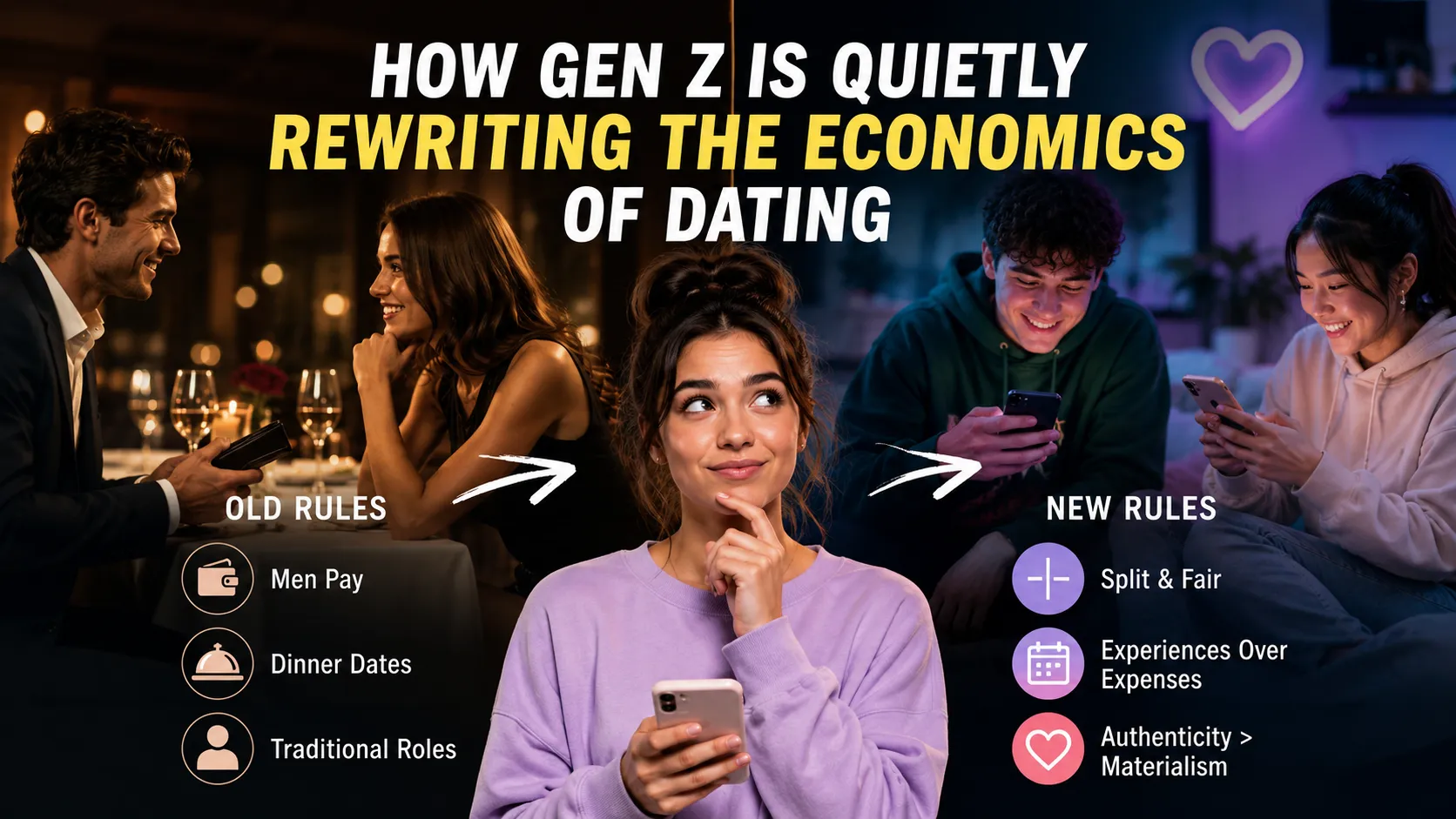
$205. That is the average amount Gen Z spends per date in 2026, according to Bank of Montreal's Real Financial Progress Index — up from $194 in 2025. All-in: the dinner, the drinks, the Uber, the pre-date haircut, the new shirt you told yourself you would wear more than once. Two hundred and five dollars. For one date. With one person. Who might not text back.
To understand why this number has become the inciting incident of a generational rethink of romance, you need to know what else $205 buys a 24-year-old in 2026. It is close to a week of groceries. It covers half a month's gym membership, a streaming subscription, and three specialty coffees. It is approximately 12 per cent of the average Gen Z monthly take-home pay after rent in a major city.
And here is the kicker: the BMO survey also found that half of all single Americans said they are going on fewer dates or choosing less expensive activities because of rising costs. Meanwhile, the Bank of America's 2025 Financial Health Report found that 53 per cent of Gen Z spends nothing on dates at all. Zero. Not less. Nothing. An additional 28 per cent spend under $100 per month.
The generation that grew up being told love would find a way has run the numbers and discovered that love, in 2026, costs approximately $205 to attempt — and is increasingly deciding whether that is a rational allocation of limited capital.
This is not a romance story. This is an economics story wearing a romance story's clothes.
Date Inflation Is Real — and It Has a Name
"Date inflation." Consumer finance expert Erica Sandberg coined the term for Moneywise, and it is now the most precise description available for what has happened to the cost of dating over the last five years.
Average menu prices at US restaurants rose 31 per cent between February 2020 and April 2025, according to the Bureau of Labor Statistics. Transportation costs are higher. Cocktails are more expensive. The pre-date economy — the haircut, the outfit, the grooming — has inflated alongside everything else. The all-in cost of a US date has climbed to $189 on average, up 12.5 per cent in a single year. For Gen Z specifically, the average hit $205.
"We are seeing the effect of 'date inflation,' which is the rising cost of going out with another person, especially if you're the one picking up the check," Sandberg told Moneywise. "Because it's so expensive, young adults need to be more selective."
More selective is, in practice, a euphemism. What the data actually shows is something closer to withdrawal.
Half of Gen Z respondents in the BMO survey said the cost of dating is getting in the way of their financial goals. That is not a marginal complaint from a small cohort of particularly frugal individuals. It is half of the generation reporting that romance is now in direct economic competition with things they care equally or more about — building savings, paying down debt, eventually buying a home in a housing market that has moved so far out of reach that the median Gen Z household is mathematically decades away from ownership in most major cities.
When a first date costs as much as a week of groceries, the opportunity cost of that first date is real, measurable, and personal. Gen Z, raised on algorithmic optimisation and economic anxiety, is doing the math.

Solo-Maxxing: When Opting Out Becomes a Lifestyle
The most culturally interesting response to date inflation is not belt-tightening. It is something more radical: rebranding singlehood as the optimal outcome rather than the consolation prize.
"Solo-maxxing" — the practice of intentionally maximising single life rather than pursuing a relationship — has emerged in 2025 and 2026 as one of the defining social media trends among Gen Z. The logic runs like this: dating is expensive, emotionally draining, time-consuming, and statistically unlikely to result in anything lasting. Being single is free, peaceful, and increasingly dignified. Why keep participating in a system that is costing you money and emotional labour with a very uncertain return?
Nearly half of respondents aged 18 to 34 in a global survey by analytics firm MyIQ said being single feels more peaceful than being in a relationship. Not temporary. Not frustrating. Peaceful.
Jess Carbino, a sociologist with a PhD from UCLA who was formerly the in-house sociologist for both Tinder and Bumble, is measured about what solo-maxxing actually represents.
The concern is real and worth stating clearly. Loneliness is a public health issue. Research consistently shows that social isolation carries health risks comparable to long-term smoking. Rebranding economic constraint as lifestyle choice is, as relationship therapist Paul Fierstein told Fortune, "avoidance dressed up as self-care."
But the fact that solo-maxxing has a name, a community, and social media legitimacy tells you something important: the social contract that said dating was a mandatory life pursuit regardless of cost has been quietly cancelled by a generation that has watched housing affordability collapse, student debt compound, and the cost of a basic first date nearly double.
The Dating App Crisis Nobody Is Admitting
Underneath the individual decision to stop dating or date less is a structural crisis in the industry that was supposed to make finding a partner easier.
Dating apps were, in their original form, a radical democratisation of romantic access. You did not need to be in the right social circle, the right geography, or the right tax bracket to encounter potential partners. The swipe was free. The connection was free. The date was the expensive part.
That model has changed dramatically. Dating apps have spent the last decade converting free features into paid tiers, adding subscription walls around basic functions like unlimited messages, and layering premium products like Tinder Platinum, Hinge's Roses subscription, and Match Group's various upsell mechanisms. A premium dating app subscription in 2026 can cost anywhere from $25 to $50 per month — on top of the $205 average cost of the date that follows.
George Arison, CEO of Grindr, told Fortune in an October 2025 interview that the Gen Z disengagement from dating apps is not primarily about economics or emotional exhaustion. It is about what the apps have done to themselves.
Arison's argument is precise: the problem is not that Gen Z does not want to find partners. It is that the industry designed to help them has built business models that extract maximum revenue from the search rather than maximising the probability of a successful match. When apps are economically incentivised to keep you searching rather than finding, the product and the user's interest are structurally misaligned.
The market data confirms the stress. Match Group — parent company of Tinder and Hinge — has seen user growth stagnate and revenue growth slow as users churn from subscriptions they no longer believe are worth the cost. Bumble has faced similar pressure. The dating app industry crossed $6 billion in global revenue in 2024, but the user experience data has been telling a different story: swipe fatigue, subscription resentment, and a declining trust that the app will actually deliver what it promises.
Money as the New Love Language
If Gen Z is pulling back from dating on one end, it is simultaneously becoming more financially explicit about what it wants from the partners it does pursue — and more ruthless in filtering for it.
Coffee Meets Bagel CEO Quincy Yang told Business Insider that the defining dating trend for his platform is the search for a steady partner with financial stability — because the economics of American adult life have made dual income not a preference but a structural necessity.
The data behind that observation is stark. A CMB survey of 1,050 US users aged 21 to 35 found that 54 per cent listed financial stability as a top priority in a partner — ranking ahead of shared interests. Nearly 60 per cent said ambition and drive were must-haves.
J.P. Morgan Wealth Management's 2025 survey found that 35 per cent of Gen Z and millennial respondents would discuss money on a first date — compared to just 7 per cent of boomers. Financial dealmakers (positive financial traits) mattered to 86 per cent of investors surveyed. Being financially independent was the top dealmaker at 61 per cent.
And the dealbreaker data is where it gets truly transactional: a 2026 survey by Achieve found that 78 per cent of Americans said a prospective partner's short-term debt would be a dating dealbreaker. Not long-term debt. Not a history of bankruptcy. Short-term debt. The stuff in a wallet.
A new phenomenon called "financial future faking" — discovered and named in early 2026 — describes what happens when this financial scrutiny goes wrong: partners who misrepresent their financial situation or financial trajectory during the relationship-building phase, creating expectations that collapse when the reality of their finances emerges. It is, as Fortune described it, "long-term partner catfishing about money." And it has been identified as a major factor in Gen Z and millennial divorces — the generation that insisted on financial transparency in dating is discovering that transparency was not always what it seemed.
The Throning Exception — and What It Reveals
Not all Gen Z dating is economically austere. There is a category called "throning" — dating someone financially or socially superior to oneself — that has emerged simultaneously with solo-maxxing, and the juxtaposition is revealing.
Throning, per Fortune's September 2025 reporting, describes Gen Zers who are deliberately dating people "25 per cent better" than themselves in perceived status, wealth, or social position. The argument from some experts is that this is a rational strategy for upward mobility — that the partner you choose has a meaningful impact on your own economic and social trajectory, and that dating strategically is simply applying adult cost-benefit analysis to one of life's most consequential choices.
Experts quoted in Fortune's coverage noted this could be a "quick ticket to long-term success." The critics noted it is also a deeply unromantic way to approach a human being.
But the existence of both solo-maxxing and throning in the same generation, at the same time, tells you something precise about what Gen Z is doing to the economics of dating. It is not that they are opting out of strategic thinking about romance. It is that they are applying more strategic thinking to it than any prior generation — explicitly calculating the cost, the return, the risk, and the expected utility of romantic investment in a way that previous generations considered gauche.

Whether that strategy produces better relationships, lonelier people, or simply a more honest accounting of what partnerships actually cost is the question that 2026 cannot yet answer.
What This Actually Means
Gen Z is not anti-romance. It is anti-waste. These are not the same thing.
The $205 average date cost, the 53 per cent who spend nothing, the half who say dating is getting in the way of financial goals, the solo-maxxers, the debt dealbreakers, the financial first-date conversations — all of it points to a generation that has looked at the economics of the romantic marketplace with the same clarity it applies to every other marketplace, and found them wanting.
Dating apps over-monetised the search. Inflation made the date itself unaffordably expensive. The housing market made the long-term payoff of finding a partner feel even more remote. And a generation raised on spreadsheets, financial TikTok, and the algorithmic habit of optimising every decision has responded by demanding that romance make economic sense or make room.
The generation that gets blamed for killing industries has not killed dating. It has priced it — which is, in many ways, the more radical act. You can rebuild something that has been abandoned. It is much harder to argue with someone who has read the receipt.