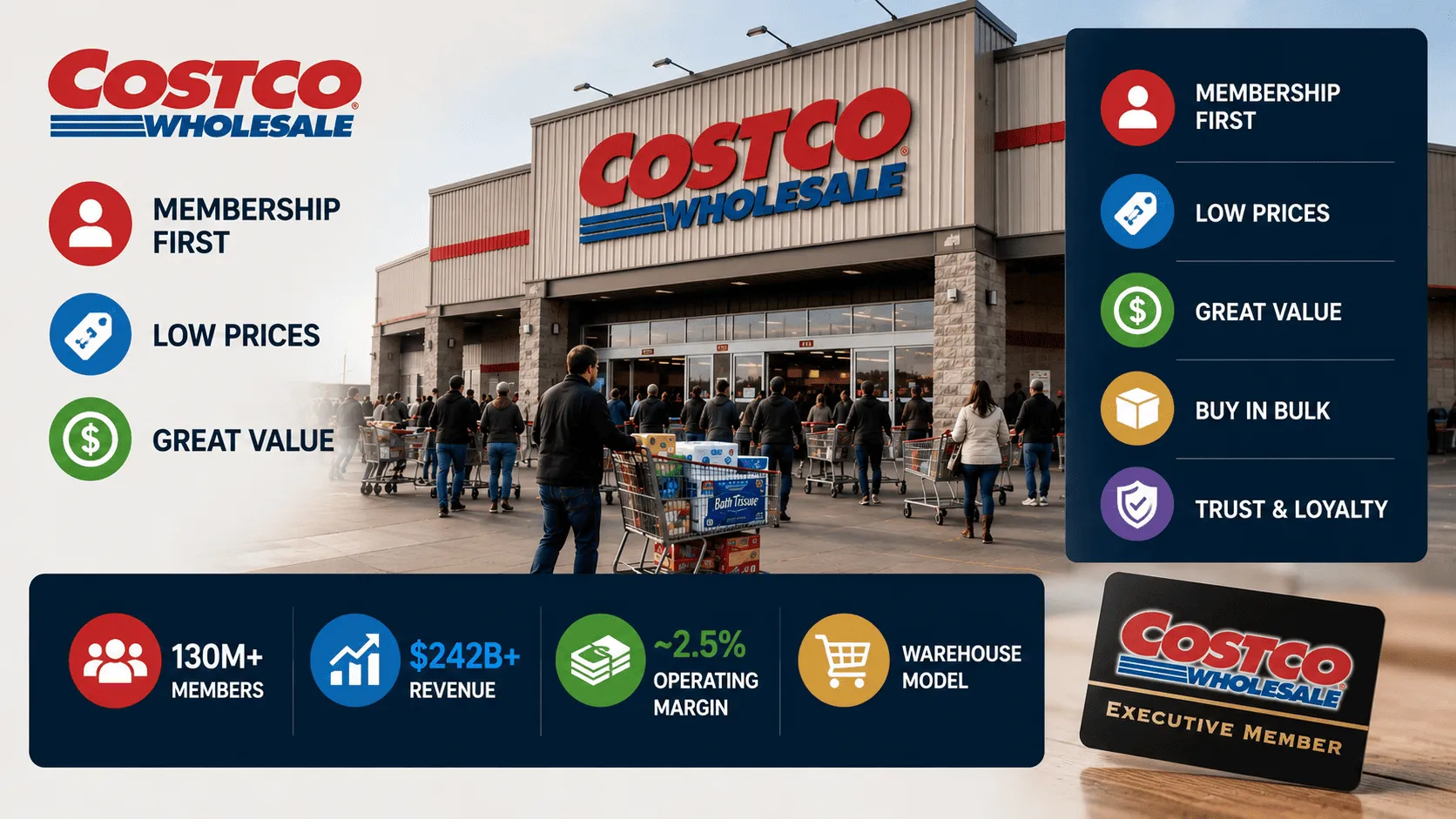
Most Retailers Make Money By Selling Products. Costco Makes Most Of Its Profit By Selling Memberships. That Difference Changed Everything.
Walk into a typical retail store and the business model appears straightforward.
Customers enter, purchase products and generate revenue through those transactions. The retailer's success depends largely on how many items it can sell and how much profit it earns on each purchase. For decades, this formula defined the economics of retail. Companies competed through pricing, store locations, product selection and marketing. The more merchandise they sold, the more money they made. Costco operates according to a very different logic.
At first glance, the company looks like a warehouse filled with bulk products.
Shoppers push oversized carts through vast aisles stacked with groceries, electronics, furniture and household goods. Prices often appear surprisingly low compared to traditional retailers. Yet the most important thing Costco sells is not visible on the shelves. It is the membership card customers carry in their wallets. That annual fee has become the foundation of one of the most successful retail businesses in the world.
The model has helped Costco build extraordinary customer loyalty, generate billions in recurring revenue and achieve a level of consistency that many competitors struggle to match.
The Membership Fee Changed Retail Economics
Most retailers depend heavily on product margins.
When customers buy merchandise, the difference between wholesale and retail pricing generates profit. This creates constant pressure to maximize margins wherever possible. Companies look for opportunities to increase prices, promote higher-margin products and encourage additional spending. The approach works, but it often creates tension between what is best for the retailer and what is best for the customer.
Costco approached the relationship differently.
Instead of relying primarily on product markups, the company built its business around annual membership fees. Customers pay for access before they purchase anything. That decision fundamentally altered the economics of the business because it created a predictable stream of recurring revenue independent of individual transactions. Membership income became so important that it eventually represented the majority of Costco's net profits in many years.
This changed incentives throughout the organization.
Because membership fees provide significant profit, Costco can afford to keep product markups unusually low. Management understands that long-term success depends on convincing members that their annual fee delivers exceptional value. The company therefore focuses on creating savings rather than maximizing margins on every item sold.
The result is a business model where customer trust becomes a strategic asset.
Why Customers Keep Renewing
The genius of Costco's model lies in its simplicity.
Once customers pay for membership, they naturally want to maximize the value of that investment. Every shopping trip becomes an opportunity to justify the annual fee. If members consistently save money, they are more likely to renew. If they renew, Costco maintains recurring revenue. The relationship creates a powerful cycle where customer satisfaction directly influences financial performance.
Renewal rates demonstrate how effectively the system works.
Costco's membership renewal percentages consistently rank among the highest in retail. Millions of customers continue paying year after year because they believe the value exceeds the cost. This loyalty gives the company remarkable stability compared to retailers that must constantly attract new shoppers through promotions and advertising campaigns.
The psychology is important.
Customers do not simply view themselves as shoppers. They view themselves as members. Membership creates a sense of participation that traditional retail transactions often lack. People feel they belong to something designed around delivering value rather than extracting maximum profit.
That subtle distinction helps explain Costco's unusually strong customer relationships.
The Power Of Selling Less Choice
One of Costco's most counterintuitive strategies involves limiting selection.
Many retailers attempt to offer as many products as possible. The logic appears obvious: more options should attract more customers. Costco takes the opposite approach. Instead of carrying dozens of variations of the same product, it often offers only a handful of carefully selected choices.
This creates multiple advantages.
Fewer products allow Costco to negotiate larger purchasing volumes with suppliers. Higher volume often translates into lower costs. Simpler inventory management improves efficiency. Customers spend less time comparing endless alternatives. The company effectively concentrates demand around a smaller number of items, strengthening its purchasing power.The strategy also reinforces trust.
Members begin assuming that products available in Costco have been selected for quality and value. Rather than navigating overwhelming choices, shoppers rely on Costco's curation. Over time, this confidence becomes part of the brand's appeal.The company is not trying to offer everything.
It is trying to offer the right things at the right price.
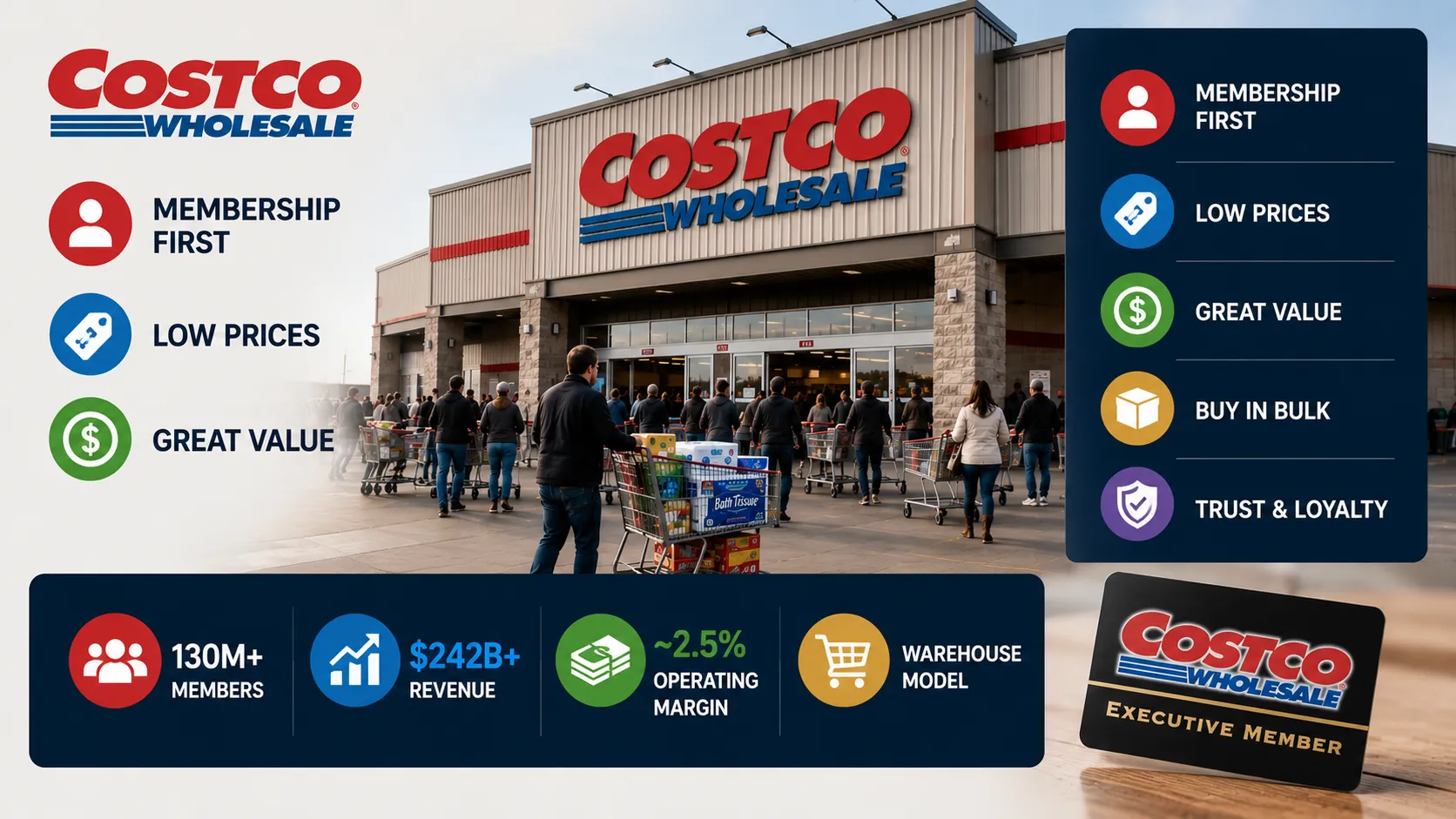
Kirkland Signature Became A Retail Giant
Few private-label brands have achieved what Kirkland Signature has accomplished.
Originally introduced as Costco's house brand, Kirkland has evolved into one of the largest consumer brands in the world. The label now spans categories ranging from food and beverages to clothing, batteries and household products. In many cases, customers actively seek Kirkland products rather than viewing them as cheaper substitutes.
The success reflects Costco's broader philosophy.
Instead of treating private labels solely as margin-enhancing tools, the company focuses heavily on quality. Many Kirkland products compete directly with premium national brands while maintaining attractive pricing. This approach strengthens customer trust and increases loyalty to the Costco ecosystem.
The business benefits are substantial.
Private-label products provide greater control over quality, pricing and supply chains. They also create differentiation because customers cannot purchase identical items elsewhere. As Kirkland expanded, it became not just a store brand but a competitive advantage.
Today, Kirkland generates revenues that would make it one of the world's largest standalone consumer brands.
Why Wall Street Loves The Model
Investors often value predictability.
Businesses with recurring revenue tend to receive higher valuations because future cash flows are easier to estimate. Software companies demonstrated this through subscriptions. Streaming platforms followed a similar path. Costco quietly incorporated subscription economics into retail long before many people recognized its significance.
Membership fees create visibility.
Millions of customers renew annually, generating recurring income regardless of short-term fluctuations in consumer spending. This provides a financial cushion that many traditional retailers lack. During difficult economic periods, the value proposition often becomes even more attractive because consumers actively seek savings.
The market appreciates this resilience.
Costco's ability to maintain customer loyalty, recurring revenue and strong operating performance has made it one of the most admired businesses in retail. Investors increasingly view it as more than a warehouse chain. It is a membership platform wrapped inside a retail operation.
That distinction matters because recurring relationships often prove more valuable than individual transactions.
A Blueprint For Modern Retail
The broader significance of Costco extends beyond warehouse shopping.
Its success demonstrates how changing incentives can transform an industry. By earning profits primarily through memberships rather than product markups, the company aligned its interests more closely with those of its customers. Lower prices encourage renewals. Renewals drive profits. The model rewards long-term trust instead of short-term extraction.
Many businesses are now adopting similar principles.
Subscriptions, memberships and recurring revenue have become central themes across industries because they create stronger customer relationships and greater predictability. Costco implemented this logic in retail long before it became fashionable elsewhere.
That is why the company remains so influential.The story is not simply about selling bulk groceries or discounted televisions.It is about building a business where loyalty becomes the product, membership becomes the engine and trust becomes the competitive advantage.And after decades of growth, few retailers have managed to replicate it at the same scale.