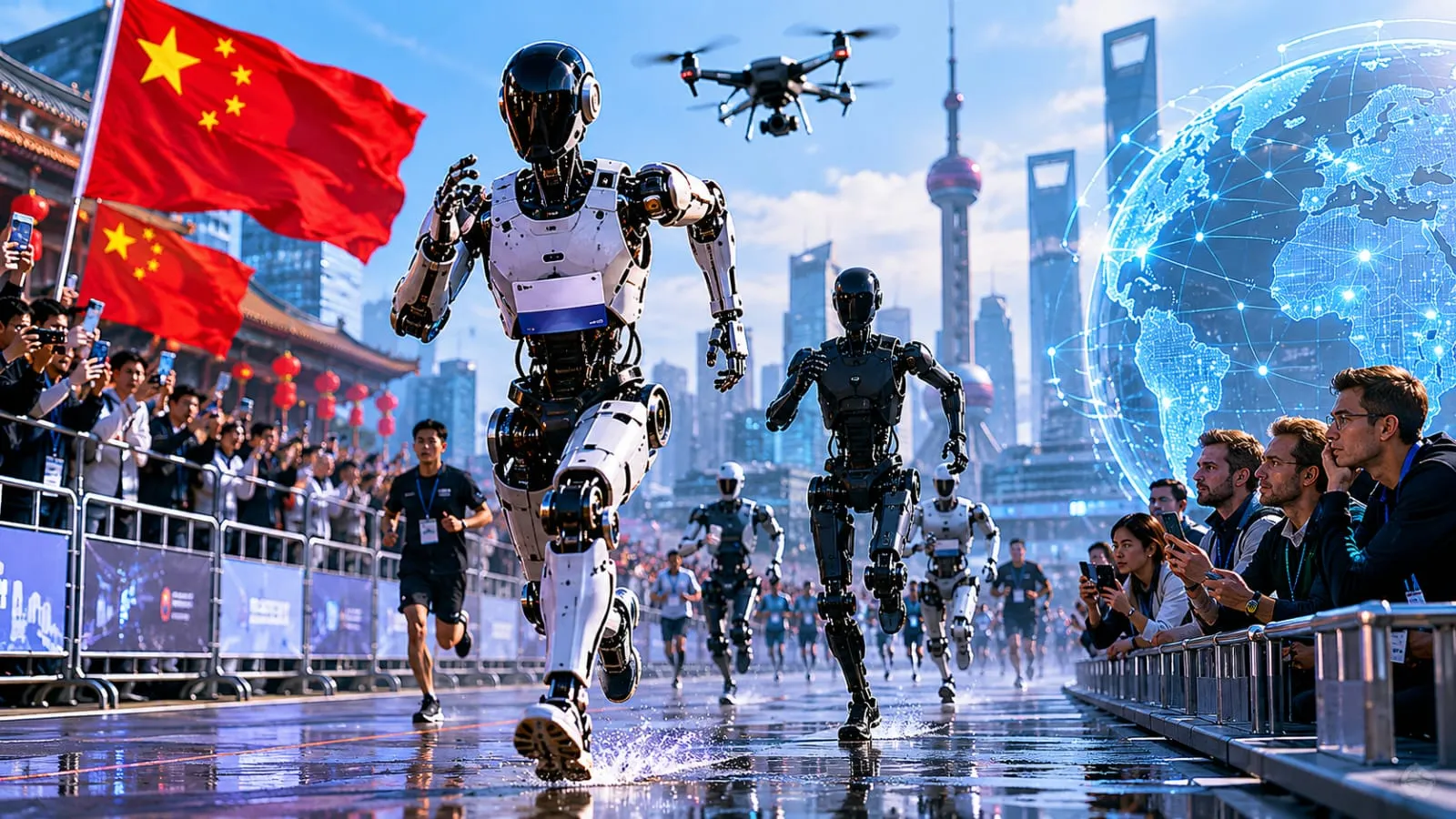
Countries Are No Longer Competing Only On AI Models. They Are Competing On Physical AI. And China Just Turned That Competition Into A Public Spectacle.
For the past two years, the artificial intelligence race has largely been measured through software.
The world compared ChatGPT with Gemini, Claude and DeepSeek. Technology companies competed to build larger models, improve reasoning capabilities and release increasingly sophisticated AI systems. Governments tracked breakthroughs through research papers, computing power and semiconductor investments. Success in AI was largely defined by what happened on screens. China's recent humanoid robot marathon suggests that definition is beginning to change.
The event attracted global attention because it showcased something far more tangible than a chatbot.
Humanoid robots built by Chinese companies and research teams participated in a long-distance running event designed to demonstrate endurance, mobility and real-world operational capabilities. While the marathon itself carried symbolic value, the broader message was unmistakable. Artificial intelligence is moving beyond software and into machines capable of interacting with the physical world. The competition for technological leadership is no longer limited to digital intelligence. It increasingly includes physical intelligence as well.
The AI Race Is Entering A New Phase
For years, artificial intelligence remained largely invisible.
Consumers interacted with recommendation algorithms, search engines and digital assistants without ever seeing the underlying systems. Generative AI changed that by making advanced intelligence visible through text, images and video. Humanoid robotics represents the next step. Instead of producing outputs on screens, AI systems begin performing tasks in physical environments. The transition may ultimately prove as important as the shift from desktop computing to mobile devices.
This is why governments and investors are paying close attention.
Whoever succeeds in combining advanced AI with capable robotics could unlock enormous economic opportunities. Manufacturing, logistics, healthcare, construction and elder care are just a few industries where intelligent machines could eventually play significant roles. The market potential extends far beyond software subscriptions. It touches some of the largest sectors of the global economy.
China Wants To Lead In Physical AI
The marathon was not simply a technology demonstration.
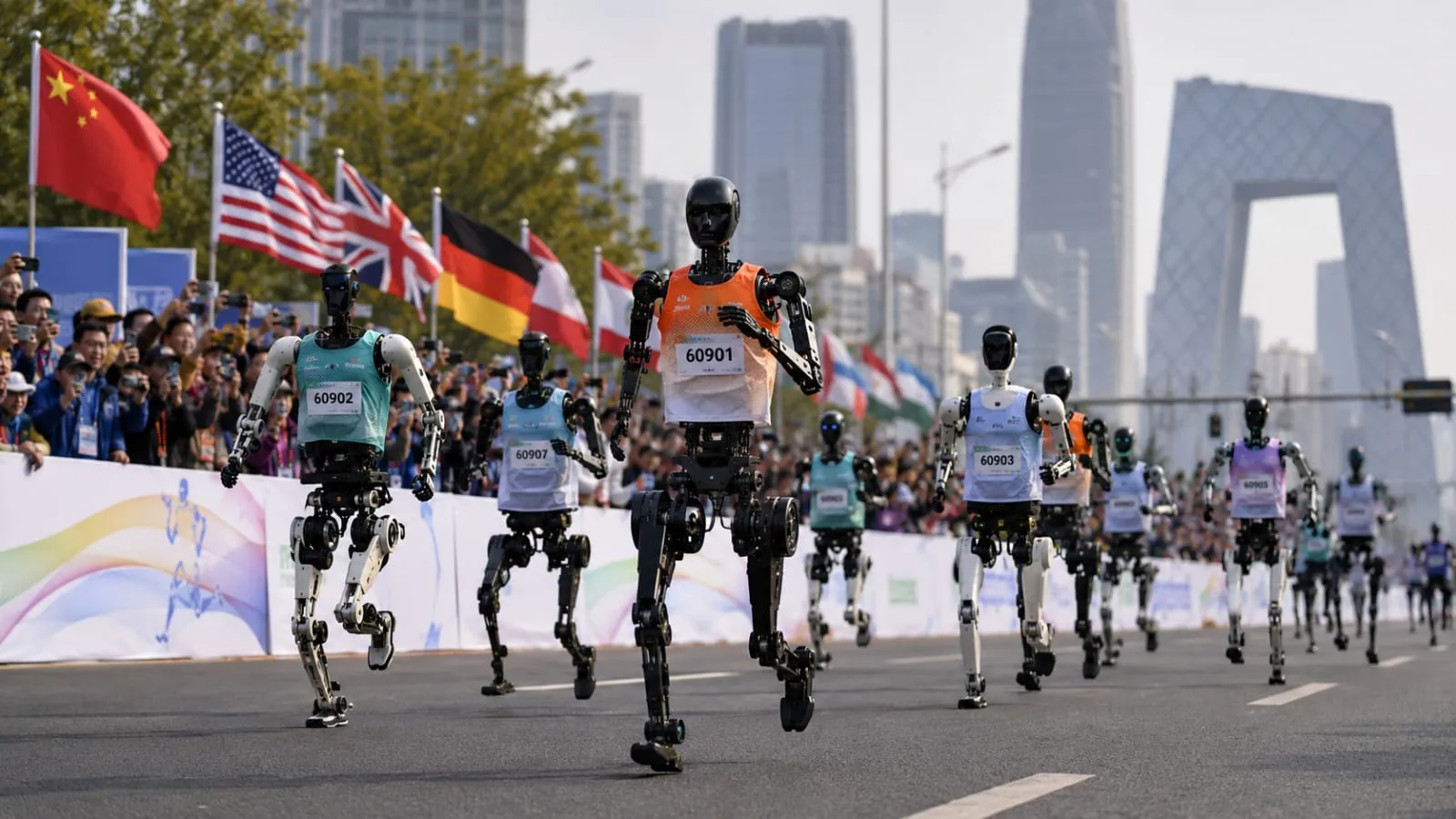
It was also a statement of national ambition. China has spent years investing heavily in artificial intelligence, advanced manufacturing, robotics and semiconductor development. Policymakers increasingly view these sectors as strategically important because they influence economic competitiveness, productivity and long-term industrial leadership. Humanoid robotics sits at the intersection of all three priorities.
The country's advantages are substantial.
China already possesses one of the world's most sophisticated manufacturing ecosystems, giving robotics companies access to supply chains, production capabilities and engineering talent at remarkable scale. Unlike purely software-focused industries, robotics requires expertise in hardware, electronics, sensors, batteries and mechanical systems. These are areas where manufacturing strength can become a significant competitive advantage.
The marathon therefore served as a public demonstration of capabilities that extend beyond individual robots.
It highlighted the broader ecosystem supporting their development.
Humanoid Robots Have Become The New Space Race
The parallels with earlier technological competitions are becoming difficult to ignore.
During the space race, countries competed to demonstrate engineering excellence and scientific leadership. During the internet era, nations invested heavily in digital infrastructure. Artificial intelligence introduced a new arena of competition focused on software and computing power. Humanoid robotics may represent the next chapter in that progression.
Technology companies around the world appear to believe so.
Tesla continues developing Optimus. Figure AI has attracted significant investment and strategic partnerships. Startups across the United States, Europe and Asia are racing to build increasingly capable humanoid machines. Venture capital firms are pouring billions into robotics because they believe physical AI could become one of the largest technology markets of the coming decades.
China's marathon placed that competition on public display.
Instead of announcing research breakthroughs through technical papers, companies demonstrated capabilities through a format that ordinary people could immediately understand.
Why Investors Are Suddenly Excited About Robotics Again
For decades, robotics promised more than it delivered.
The technology often struggled with high costs, limited flexibility and technical constraints that restricted widespread adoption. Recent advances in artificial intelligence are changing that equation. Modern AI systems allow robots to interpret environments, adapt to unexpected situations and perform tasks with greater autonomy than previous generations could achieve.That shift is attracting significant investment.
Investors increasingly see robotics as a natural extension of the AI boom because intelligence becomes more valuable when it can interact with the physical world. Software can answer questions. Robots can move objects, inspect facilities, assist workers and perform repetitive tasks. Combining AI with robotics potentially expands the addressable market far beyond traditional software categories.The enthusiasm is not merely theoretical.Major technology companies, venture capital firms and industrial investors are all increasing exposure to robotics because they believe commercial deployment is becoming more realistic. The result is a funding environment that increasingly resembles the early stages of the AI boom.
The Economic Stakes Are Enormous
The long-term implications extend far beyond technology demonstrations.
Many countries face labor shortages, aging populations and productivity challenges. Humanoid robots are increasingly viewed as potential solutions to these issues because they could operate within environments originally designed for humans. Factories, warehouses, hospitals and homes already exist. Machines capable of functioning within those spaces require fewer infrastructure changes than entirely new systems.
This explains why governments are treating robotics as a strategic industry.
The ability to deploy intelligent machines at scale could influence economic growth, industrial competitiveness and workforce dynamics. Countries that lead in robotics may gain advantages comparable to those achieved by nations that dominated previous technological revolutions.That possibility helps explain the attention surrounding China's marathon.
This Was About More Than Running Robots
The event may ultimately be remembered less for the race itself than for what it symbolized.
Artificial intelligence is entering a new stage where success will increasingly be measured not only by what systems can think but also by what they can do. The companies and countries leading that transition could shape the next era of technological development.That is why China's humanoid robot marathon matters.The story is not about robots running long distances.It is about the emergence of a new global competition where intelligence leaves the screen and enters the physical world.And increasingly, nations are racing to make sure they arrive first.