A Pattern, Not an Incident
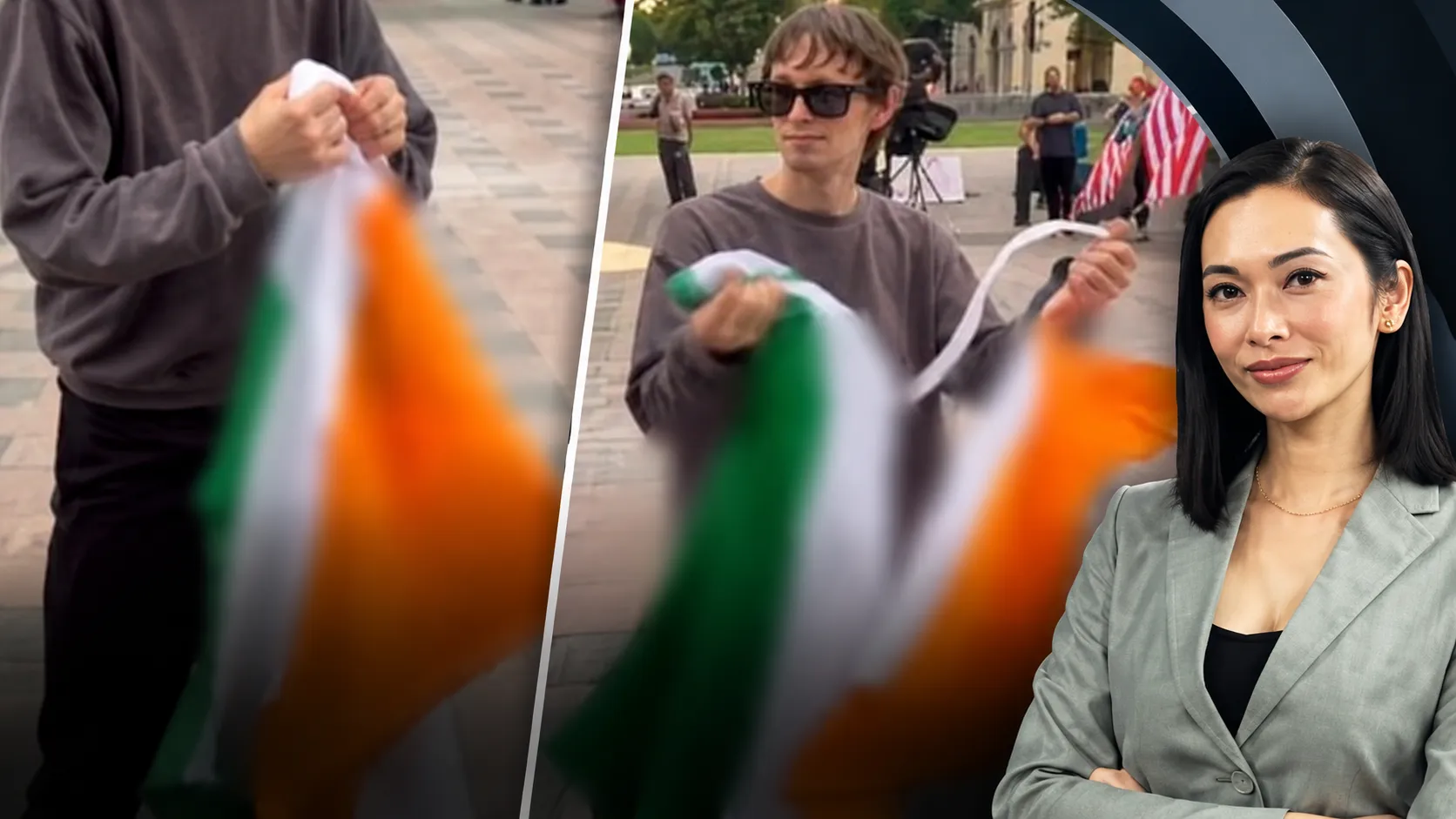
When a man tore an Indian flag outside Frisco City Hall in June 2026 while a crowd shouted anti-India slogans, much of the national coverage framed it as a single, shocking moment. But for researchers tracking online hate and for the Indian-American communities living through it, the Frisco incident was the latest entry in a pattern that had already been building for months across multiple North Texas suburbs — and, according to civil rights groups, in cities far beyond Texas entirely.
This piece looks specifically at that wider pattern: the Plano city council meeting where a conservative YouTuber dressed as a caricature of a Hindu worshipper, the masked protest in Irving that called Hindu deities "foreign demons," and the data — from the Center for the Study of Organized Hate and Stop AAPI Hate — that researchers say shows this isn't a series of isolated incidents, but a coordinated and measurable surge.
Plano: A Council Meeting Becomes a Costume Routine
In February 2026, conservative comedian and YouTuber Alex Stein appeared before the Plano City Council dressed in a yellow kurta, black shorts, sandals, and a red tilak mark on his forehead. Speaking in an exaggerated, caricatured Indian accent, Stein introduced himself as a "young Indian boy" from the "holy land of India far, far away" before launching into a series of comments mocking Hindu religious traditions — including the Hindu reverence for cows, which he described in deliberately crude terms designed to provoke.
Several Indian-American attendees walked out of the meeting in protest before it ended, with witnesses describing the room as visibly uncomfortable. Stein's appearance wasn't his first brush with controversy. The 39-year-old, who hosted a show on Glenn Beck's Blaze Media network from 2023 to 2025, has built a public persona around disrupting local government meetings and confronting public figures — he was removed from the 2024 Republican National Convention for disrupting an interview, and has previously drawn criticism for a separate appearance making inflammatory comments about transgender people at the Texas Capitol. He also referenced FBI Director Kash Patel during his Plano remarks, tying the stunt to broader political commentary beyond the religious mockery itself.
Sanjeev Joshipura, who leads the Indian-American advocacy organisation Indiaspora, has described anti-immigrant sentiment toward Indians in the U.S. as something that has been building gradually over time — with the Plano incident serving, for many in the community, as one of the starkest public examples yet of religious mockery delivered directly inside a government building, on the public record, during an official meeting.
Irving: Masked Protesters and "Foreign Demons"
In late October 2025, a group of masked men affiliated with a group calling itself Take Action Texas staged demonstrations at multiple locations across Irving — a Dallas suburb with a large Indian-American population. The group carried signs reading "Don't India My Texas," "Deport H-1B Scammers," and, most pointedly, "Reject Foreign Demons" — the latter placard featuring images of Hindu deities marked with red crosses, alongside the phrase "Jesus Christ is Lord."
In a post on X, the group framed the demonstration as a response to what it called "Diwali garbage," explicitly linking its protest timing to the Hindu festival of Diwali, which had recently concluded, and describing Irving as a city "ravaged by H-1B scams and massive demographic shifts due to labor imports coming from India." The group described the action as its "9th point of activism for October" — language that several reports flagged as evidence of an organised, recurring campaign rather than a spontaneous gathering.
The reaction was swift and unified across Indian-American civil society groups. The Coalition of Hindus of North America (CoHNA) condemned the protest and called on the city of Irving to ensure the safety of Hindu residents. The Hindu American Council drew a direct line from the rhetoric's evolution — describing how criticism of the H-1B visa programme had "morphed into online Hinduphobia and anti-Indian racism," which then saw city council members and political candidates calling for mass deportations, and had now reached the point of masked men on sidewalks describing Hindu divinity as "foreign demons." The organisation's pointed question — "What's next?" — captured the sense among advocacy groups that each incident was representing an escalation rather than a plateau.
It's also worth noting that reporting on the protest emphasised that only a handful of individuals were involved, even as the group's own social media posts amplified the demonstration's reach far beyond those present.
The Data: What the Numbers Actually Show
Beyond individual incidents, two research organisations have attempted to quantify the scale of this trend — and their findings, taken together, paint a picture of a surge that researchers connect to specific political triggers.
The Center for the Study of Organized Hate (CSOH)
The Washington, D.C.-based Center for the Study of Organized Hate published a report titled "Anti-Indian Hate on X: How The Platform Amplifies Xenophobia and Racism," which analysed a surge in anti-Indian posts on X between December 22, 2024, and January 3, 2025. The researchers identified the trigger as a backlash to two specific events: the December 22 appointment of Indian-American venture capitalist Sriram Krishnan as the White House's Senior Policy Advisor for AI, and a December 26 post by Vivek Ramaswamy discussing American culture.
In just that roughly two-week window, the report analysed 128 posts that had collectively garnered 138.4 million views — and found that many of these posts violated X's own policies on hateful conduct, yet remained active on the platform. Crucially, the report's authors — including researcher Sahana Udupa — found that these hateful posts targeted all people perceived to be of Indian origin, not solely Hindus — meaning the backlash wasn't narrowly religious, but ethnic and national in character.
By the time reporting on the broader pattern (including the events in Frisco) caught up months later, the figure most commonly cited had grown substantially: anti-Indian posts on X reportedly received more than 280 million views over a 10-week period, with posts frequently framing Indian Americans as "invaders" and "job thieves" — language researchers say echoes the rhetoric used against virtually every immigrant group that has previously been targeted by similar campaigns in American history.
The "Great Replacement" framing
Researcher Sahana Udupa has explicitly connected this rhetoric to the Great Replacement Theory — the broader conspiracy narrative holding that immigrants are being deliberately brought into a country to displace its existing population, and that only certain people are considered legitimately "deserving" of jobs and belonging, regardless of legal status or how someone arrived.
Udupa's framing of the current moment was direct: regardless of the legal pathway someone used to come to the United States — H-1B visa, green card, citizenship — that pathway no longer guarantees a sense of belonging once someone becomes a target of this rhetoric.
Stop AAPI Hate: South Asians bearing the brunt
Stop AAPI Hate, the organisation founded in 2020 to track anti-Asian American and Pacific Islander hate incidents, has documented a parallel and measurable surge specifically affecting South Asian communities. In a report covering the period immediately following the 2024 U.S. presidential election, the organisation found that January 2025 marked the highest number of anti-Asian-American incidents since it began monitoring in August 2022.
Metric (Nov 2024 → Jan 2025) | Change Anti-South Asian slurs | +75% (from 36,136 to 63,258) Anti-East Asian slurs | +51% (from 15,476 to 23,287) Threats against the AAPI community overall | +50%, with South Asians bearing the brunt Anti-Indian slurs tied to violent rhetoric (2023 → late 2025) | +115%+, per Stop AAPI Hate's longer-term tracking
Manjusha Kulkarni, co-founder of Stop AAPI Hate and executive director of the AAPI Equity Alliance, described the organisation as "extremely alarmed" by these spikes, attributing them in part to xenophobic rhetoric and policy debates that she said were actively fuelling hostility both online and in person.
The report specifically linked part of the surge to the H-1B visa debate — noting that the visa programme, primarily used by the tech industry and a frequent flashpoint in the rhetoric seen in Frisco, Plano, and Irving, had also become a wedge issue within the Republican party itself, with some figures voicing support for the programme and others opposing it. The report also noted that some of the hate was directed at high-profile Indian-American figures, including Vice President JD Vance's wife Usha Vance and former presidential candidate Vivek Ramaswamy — illustrating that the rhetoric extends to prominent public figures, not only ordinary residents.
Not Just Texas: A National Spread
While Frisco, Plano, and Irving represent a concentrated cluster in North Texas, civil rights reporting has documented similar incidents well beyond the state. In Palm Bay, Florida, a sitting city councilmember repeatedly made disparaging remarks about Indian Americans on social media and called for their mass deportation — prompting the Palm Bay City Council to vote, on October 2, 2025, to formally request his removal from office. CNN's coverage of that case explicitly grouped it with the Irving protest as evidence that Indian Americans are being "openly targeted" in multiple parts of the country simultaneously, not as disconnected local controversies.
In response to the broader surge, Democratic Congressman Shri Thanedar of Michigan's 13th District — reacting to the anti-Indian hate documented on social media — has promoted a bipartisan bill aimed at combating Hinduphobia specifically, an indication that the issue has begun to register as a distinct legislative concern at the federal level, separate from broader anti-immigrant or anti-Asian hate frameworks.
How Each Side Frames It
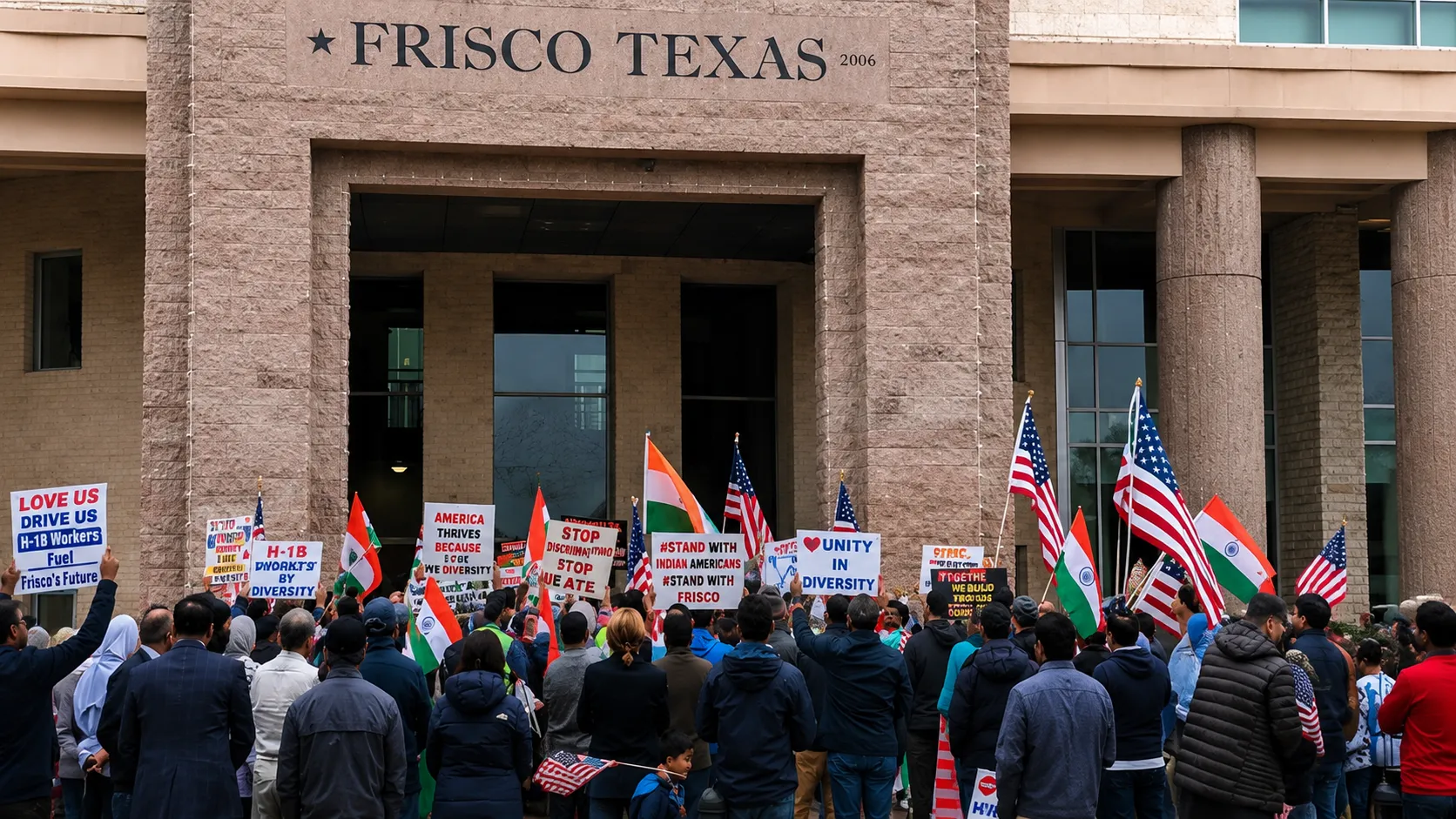
As with the Frisco situation specifically, the broader pattern has been read very differently depending on the observer.
Civil rights organisations — including CoHNA, the Hindu American Council, Hindus for Human Rights, and Stop AAPI Hate — frame these incidents collectively as evidence of an organised, ideologically-driven campaign that uses immigration policy debates (particularly around H-1B visas) as an entry point for rhetoric that researchers say draws on Great Replacement narratives, and that escalates from online posts, to public meetings, to street demonstrations, to (in some documented cases) physical confrontation.
Participants in these incidents have generally framed their own actions differently: Clayton Walker (the Frisco flag-tearing incident) described his actions as protected free speech; the Take Action Texas protesters in Irving framed their demonstration as a response to what they characterised as harmful demographic and economic change tied to the H-1B visa programme; and figures like Alex Stein have a long history of framing similar stunts at council meetings as satire or political commentary rather than targeted harassment — a framing that outlets like D Magazine have historically described as "mostly harmless, if at times in poor taste," though more recent coverage of his Plano appearance has been considerably more critical.
What's less disputed is the scale the rhetoric has reached in measurable terms — hundreds of millions of views on a single platform over a period of weeks, documented increases in slurs and threats following specific political triggers, and a geographic spread from North Texas to Florida within roughly a year. Whether characterised as organised hate, fringe trolling, legitimate policy debate gone too far, or some combination of all three, the documented reach of this rhetoric — and its translation into real-world confrontations at city halls, temples, and roadside protests — is, by the numbers, considerably larger than any single incident in any single city.
The Throughline
Strip away the specifics of any individual incident — a costume at a podium, a torn flag, a placard calling deities "demons" — and a consistent throughline emerges across Plano, Irving, Frisco, and Palm Bay: a policy debate over H-1B visas that has, according to multiple independent researchers and civil rights organisations, become a vehicle for rhetoric that goes well beyond visa policy — into religious mockery, ethnic stereotyping, and language that researchers explicitly connect to replacement-theory narratives historically used against other immigrant groups.
For Indian-American communities living in the suburbs where these incidents have occurred, the throughline isn't abstract — it's the experience Saahas Kaul described in Frisco: a sense that something which felt unthinkable a few years ago has become a near-weekly occurrence, tracked not just by local news but by national hate-monitoring organisations producing reports with view counts in the hundreds of millions.
Whatever the underlying policy debate's merits, the data suggests it has, for now, become inseparable from a much larger and more visible wave of hostility — one that researchers say is unlikely to remain confined to North Texas.