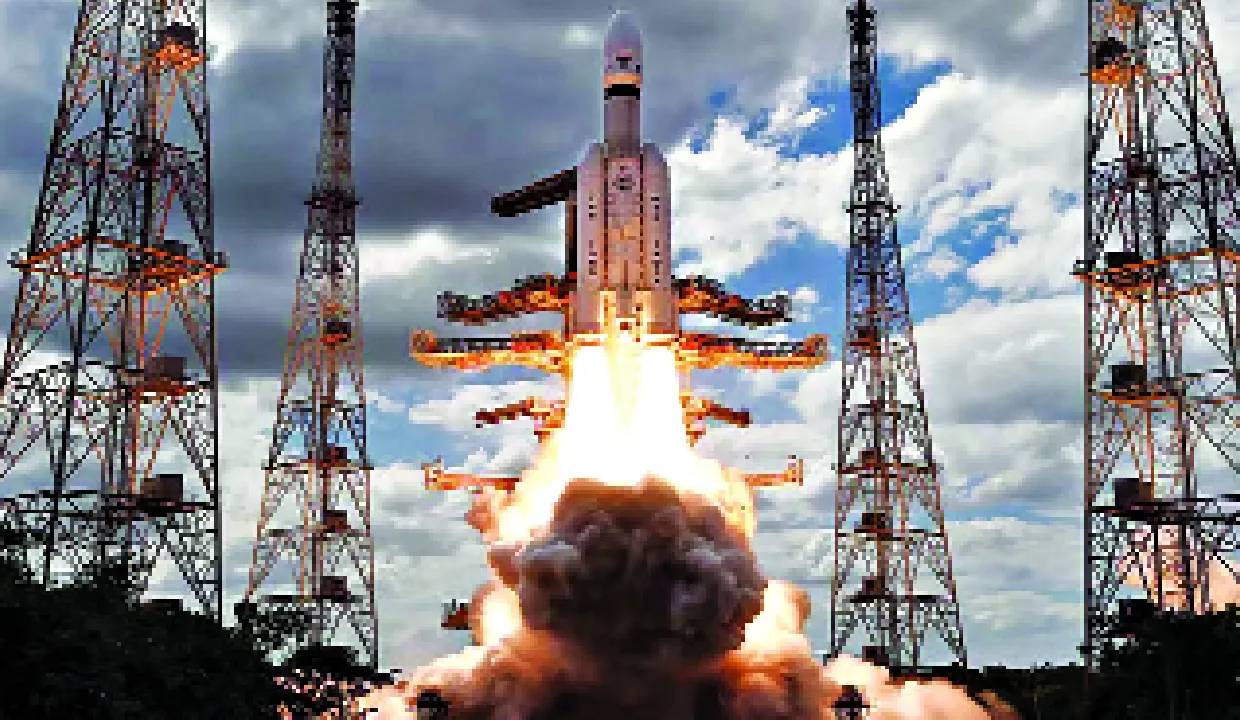
KULASEKARAPATTINAM, Thoothukudi District — From the outside, it looks like just another patch of coastal land in southern Tamil Nadu. Salt flats stretch to the horizon. Fishing boats bob in the distance. The Bay of Bengal glimmers under the relentless sun.
But look closer.
The ground is being prepared for something that could reshape the global aerospace industry. By 2028, this sleepy stretch of coastline will host India's second satellite launch complex — a facility designed to send small rockets into space faster, cheaper, and more frequently than anywhere else in the world.
And that's just the beginning.
Ten kilometers away, the government is breaking ground on a Space Vehicles Cluster — a sprawling manufacturing and testing hub where private companies will build rockets, integrate satellites, and validate propulsion systems. The Indian government has already sanctioned ₹100 crore ($12 million) for a Common Technical Facility equipped with vibration, shock, thermal vacuum, and electromagnetic compatibility testing systems — infrastructure so expensive that most startups could never afford it alone.
This is Tamil Nadu's quiet bet on the future. And if it pays off, the state will transform from India's manufacturing powerhouse into its aerospace and defense capital.
The Numbers That Explain Everything
Here's the number that explains everything: ₹3 lakh crore.
That's India's target for defense production by 2029 — roughly $36 billion. Add to that the global space economy, projected to reach $1.8 trillion by 2035, and you begin to understand why Tamil Nadu is moving with urgency.
The state already has a head start. India's defense production crossed ₹1.54 lakh crore last year, with exports exceeding ₹38,000 crore. Tamil Nadu is positioning itself to capture a disproportionate share of the growth, leveraging its existing strengths in engineering, precision manufacturing, and supply-chain readiness.
But here's the twist: Tamil Nadu isn't just chasing defense contracts. It's building an end-to-end ecosystem that spans design, manufacturing, testing, and launch — a vertical integration that few regions outside the United States, China, and Europe can match.
The Defense Industrial Corridor: A ₹23,000 Crore Play
If Tamil Nadu's space ambitions are the headline, its defense push is the foundation.
The state is home to the Tamil Nadu Defense Industrial Corridor — a designated zone that has already attracted ₹23,000 crore ($2.8 billion) in investment commitments**, with a target of reaching **₹75,000 crore ($9 billion) by 2032. The corridor spans multiple nodes across the state, from Chennai to Coimbatore to Madurai, each specializing in different aspects of the defense supply chain.

What's Already in Place:
· 120+ aerospace component manufacturing companies operate in the state · 700+ suppliers to Defense Public Sector Undertakings · TIDCO Aerospace Park — 250 acres (expandable to 500) dedicated to aerospace manufacturing · Centres of Excellence in partnership with GE Aerospace, Siemens, and Dassault Systems — helping MSMEs design and develop prototypes for military applications · Four incubation centres recognized by the Defence Innovation Organisation
What's Coming:
· A Mechanical and Material Testing Facility established by the Ministry of Defence · An Aircraft MRO facility in Krishnagiri, with another planned for Chennai · Dedicated industrial parks for aerospace, space, and defense sector companies
The state's pitch to industry is simple: come for the infrastructure, stay for the ecosystem.
The Spaceport: India's Gateway to the Small Satellite Revolution
But the crown jewel of Tamil Nadu's strategy is the Kulasekarapattinam spaceport.
India's first satellite launch complex — the Satish Dhawan Space Centre in Sriharikota, Andhra Pradesh — has served the nation well for decades. But it's optimized for large, heavy-lift rockets. The small satellite revolution demands something different: frequent, low-cost, dedicated launches for payloads weighing less than 500 kilograms.
Kulasekarapattinam is designed for exactly that. Its location offers a key advantage: rockets launched southward from this coast can insert satellites into polar orbits without flying over populated areas. That means fewer restrictions, faster turnaround times, and lower insurance costs.
The Economics Are Compelling:
· Global demand for small satellite launches is expected to exceed 10,000 satellites over the next decade · Launch costs for dedicated small rocket missions are projected to fall by 40-50% as new players enter the market · India's private space industry is growing at 40% annually, with over 200 space tech startups now operating in the country
The spaceport is expected to become fully operational by 2028, with the first commercial launches likely to follow shortly after.
The Space Vehicles Cluster: Manufacturing Next to the Launch Pad
Here's the genius of Tamil Nadu's strategy: don't just launch rockets — build them next to the launch pad.
The Space Vehicles Cluster in Thoothukudi is designed to host manufacturing, testing, and integration facilities for launch vehicle systems. Private companies will be able to:
Manufacture rocket stages and satellite components
Test propulsion systems, structural integrity, and electronics
Integrate payloads and launch vehicles
Transport finished rockets to the launch pad — just kilometers away
The Common Technical Facility, funded with ₹100 crore from the Department of Space, will provide shared access to capital-intensive testing equipment. This removes a major barrier for startups and MSMEs, who can now qualify their components for space applications without investing in their own test facilities.
The Facility Will House:
· Vibration and shock testing systems · Thermal vacuum chambers · Electromagnetic compatibility testing · Pressure and flow simulation equipment · Assembly and integration capabilities
According to Dr. M. Sai Kumar, Chief Secretary of Tamil Nadu, "The advanced equipment will enable launch vehicle assembling, satellite assembling and advanced testing of various components. These facilities will be immensely helpful for the manufacturers in the space sector, particularly space tech startups."
The Semiconductor Connection
Tamil Nadu's aerospace gambit doesn't exist in isolation. It's part of a broader strategy to capture high-value manufacturing across multiple sectors.
The state already accounts for 65% of India's electronics component manufacturing approvals, led by Foxconn, Tata Electronics, and Motherson. The Union Budget 2026's Semiconductor 2.0 Mission — covering everything from consumer electronics to defense electronics — aligns perfectly with Tamil Nadu's ambitions.
The convergence is strategic:
· Semiconductors power satellite electronics and avionics · EV batteries require advanced materials and precision manufacturing · Aerospace components demand the same quality standards as medical devices
By building capability across these sectors simultaneously, Tamil Nadu is creating a manufacturing ecosystem that no other Indian state can match.
The Global Context: Why This Matters
Tamil Nadu's aerospace push isn't happening in a vacuum. It's part of a global shift in the space industry.
The United States
Private companies like SpaceX, Rocket Lab, and Relativity Space have revolutionized launch economics. SpaceX alone launched over 100 missions in 2025, with its Falcon 9 rocket becoming the workhorse of the industry. The company's Starlink satellite constellation now has over 6,000 satellites in orbit, with plans for tens of thousands more.
China
China is rapidly expanding its space capabilities. The country launched over 60 orbital missions in 2025, including crewed missions to its Tiangong space station and lunar exploration missions. Chinese commercial space companies are also emerging, with iSpace and Galactic Energy conducting frequent launches.
Europe
The European Space Agency is struggling to keep pace, with delays in the Ariane 6 rocket forcing the continent to rely on SpaceX for critical launches. This has created an opening for new entrants — including India.
The Opportunity
India's space program has historically been government-led, with the Indian Space Research Organisation (ISRO) serving as the primary operator. But the sector was opened to private participation in 2020, creating a wave of innovation:
· Skyroot Aerospace: Launched India's first private rocket in 2022 · Agnikul Cosmos: Developing small-satellite launch vehicles · Pixxel: Building a constellation of hyperspectral imaging satellites · Dhruva Space: Developing satellite platforms and ground stations
These companies need manufacturing capacity, testing facilities, and launch infrastructure. Tamil Nadu is positioning itself to provide all three.
The Challenges: Infrastructure, Talent, and Policy
Tamil Nadu's aerospace ambitions face three significant hurdles.
Infrastructure Bottlenecks
Chennai's Floor Space Index is capped at about 2, compared to Hyderabad's minimum of 6. This throttles the Grade-A real estate that design, research, and global offices require. The state is responding with plans to create high-FSI knowledge zones, but implementation has been slow.
Talent Migration
Industry leaders are openly warning about the migration of skilled professionals to Bengaluru and Hyderabad. The state produces engineering talent but struggles to retain it. Chief Minister C. Joseph Vijay has pressed for technology skill centres in every district to train youth in AI, deep tech, cybersecurity, cloud computing, EV tech, and semiconductor sectors.
Policy Coherence
Tamil Nadu has issued separate policies for R&D, EVs, semiconductors, space, toys, textiles, shipbuilding, and the circular economy. The new government's first task, according to analysts, is not invention but coherence — harmonizing this thicket of policies into a single, reliable framework.
What This Means for the World
Tamil Nadu's aerospace bet isn't just about India. It's about reshaping the global aerospace industry.
The space industry has traditionally been dominated by a few major powers: the United States, Russia, China, and Europe. But the economics are changing. Launch costs have fallen by over 90% in the past two decades, making space accessible to a much broader range of actors.
India's advantages are clear:
· Low-cost engineering talent: India produces over 1.5 million engineers annually · Manufacturing infrastructure: Tamil Nadu alone has over 40,000 manufacturing units · Strategic location: India's southern coast offers ideal launch trajectories · Government support: The union government has committed $30 billion to space infrastructure
If Tamil Nadu succeeds, it could become a launchpad for a new wave of space entrepreneurship — not just for India, but for the entire Global South.
The Bottom Line
Tamil Nadu is betting big on aerospace and defense. The state is building a spaceport, a manufacturing cluster, testing facilities, and a defense industrial corridor — all in a coordinated attempt to capture a share of the $1.8 trillion space economy.
The risks are real. Infrastructure is lagging. Talent is migrating. Policy is fragmented.
But the opportunity is enormous. India's defense production target is ₹3 lakh crore. The global space economy is projected to reach $1.8 trillion by 2035. And Tamil Nadu is positioning itself at the intersection of both.
As one industry executive put it: "We're not just building rockets. We're building an industry that will define the next 50 years."
And it's happening right here, on a patch of coastal land in southern India.