
The 2% Reality That Won't Go Away
Venture capital presents itself as one of the most meritocratic corners of finance. It rewards vision, execution, and the ability to convince strangers to bet on an uncertain future. Yet beneath this self-image lies a stubborn statistical reality that no amount of DEI training has managed to erase.
All-women founding teams secure only around 2 percent of early-stage funding . Between 2011 and 2021, only one in ten funded founders in Europe was a woman . In the United States, women-only founding teams account for roughly 1 percent of venture capital funding . In India, the figure is similarly stark: startups led by women receive just ₹4 for every ₹100 raised by founders — a gap that one report describes as a failure of price discovery rather than merely a diversity concern .
These numbers have remained stubbornly low despite decades of awareness campaigns, targeted funds, and corporate diversity initiatives. A recent study by Chiara Andreoli and Leonora Buckland of the Esade Center for Social Impact, together with Ody Neisingh of Equinox Equality Experts, investigated why this gap persists. The study, conducted across six European venture capital firms, revealed the extent to which gender bias continues to influence investment decisions in subtle and subconscious ways .
The researchers found that investment professionals themselves often struggle to pinpoint where bias enters the process. It is not typically overt discrimination — few investors consciously decide to exclude women. Instead, bias accumulates across the investment cycle, from sourcing to pitching to due diligence to final decision-making . Each stage introduces small distortions that compound into a massive aggregate gap.

The Bias That Investors Cannot See
The Esade study identified several specific biases that operate beneath the surface of rational decision-making. Understanding them is the first step toward mitigation.
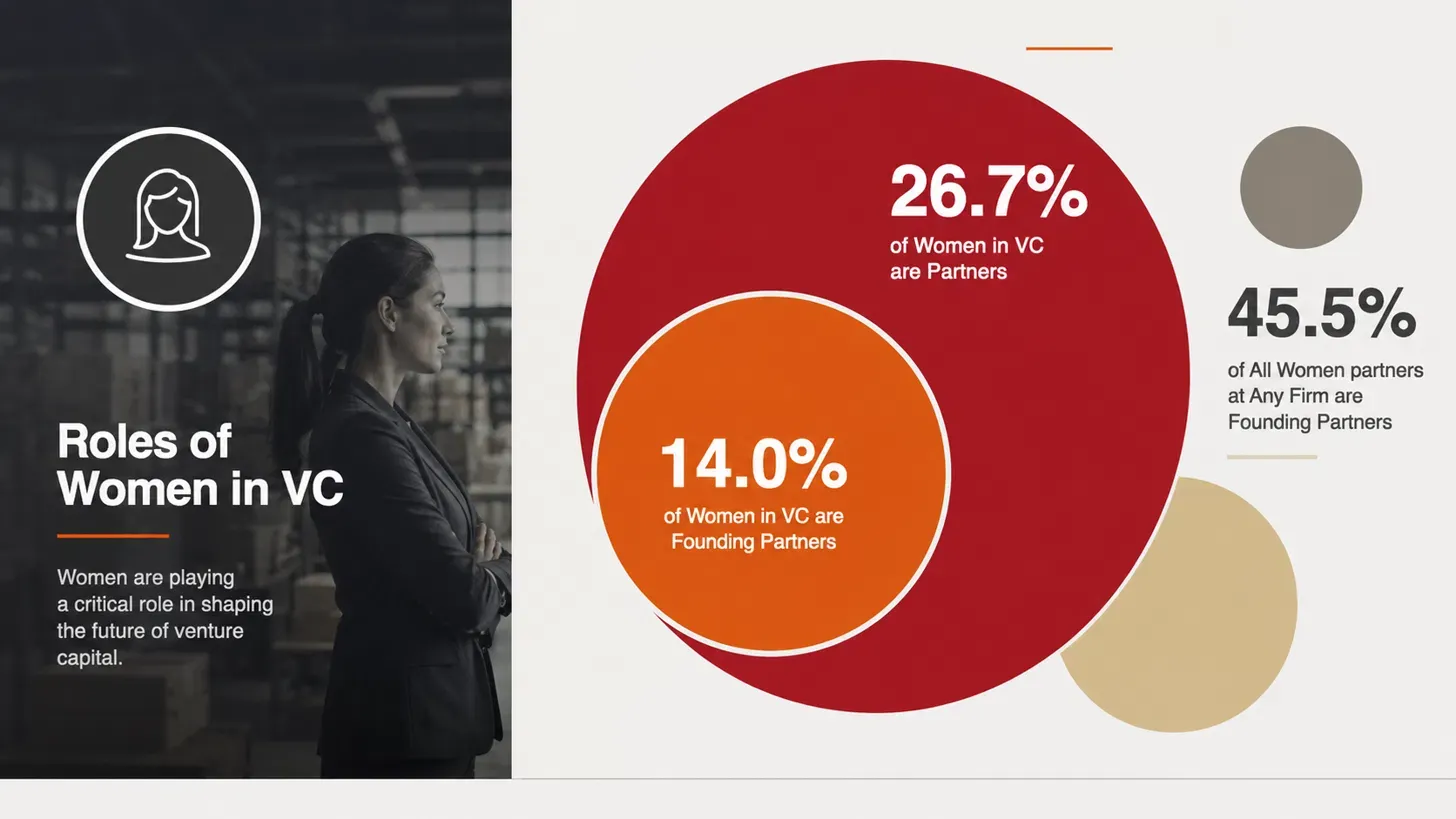
Affinity bias plays a significant role. Venture capital networks remain tight and male-dominated. Investors unconsciously favor founders who resemble themselves — in background, in education, in social circles, and in gender . When the partnership table is overwhelmingly male, the effect compounds. Women account for only 13 percent of investing partners at VC firms in the United States, and two-thirds of VC firms have no female partners at the table . The people making the decisions are, in large part, the people who look like the founders who have always been funded.
Stereotypes about the "typical entrepreneur" persist and shape evaluations. The commonly shared characterization of a successful founder is often someone highly competitive, risk-taking, and aggressive — traits traditionally interpreted as masculine . Anyone seeking funding who does not display these traits, or who displays them in a different register, may be overlooked. This is not about capability. It is about performance.
Confirmation bias reinforces existing patterns. Investors feel more comfortable with signals and patterns that reinforce their past decisions. They are less open to opportunities that challenge their frameworks . When most past investments have gone to male founders, the pattern is self-reinforcing. Breaking it requires deliberate effort.
The study also documented how differences in pitching styles contribute to the gap. Male founders often present more ambitious future scenarios, making bold projections about market capture and exponential growth. Female founders tend to make evidence-based claims grounded in realistic outcomes . While this approach strengthens credibility, it may disadvantage women in an environment where bold projections — even unrealistic ones — are frequently rewarded over cautious forecasting.
One female entrepreneur captured the frustration succinctly in an online conversation analyzed by Culturintel: "Men are good investments until they prove otherwise. Women are unsound investments until they prove they are worth taking a risk on" .
Beyond Lean In: The Motherhood Penalty and Brilliance Bias
The biases documented in academic research extend beyond the pitch room. Two specific phenomena have received increasing attention.
The motherhood penalty refers to the assumption that becoming a mother will affect a woman's long-term commitment to a project . No equivalent assumption applies to fathers. The result is that women founders who are mothers, or who may become mothers, are evaluated through a lens that their male peers never face. A study of 5,400 social entrepreneurs across 44 countries revealed how this penalty systematically disadvantages women, particularly during what should be their peak founding years .
Brilliance bias operates differently but just as powerfully. It is the assumption that exceptional talent, genius, and visionary thinking are inherently masculine traits. One entrepreneur described how she felt compelled to hire a white male co-founder simply to sit alongside her during pitches, because she believed investors would not take her seriously otherwise . The bias is not about competence. It is about perception of who gets to be brilliant.
These biases are not merely theoretical. In online conversations, female entrepreneurs are meaningfully more likely than men (42 percent vs 26 percent) to discuss social barriers to raising capital — prejudice, stereotyping, and bias. Men, by contrast, are more likely to discuss environmental barriers such as business climate, competition, and regulation . Hispanic and African American women are most likely of all — 51 and 52 percent of conversations respectively — to speak about the social barriers they experience .
The Business Case That Changes Nothing
One of the most frustrating aspects of the funding gap is that it persists despite overwhelming evidence that women-led ventures perform exceptionally well.
According to the Arise Ventures Diversity Report 2026, women-led ventures generate about 10 percent more revenue than male-led startups and deliver up to 20 percent higher net internal rates of return for investors . They achieve around 35 percent higher return on investment and capture 70 percent more new markets compared with non-diverse teams . Boston Consulting Group research cited in the Kalaari Capital report found that women founders generate 10 percent higher cumulative revenue over five years .
The financial case for investing in women founders is clear. Yet the funding gap remains. This is not a puzzle. It is evidence that the decision-making process is not purely rational. It is shaped by bias, by comfort, by pattern-matching, and by a definition of "scalable" that systematically excludes founders who do not fit the mold.
As Vani Kola, founder and managing director of Kalaari Capital, put it: "When capital concentrates around pattern-matched familiarity — the same schools, the same companies, the same networks — blind spots emerge. Blind spots create inefficiency. And inefficiency, for those willing to see it, creates opportunity" .
The funding gap is not just a question of equality. It is a failure of price discovery. An entire category of founders is systematically underestimated, not because of their ventures, but because of who they are. Until the market corrects for this, it will remain inefficient and unequal.
The Five Levers: A Framework for Fixing the System
The Esade study did not merely document the problem. It proposed a practical framework for addressing it. The five levers for mitigating gender bias offer venture capital firms a roadmap for structural change .
Lever 1: Awareness of Gender Bias. The first step is acknowledging that bias exists. This requires dedicated unconscious bias training across organizations, with ongoing attention to how bias operates in each investment context . Awareness is not a one-time exercise. It requires continuous reflection.
Lever 2: Leadership Support for Inclusion. Commitment from leadership teams — including both women and men partners — is critical to driving sustained action . Without top-level buy-in, individual initiatives lack the authority and resources to create lasting change.
Lever 3: Gender Diversity and Inclusive Working Culture. Increasing the presence of women at all levels of VC firms correlates with greater investment in women-led startups . Some firms are adopting intentional hiring practices to address imbalances in applicant pools. The numbers matter. As of 2026, women make up 38 percent of VC analysts but only 16 percent of partners, where key capital allocation decisions are made .
Lever 4: Gender Inclusive Investment Process. Every stage of the investment cycle provides opportunities to counteract bias. Examples include the use of standardized interview questions, structured scorecards, and the involvement of scouts to source underrepresented founders . Removing opportunities for subjective improvisation reduces the space where bias operates.
Lever 5: Gender Inclusive Ecosystem. Actively participating in the wider ecosystem, mentoring women founders, and joining collective initiatives focused on gender diversity help strengthen systemic change . Individual firms cannot solve the problem alone. The ecosystem must move together.
The accompanying Gender Bias Mitigation Tool provides practical steps and examples drawn from the firms that participated in the study . It is one of the first dedicated resources designed specifically to help VC firms identify, understand, and mitigate gender bias across their investment processes.
The Complication: When Well-Intentioned Solutions Backfire
One of the most nuanced findings from recent research is that even well-intentioned solutions can create unintended consequences. A study by INSEAD and ESSEC Business School examined what happens when female founders seek funding exclusively from female investors.
The researchers analyzed data from 2,136 US-based startups that received first-round funding. They found that female-founded firms backed by female investors in their first round were two times less likely to raise further investment compared with those backed by male investors .
A lab experiment confirmed the mechanism. Participants viewed identical startup pitches, varying only the gender of the founder and the gender of the initial investor. The pitch delivered by a female entrepreneur backed by a female investor was rated less favorably, and the entrepreneur was perceived as less competent .
The reason appears to be a question of perception. When a female investor funds a female-led startup, other investors may assume that the decision was made because of gender solidarity rather than commercial merit. The fact that a woman and her backer share the same gender is used as an excuse to "explain away" the woman's achievements . The same effect does not occur when a male investor funds a male founder.
This does not mean that female investors should avoid backing female founders. It means that the solution is more complex. The same study found that female entrepreneurs who received backing from both female and male investors suffered no penalty when it came to future investment . Mixed-gender syndicates appear to provide the stamp of approval without the stigma. For VC firms, the implication is clear: assign teams, not individuals, to support underrepresented founders.
Are Things Finally Changing?

For the first time since tracking began, there is a small but meaningful sign of shifting sentiment. According to January Ventures' 2026 founder survey, the longtime "gender pessimism gap" has closed. Men and women founders are now equally optimistic about fundraising .
The reason is not that men have become more pessimistic. It is that women have become more optimistic. Among a cohort of 482 early-stage founders, 72 percent are feeling optimistic — a huge rebound from a low of 22 percent in 2022 .
What is behind the shift? One theory is that artificial intelligence is leveling the playing field. With AI tools, early-stage founders can now do more with less. They are less dependent on large capital infusions to build prototypes, validate products, and reach early customers. The perception that AI can reduce the capital barrier may be increasing the optimism of female founders .
The reality on the ground has not yet caught up. Deal count for female-founded companies fell for the fourth straight year in 2025. All-female founding teams posted steeper drops in both deal value and count than mixed-gender cohorts . The optimism is ahead of the outcomes.
Yet optimism matters. It shapes who starts companies, who persists through rejection, and who returns for another round of fundraising. If women founders are becoming more confident in their ability to build without relying on traditional venture capital, the funding gap may begin to shift — not because capital becomes more accessible, but because founders find alternative paths to scale.
The Hidden Cost of Inefficiency
The funding gap is not merely a problem for women founders. It is a problem for the entire economy. According to the Kalaari Capital report, boosting women's economic participation could add hundreds of billions of dollars to India's GDP . Women-led MSMEs face a credit shortfall of over $158 billion, representing a massive amount of untapped economic potential .
In healthcare, less than 2 percent of research and development funding is directed toward women's health, even though women make the majority of healthcare decisions within households. The global femtech market is projected to exceed $100 billion by the end of the decade . The opportunity is massive. The capital is not flowing.
In climate technology, women-led startups are increasingly active, working on solutions ranging from clean energy and carbon capture to sustainable agriculture and circular packaging. Yet they remain underfunded relative to their male-led peers .
The question is not whether women founders can build successful companies. They already do, and their returns demonstrate it. The question is whether the venture capital industry can overcome its own biases fast enough to capture the opportunity. As Ankita Vashishtha, founder and managing partner of Arise Ventures, put it: "Closing this gap is not just about inclusion; it represents one of the largest untapped economic opportunities across sectors such as healthcare, climate technology, AI and consumer innovation" .
The Final Countdown
The Esade study and the accompanying toolkit represent a significant step forward. They move the conversation beyond individual "lean in" narratives and toward structural, systemic solutions. The five levers offer a practical framework for firms that are serious about change.
But frameworks alone will not close the gap. Implementation will. Venture capital firms must move from awareness to action. They must audit their own processes, diversify their partnership tables, standardize their evaluation criteria, and hold themselves accountable for outcomes.
The 2 percent figure has remained stubbornly static for years. It will not change by accident. It will change only when the people who control capital decide that leaving returns on the table is a bigger risk than backing founders who do not look like them. Until then, the hidden bias will remain hidden only to those who choose not to see it.


