
For years, artificial intelligence in healthcare was often presented as a future technology story. Research papers demonstrated promising breakthroughs, startups showcased ambitious prototypes and conferences highlighted possibilities ranging from predictive diagnostics to fully AI-assisted care systems. Yet despite years of excitement, a large part of healthcare AI remained limited to pilot programmes and controlled environments. Adoption moved cautiously, partly because healthcare systems operate differently from most technology sectors. In medicine, innovation is rarely measured only by speed. Trust, reliability and patient outcomes often determine whether technologies survive beyond experimentation.
That reality now appears to be shifting. Across multiple healthcare systems globally, artificial intelligence is increasingly moving from research environments into operational systems serving patients in real-world settings. Rather than replacing healthcare professionals, many of these deployments are focused on solving practical problems — reducing administrative burden, improving workflows, strengthening diagnostics and helping healthcare systems process growing volumes of information more efficiently.
From Experiments to Deployment
The transition is becoming increasingly visible across public and institutional healthcare systems. Recent industry studies suggest a growing share of hospitals and healthcare organizations are now moving beyond AI pilots and integrating tools into operational settings. Adoption is increasingly focused on measurable outcomes rather than experimentation alone. Healthcare leaders appear less interested in testing isolated technologies and more focused on whether systems can improve efficiency, reduce costs and support clinical decision-making.
The broader healthcare environment helps explain the shift. Across countries, public systems continue facing workforce shortages, aging populations and increasing patient demand. Administrative tasks consume substantial time for clinicians while health systems simultaneously manage pressure around staffing and operational efficiency. Under these conditions, AI increasingly appears not as an optional innovation layer but as a potential support mechanism.
Why Public Systems Are Paying Attention
Healthcare systems globally continue facing structural pressures that extend far beyond technology.
Several trends are driving increased interest:
• Growing shortages of doctors and clinical staff
• Rising patient volumes and healthcare demand
• Administrative workload contributing to clinician burnout
• Expansion of digital health records and data systems
• Greater emphasis on preventive and predictive healthcare
• Pressure around costs and system efficiency
These pressures are forcing institutions to explore tools capable of helping systems scale without proportionally increasing workloads.
AI Is Already Entering Everyday Healthcare Operations
The transition toward deployment is becoming increasingly visible through practical use cases.
In the United States, hospital systems are increasingly implementing AI tools across workflow management, patient communication and administrative systems. Industry surveys suggest many organizations are now moving beyond experimentation and into broader operational adoption.
In India, public health initiatives are also exploring AI-enabled systems. Under Ayushman Bharat PM-JAY, technology initiatives have reportedly been used to strengthen fraud detection and identify irregular healthcare claims. While these applications differ significantly from consumer-facing AI tools, they demonstrate how artificial intelligence is beginning to integrate into public systems supporting large populations.
In the United Kingdom, discussions around healthcare AI have expanded beyond diagnostics and increasingly involve broader infrastructure conversations involving healthcare data systems and digital modernization efforts.
The movement remains uneven globally, but implementation is increasingly becoming visible.
Diagnostics Continue Leading Adoption
Among the clearest examples of AI deployment involves diagnostics and medical imaging.
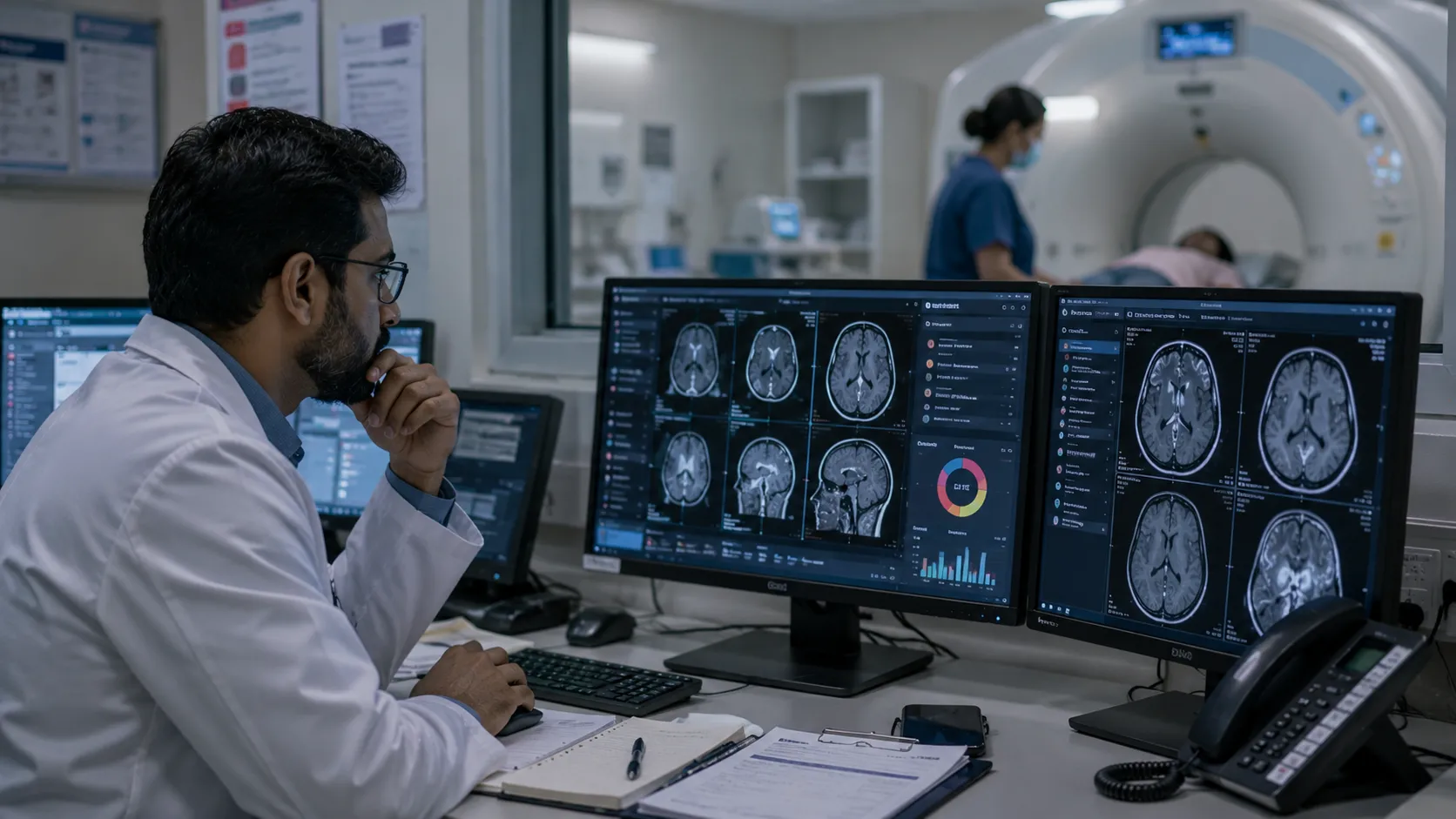
Healthcare institutions globally are increasingly testing and deploying systems designed to support:
• Cancer screening analysis
• Radiology prioritization systems
• Cardiovascular assessments
• Retinal disease detection
• Scan interpretation assistance
• Predictive analytics around clinical workflows
Medical imaging has become a particularly active area because specialists often process extremely large volumes of information daily. AI tools increasingly function as support systems capable of helping clinicians identify patterns, prioritize cases and improve workflow efficiency.
Importantly, healthcare systems largely position these technologies as augmenting professionals rather than replacing them.
Administrative Systems May Have the Largest Immediate Impact

While diagnostics often receive attention, several industry observers suggest administration may become healthcare AI’s largest short-term opportunity.
Doctors and healthcare workers frequently spend large portions of their day navigating digital systems, updating records and handling repetitive tasks.
Artificial intelligence tools increasingly support:
• Medical documentation and summarization
• Scheduling automation
• Data entry assistance
• Clinical note generation
• Workflow management
• Patient communication systems
Even modest efficiency gains across these areas may produce significant impact when applied across large healthcare systems.
Healthcare AI Still Faces Major Challenges
Despite increasing deployment, healthcare AI continues facing important questions.
Researchers and policymakers continue raising concerns around:
• Algorithmic bias across populations
• Data privacy and security risks
• Transparency in AI decision-making
• Regulatory oversight
• Clinical validation standards
Healthcare technologies often move more slowly because adoption requires evidence and trust. Unlike consumer applications, systems affecting patient care face significantly higher expectations around accountability.
Why This Shift Matters
Historically, healthcare innovation often focused on breakthrough technologies and dramatic discoveries. Artificial intelligence may evolve differently. Instead of arriving through one defining moment, deployment increasingly appears to be happening through smaller changes integrated into existing systems.The larger story may therefore not involve futuristic AI hospitals or automated healthcare systems.
It may involve quieter transformations already taking place workflow by workflow, institution by institution and public system by public system.Because healthcare AI increasingly appears to be entering a different phase.
Not one centered around experimentation. But one centered around implementation.