The House That Was Sold
Prayagraj, Uttar Pradesh. Early 2000s. A family does something no family should have to do: they sell their home to stay alive.
That family was the Pandeys. Satish Pandey, a private contractor, and his wife Rajat, a school teacher, watched financial pressure close in. First they sold part of the house. Then the rest. The family shifted to a rented apartment in a slum neighbourhood.
Their son Alakh was watching. He was in school. He was supposed to be thinking about exams. Instead, he was learning the most important lesson of his life: what it feels like when the floor disappears from under you.
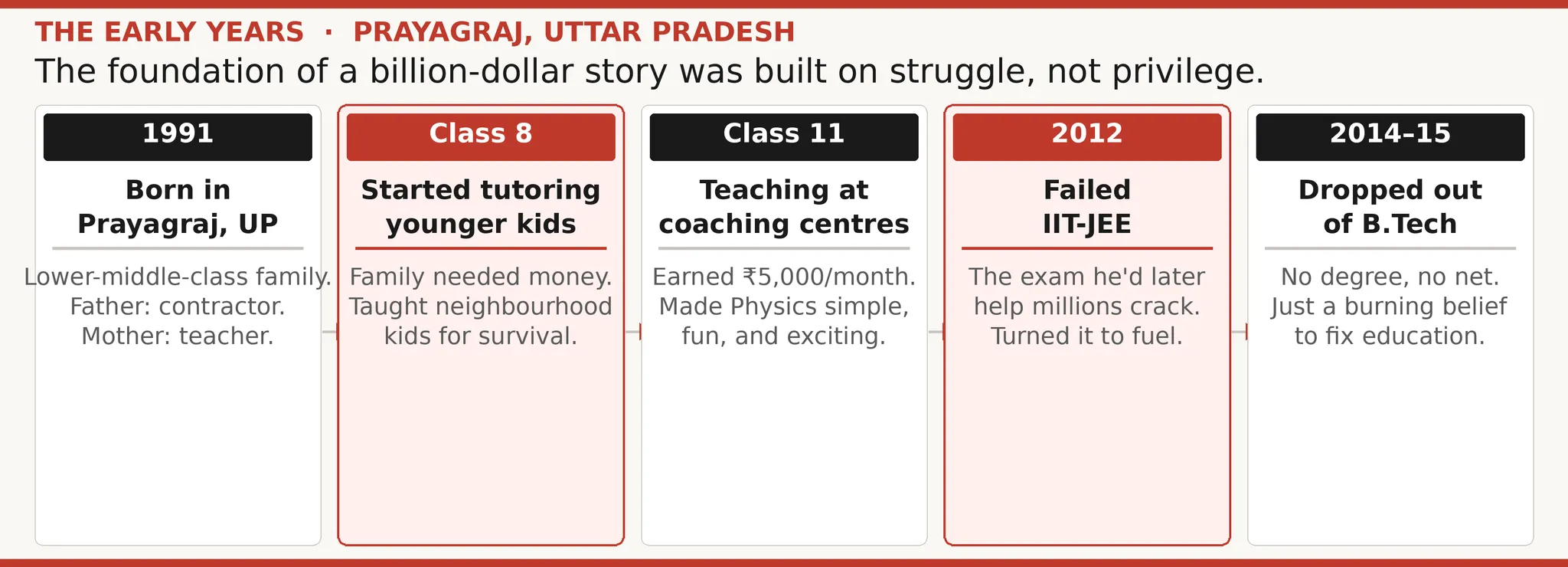
Alakh's early journey — from a sold family home to tutoring at age 12, failing IIT-JEE, and dropping out of engineering college.
“The day my father sold our house, I understood what money really means. Not greed. Survival.”
— Alakh Pandey
Most people spend the rest of their lives running from that feeling. Alakh ran toward it. By Class 8, he was already tutoring neighbourhood children — because his family needed it. He was 12, carrying the weight of his household.
He dreamed of IIT. He prepared relentlessly. And then — he failed IIT-JEE. The very examination he would later help millions crack, he himself could not. He enrolled in B.Tech at Harcourt Butler Technical University, Kanpur — and then dropped out. No degree. No safety net. Just one stubborn belief: education in India was broken, and he was going to fix it.
The detail everyone misses: Alakh didn’t start teaching because he loved it. He started because he had to. The love came later. But the discipline, the hunger — those came from watching his father carry furniture out of a home that used to be theirs.
A Camera, a Whiteboard, and a Mission
In 2016, Alakh sat in front of a basic camera, propped up a whiteboard, and began recording Physics lessons. He named his YouTube channel PhysicsWallah — inspired by the “ChaiWallah” tea stall near his coaching centre.
No polished studio. No English jargon. Just a young man explaining the laws of the universe in clear, colloquial Hindi — with everyday analogies, with humour, with visible passion, and with genuine care for whether the student actually understood.
Every single video was free. No subscription. No paywall. Just knowledge offered openly to anyone with a phone.
“No child should be denied the right to dream just because their father cannot pay the coaching fee.”
— Alakh Pandey
By 2019, he had millions of subscribers. But more critically, he had built what no edtech company had built with hundreds of crores: trust. Students didn’t just watch his videos. They felt he was genuinely on their side.
The insight that changed everything: Every major edtech company targeted the top 10% of students in Tier-1 cities. Alakh targeted the other 90%. He taught in Hindi. Kept fees negligible. He understood, from personal experience, exactly what it felt like to be on the wrong side of India’s education gap.
The Most Important ‘No’ in Indian Business History
Before the unicorn, before Forbes, when he was still a YouTuber — Unacademy offered him ₹75 crore to join as a star educator. Seventy-five crore rupees. For a man who once earned ₹5,000 a month.
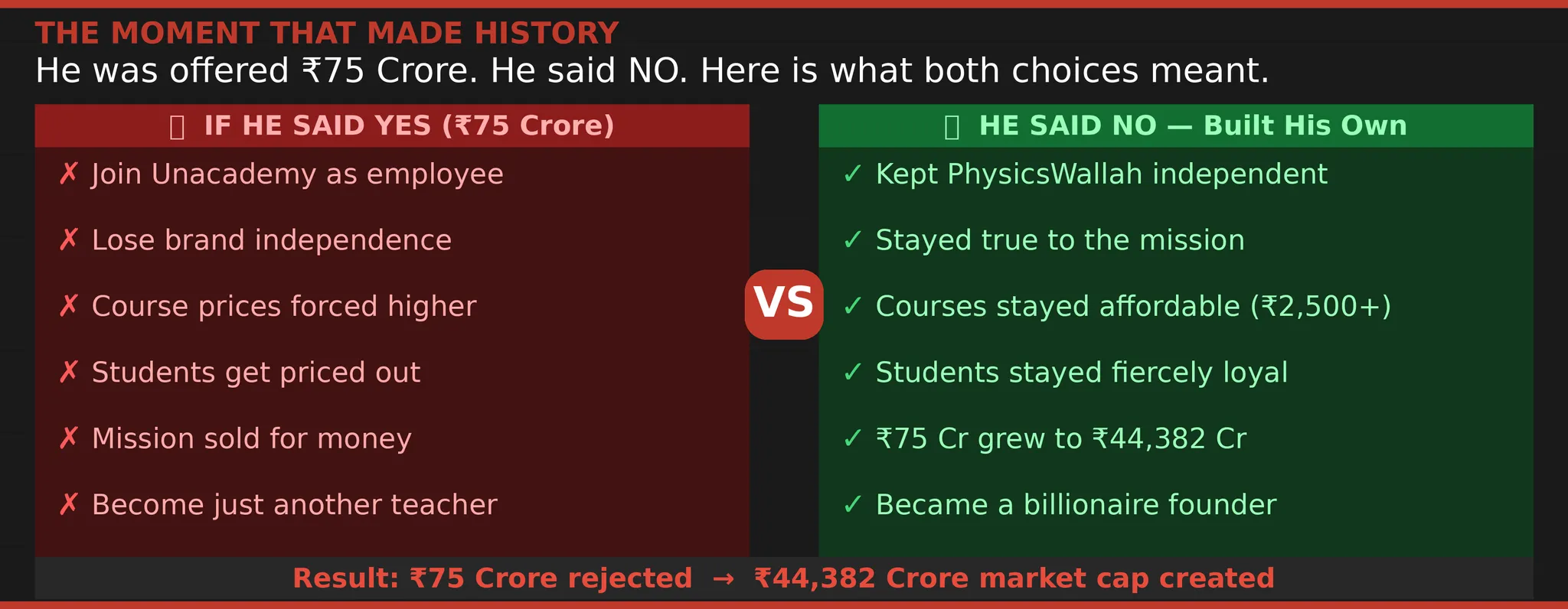
The choice that compounded ₹75 crore into ₹44,382 crore — mission over money.
“I will not allow investors into this company if it means increasing course prices. My students come first. Always.”
— Alakh Pandey
Accepting meant becoming their employee, teaching at their price points, betraying the mission. He also turned down a separate ₹40 crore offer. Both times he walked away. Even Unacademy CEO Gaurav Munjal later wrote: “I really respect some of the things PW is doing.”
What that rejection compounded into: The ₹75 crore he turned down compounded into ₹44,382 crore in market cap at IPO. By every rational metric, it was the best financial decision he ever made — and he made it entirely on principle.
Building an Empire from a Broken System
In 2020, Alakh officially co-founded PhysicsWallah with Prateek Boob. COVID-19 had shut every school and coaching centre. Suddenly everyone needed exactly what PhysicsWallah offered.
On launch day, the app crashed — not from a bug, but because over 2 lakh students hit it simultaneously. The crash was proof of demand so overwhelming their servers buckled. Students came back and stayed.
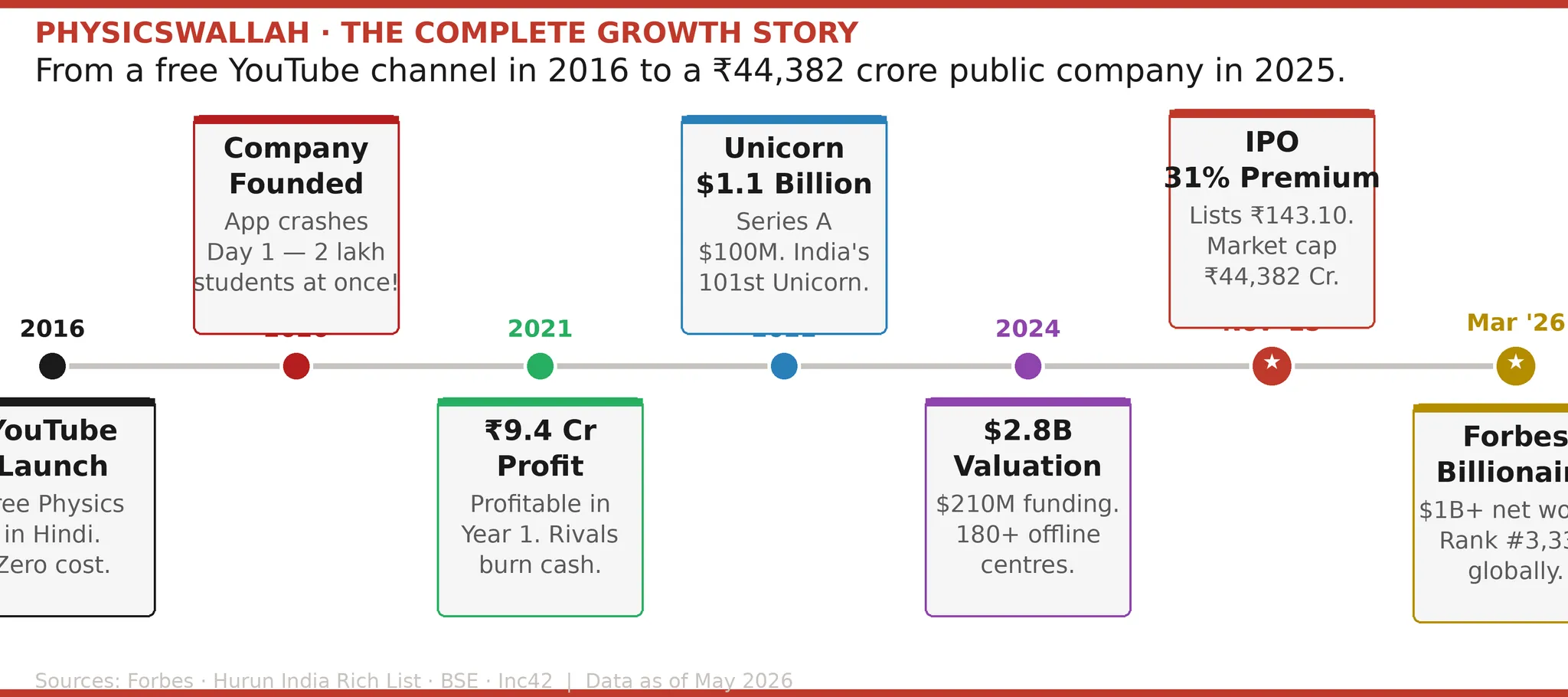
PhysicsWallah's 9-year journey — from free YouTube videos to one of India's top IPOs of 2025.
2014 | Teaching at coaching centres ₹5,000/month. Free YouTube videos launched in spare time. |
2016 | PhysicsWallah YouTube launches Free Physics in Hindi. Zero marketing. 100% trust. |
2020 | Company founded + App launch App crashes Day 1 — 2 lakh students at once. |
2021 | First year profit: ₹9.4 crore While Byju’s and Unacademy burn cash, PW makes money. |
Jun 2022 | India’s 101st Unicorn $100M Series A. Valuation: $1.1 billion. |
Sep 2024 | Valuation: $2.8 billion $210M funding. 180+ offline centres across India. |
Nov 2025 | IPO — 31% listing premium Lists at ₹143.10 on BSE. Market cap: ₹44,382 crore. |
Mar 2026 | Forbes Billionaire at 34 Rank #3,332 globally. Net worth $1B+. Overtakes SRK. |
In an era when Byju’s was imploding and Unacademy was laying off hundreds, PhysicsWallah made money every single year: ₹9.4 crore (2021), ₹133.7 crore (2022), ₹108 crore (2023). The affordable model was not charity — it was the business model.
Forbes, Shah Rukh Khan, and the Number That Shocked India
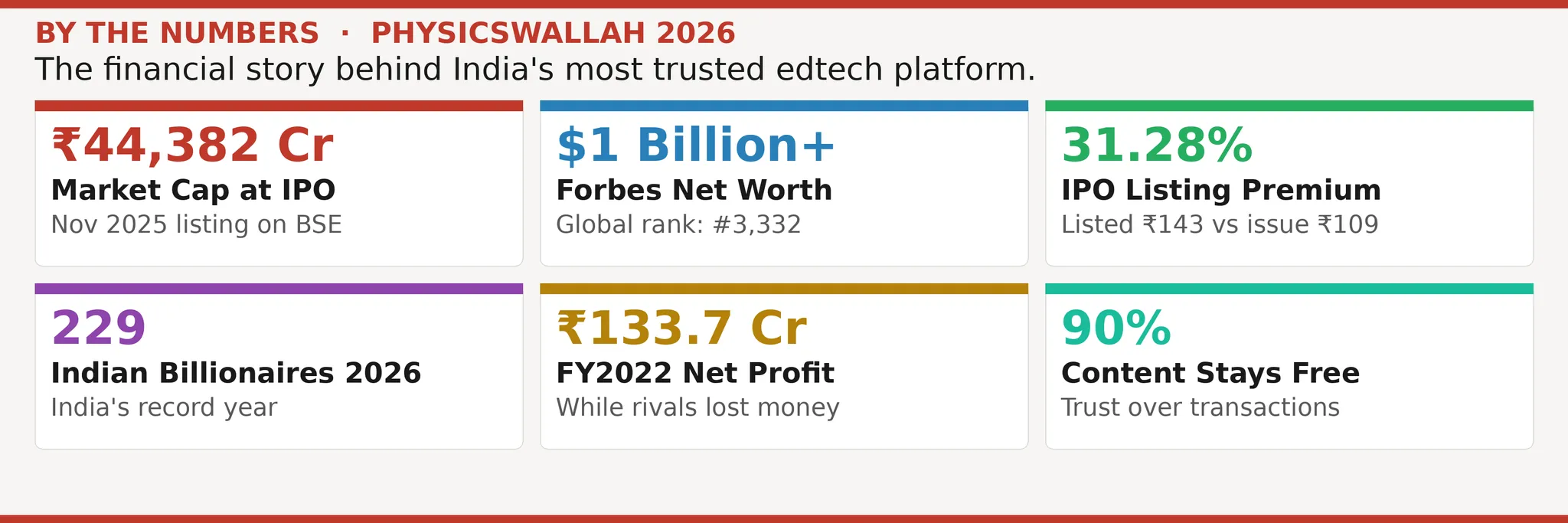
PhysicsWallah by the numbers — the financial story behind India's most trusted edtech.
In March 2026, at rank 3,332 on the Forbes World Billionaires List: a 34-year-old dropout from Prayagraj. Net worth: $1 billion+. Hurun placed it even higher — ₹16,044 crore, nearly $2 billion.
The number that broke the internet: a YouTube physics teacher now had a higher net worth than Shah Rukh Khan. Pandey’s wealth had surged 223% year-on-year. For millions who studied from his free videos, this wasn’t just business news. It felt like their teacher had won.
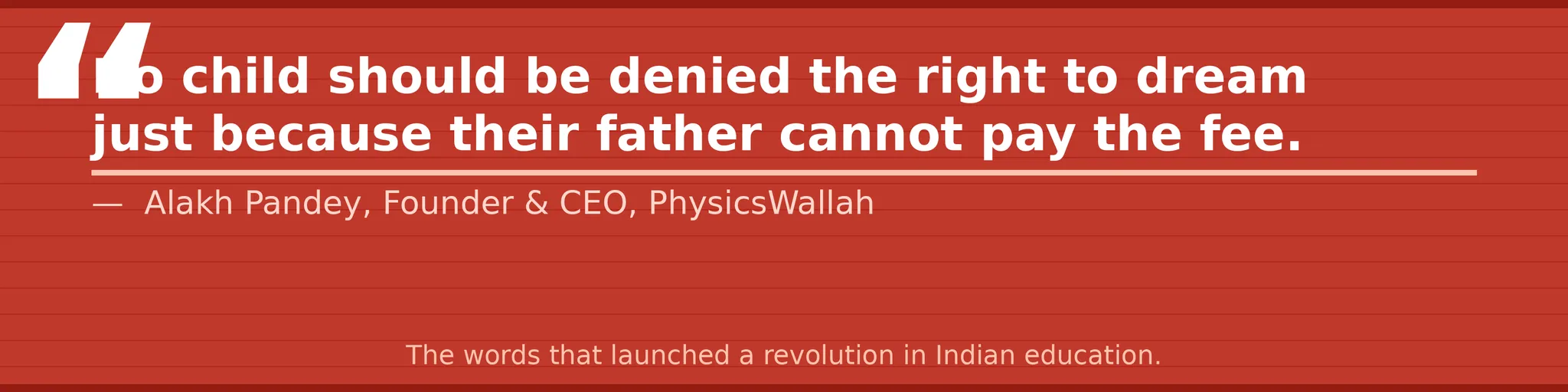
The words that launched a revolution in Indian education.
A Billionaire Who Still Fights for His Students
In May 2026, NTA cancelled NEET-UG 2026 after a paper leak. Students who prepared for years were shattered. India’s newest billionaire did not stay silent. Alakh Pandey called out an ‘organised nexus’ of insiders behind the leak and demanded justice: “How can students trust the system again?”
“The system failed them. I will not.”
— Alakh Pandey, on the NEET-UG paper leak, May 2026
This is the final twist — the one that says most about who he really is. He became a billionaire and went right back to fighting for the students who made him one. He never stopped being their teacher.
What Every Founder, Student, and Dreamer Can Learn
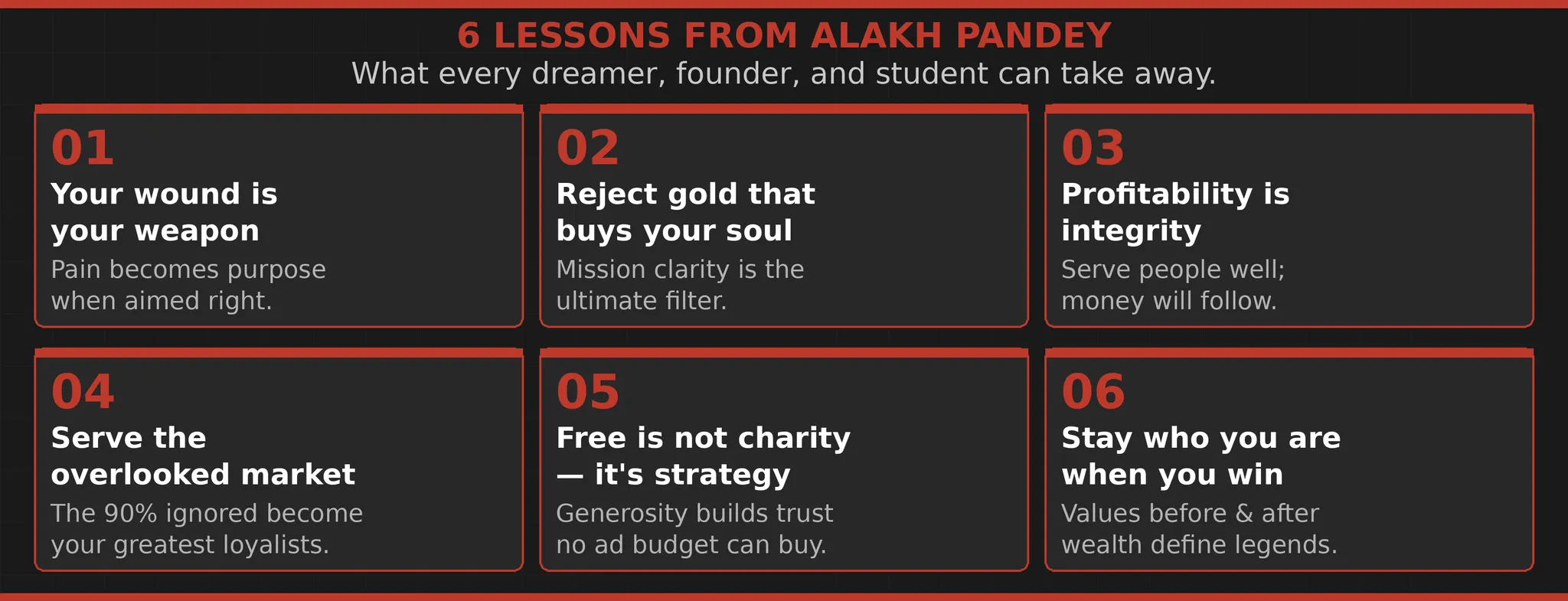
Six powerful lessons from Alakh Pandey's journey — applicable to every founder and dreamer.
01. Your wound can be your weapon. Alakh’s poverty, his IIT failure — these became his empathy and competitive advantage. He understood his customer because he had been his customer.
02. Reject the gold that compromises your mission. He turned down ₹75 crore. Clarity of purpose is the ultimate filter for every decision.
03. Profitability is a form of integrity. While rivals burned money impressing investors, Alakh made money by serving students. Mission and business model were the same thing.
04. Serve the overlooked market. The Tier-2 student. The Hindi-medium learner. Everyone said unmonetisable. He proved serving the underserved creates the most loyal customers on earth.
05. Free is not charity — it is distribution. Making 90% of content free built a brand no ad budget can replicate — word-of-mouth from students who genuinely felt helped.
06. Stay who you are, even when you win. He became a billionaire and immediately returned to fighting for students. That consistency is what transforms a businessman into a legend.
The Story India Needed
He is not a second-generation industrialist. Not the beneficiary of inherited networks. He is a boy from Prayagraj whose family sold their house while he was in school. A boy who failed IIT. A boy who dropped out. A boy who decided that if the system would not serve the students who needed it most, he would.
And then he made a billion dollars doing it.
He sold his house. He failed IIT. He said no to ₹75 crore. And then he built a billion.
Not by chasing money. But by refusing to let it own him.