A Different Kind of Ambition
The startup world has a vocabulary of ambition that is almost entirely financial. Companies aspire to 'reach unicorn status,' to 'achieve a 10x exit,' to 'dominate the market,' to 'blitz-scale before competitors can respond.' These are legitimate ambitions, and the companies that achieve them create genuine value. But they are also incomplete ambitions — they measure success only in terms of the financial claims that can be made against a company's future earnings, not in terms of whether the company's existence makes the world better.
Rachana Gupta, co-founder of Gynoveda, approaches ambition differently. In conversations about her company — the ayurveda-based women's health platform she built to address conditions from polycystic ovary syndrome to menstrual irregularity to hormonal imbalance — she speaks consistently about impact before income. She describes Gynoveda's success in terms of the number of women who have found relief from chronic conditions that the mainstream medical system had failed to adequately address, not in terms of the multiple at which the company might one day be valued. She prioritizes, in her words, 'making a meaningful impact and continuously striving to better the lives of those we serve' over financial achievement.
This is not naive or commercially unsophisticated. It is a specific and deliberate philosophy of company building — one that, as Gynoveda's growth demonstrates, is compatible with significant commercial success. And it reflects a truth that the startup world's financial vocabulary obscures: the companies that solve genuine problems for underserved people tend to be the companies that build the most loyal customers, the strongest organic growth, and the most durable competitive positions. Impact and commercial excellence are not opposites. In the best companies — of which Gynoveda is one — they are expressions of the same underlying commitment to doing the work well.
The Problem Gynoveda Is Solving — and Why It Needed to Be Solved
Gynoveda operates at the intersection of two large and historically underserved areas: women's reproductive health and India's ayurvedic medical tradition. The conditions it addresses — polycystic ovary syndrome, thyroid disorders, menstrual irregularity, fertility challenges, and the complex hormonal imbalances that underlie many of these conditions — affect hundreds of millions of Indian women. They are conditions that are frequently misdiagnosed, inadequately treated, and poorly understood even in well-resourced medical settings.
The modern allopathic treatment of these conditions typically involves hormone therapies and symptom management that address the manifestations of dysfunction without necessarily addressing the underlying causes. Side effects are common. Long-term efficacy is variable. And for many patients, the experience of navigating the medical system while dealing with conditions that are often dismissed as 'women's problems' or attributed to stress, weight, or lifestyle choices made without adequate clinical evidence — is profoundly alienating.
Gynoveda's approach combines the physiological analysis of modern medicine with the constitutional understanding of ayurvedic medicine — the recognition that the same symptom pattern can have different underlying causes in different body types and constitutions, and that addressing the root cause requires understanding the whole person rather than just the presenting symptom. This is not alternative medicine in the dismissive sense that phrase sometimes implies. It is a complementary approach that draws on a 5,000-year-old medical tradition that has accumulated deep knowledge about hormonal health, reproductive function, and the management of chronic conditions through diet, lifestyle, and specific herbal formulations.
The company's product development is subject to clinical scrutiny. Gynoveda does not make claims without evidence. Its formulations are developed by ayurvedic physicians with expertise in women's health, tested in clinical settings for safety and efficacy, and offered to consumers with the transparency about ingredients and mechanisms that the toxin-free movement has helped make a consumer expectation. This evidence base distinguishes Gynoveda from the large category of supplements and wellness products that make health claims without clinical support — and it is the foundation of the consumer trust that drives the brand's growth.
The Direct-to-Consumer Model and the Subscription Relationship
Gynoveda's decision to build as a D2C brand — selling directly to consumers through digital channels, building a subscription relationship that allows for ongoing personalization and clinical monitoring — is particularly well-suited to the healthcare context it operates in. Women's health conditions are chronic, not acute. They require sustained management over months and years, not one-time treatment. The subscription model matches this clinical reality with a commercial structure that serves both the company and its customers.
The subscription relationship that Gynoveda builds with its customers is also, at its best, a care relationship. The company employs ayurvedic doctors who are available to subscribers for consultations, and its products are personalized based on each subscriber's constitution, condition, and response to treatment over time. This ongoing clinical engagement transforms the commercial relationship from a transaction to a therapeutic partnership — a relationship characterized by trust, continuity, and mutual investment in the customer's health outcomes.
The community that forms around Gynoveda — women sharing their experiences with the conditions the brand addresses, supporting each other through the challenges of long-term management, and celebrating each other's progress — is one of the brand's most distinctive and most durable assets. Communities of this kind, built around shared experience of health challenges that carry social stigma, are enormously valuable to their members in ways that go beyond the commercial. They provide the social support that medical research consistently shows improves health outcomes. And they create the kind of brand loyalty — grounded in gratitude rather than habit — that no marketing budget can purchase.
The Broader Lesson: When Impact Is the Competitive Moat
Gynoveda's story illuminates a strategic insight that the startup world's financial vocabulary tends to obscure: genuine commitment to impact — not as a marketing claim but as an operational reality, demonstrated through product quality, clinical evidence, and honest consumer communication — creates a competitive moat that is more durable than most technology-based moats.
Technology can be replicated, improved upon, and disrupted. A brand that has earned deep consumer trust through years of honest engagement with a community's specific health needs cannot be replicated in a funding cycle. The women who have used Gynoveda's products, experienced meaningful improvement in conditions that had significantly affected their quality of life, and built their own experience of the brand as a trustworthy partner in their health journey — these women are not going to switch to a competitor because the competitor runs a better Instagram campaign or offers a lower entry-price subscription tier.
This is what Rachana Gupta means, we think, when she says that impact takes priority over financial return. She is not expressing a disinterest in commercial success. She is articulating a theory of competitive advantage: that the companies which actually change people's lives, which earn trust through genuine effectiveness rather than marketing sophistication, which build relationships with customers that are grounded in mutual care rather than transaction — these companies build the most durable commercial positions. The financial returns follow the impact. Not always, and not always at the speed that investors prefer. But more reliably than any other foundation.
For The Impactful Global Indian, Gynoveda's story is a reminder of the kind of company building we find most inspiring: not the fastest-growing, not the highest-valued, not the most visibly funded, but the most genuinely committed to changing the lives of the people it was built for. In India's startup ecosystem, there is room for every kind of ambition. But the companies that will define its legacy over the long term will be those, like Gynoveda, that chose impact and found excellence in the choosing.
— The Impactful Global Indian
📋 CONTENT MARKETING TOOLKIT — Article 24
🔍 SEO TITLE
Gynoveda's Rachana Gupta on Building India's Ayurvedic Women's Health Startup: Why Impact Comes Before Income |
💬 EDITORIAL QUOTE
“The companies that genuinely change people's lives — that earn trust through effectiveness rather than marketing, that build relationships grounded in care rather than transaction — build the most durable commercial positions. Impact is not the alternative to returns. It is the foundation of them.”
— The Impactful Global Indian
🖼️ IMAGE PROMPTS (Midjourney / DALL-E / Adobe Firefly)
1 | Indian woman consulting with Gynoveda's online ayurvedic doctor on smartphone, at-home setting, trust and relief on her face, warm domestic light, authentic health empowerment moment, editorial |
2 | Gynoveda product range flatlay — herbal formulations, ayurvedic ingredients (ashwagandha, shatavari), modern packaging, clinical trial certificates visible, blend of traditional and evidence-based, product photography |
3 | Rachana Gupta at Gynoveda headquarters — surrounded by research reports and product samples, combination of health practitioner and entrepreneur, warm editorial founder portrait, conviction and purpose |
4 | Gynoveda community session: group of Indian women sharing health experiences, some on video call (Gynoveda platform), others in person, the community as a therapeutic and commercial asset, editorial warmth ““Public capital that corrects a market distortion is not a subsidy — it is a correction. And when the distortion being corrected is the systematic undervaluing of women founders, correcting it is both a moral imperative and an act of sound economic policy.”” |
5 | Ayurvedic ingredient sourcing: Indian herbs being harvested in a sunlit field, women farmers picking medicinal plants that become Gynoveda formulations, farm-to-health supply chain, documentary photography |
🏷️ TOP 10 SEO TAGS
#Gynoveda | #Rachana Gupta Founder | #Ayurvedic Women's Health India | #Indian Health Startup | #Women's Health India |
#PCOS India Treatment | #Impact Startup India | #Ayurveda Modern India | #D2C Health India | #Women Wellness Startup |
🌱 IMPACT • Article 25 of 30
₹2,995 Crore for Women-Led Enterprises: What Targeted Public Investment Has Built — and Why It Must Go Further
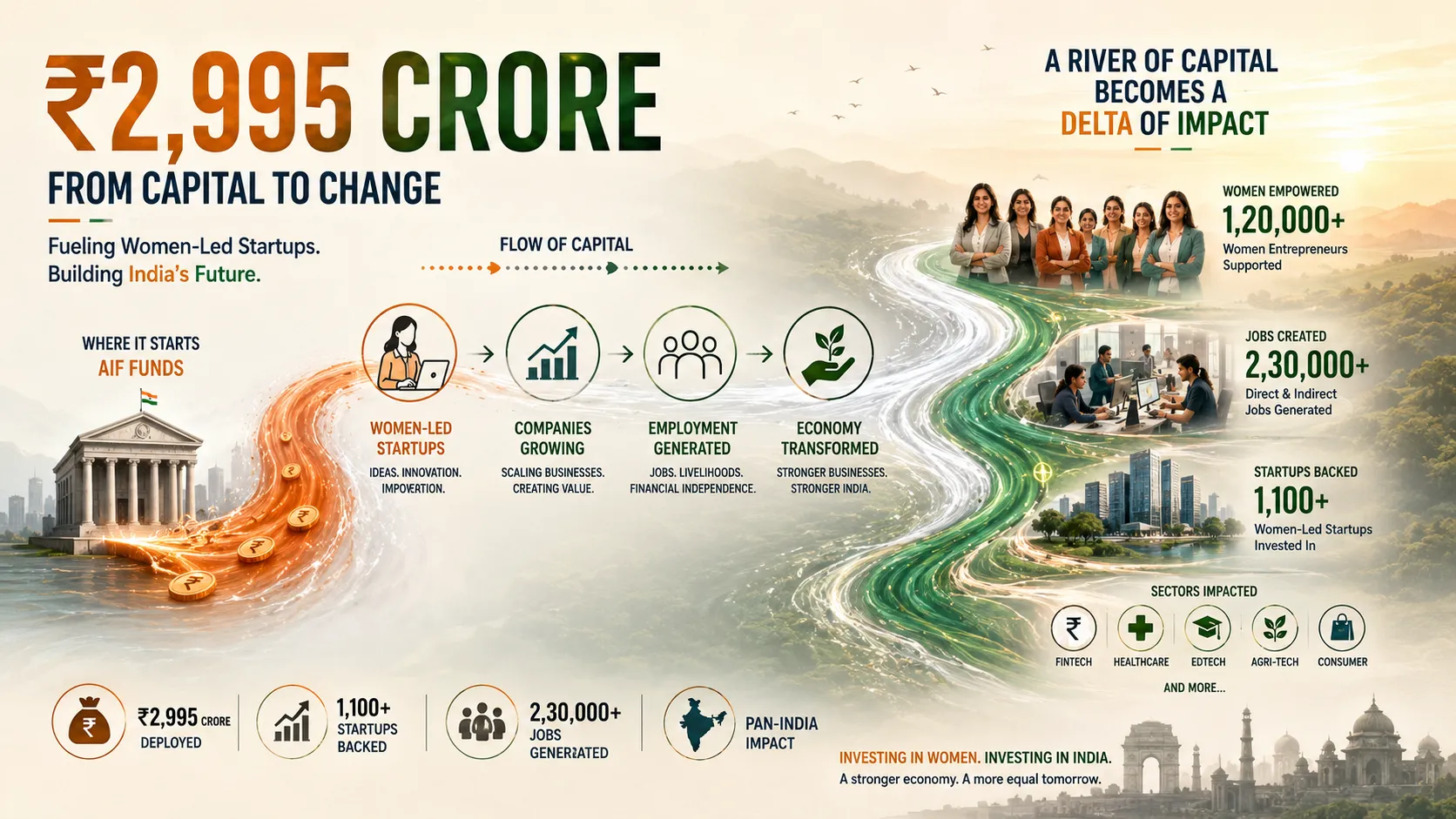
Since 2020, government-backed Alternative Investment Funds have channeled nearly ₹3,000 crore into women-led startups. The investment has been productive. The story of what it has built — and what structural barriers it has revealed — is essential context for understanding what India's inclusive innovation agenda must do next.
By The Impactful Global Indian Editorial Team | March 2026 | theimpactfulglobalindian.com
The Case for Targeted Public Investment
The debate about government investment in private enterprises is old, contested, and unlikely to be resolved by any particular program's outcomes. The abstract case for market purity — that capital should flow to where it generates the best risk-adjusted returns, without public sector direction that distorts this process — has genuine theoretical merit. The abstract case against it — that markets contain systematic biases that prevent optimal capital allocation, particularly when those biases are products of discrimination or information asymmetry rather than genuine quality differences — also has genuine theoretical merit.
The question that matters for policymakers is not which abstract principle is correct, but which specific market failures exist in the specific context of Indian startup investment — and whether those failures are of the kind that targeted public investment can usefully correct.
The evidence strongly suggests that the market for early-stage investment in women-led startups in India exhibits a systematic bias that is not driven by quality differences. Women-led startups, when they receive comparable capital to male-led counterparts, perform comparably or better. Yet they receive significantly less capital, at lower valuations, with higher bars for proof than equivalent male-led companies. This is not an efficient allocation. It is a misallocation driven by pattern-matching bias, network effects that exclude women from the informal deal flow that drives much early-stage investment, and cultural assumptions about who is credible as a founder that are empirically unjustified.
Public capital that corrects this misallocation — that provides first capital to women-led companies that the private market has systematically undervalued — is not distorting the market. It is correcting a market distortion that already exists. The moral case for this correction is strong. The empirical case, supported by the evidence on women-led startup performance, is equally strong.
What ₹2,995 Crore Has Built
The capital directed to women-led enterprises through government-backed AIFs since 2020 has seeded a set of companies whose impact extends beyond the specific businesses they operate. In aggregate, they represent a demonstration — both to private investors and to aspiring women founders — that women-led startups are commercially viable at scale, that the market failure is real and correctable, and that public capital invested in correcting it generates both financial and social returns.
The specific companies that have benefited from this investment span every sector of India's startup ecosystem: health-tech platforms serving women's specific health needs, fintech companies building financial inclusion tools for women consumers and women-owned small businesses, consumer brands built on the insight and values of women founders, education technology companies addressing the learning needs of women and girls in underserved communities, and agricultural technology companies built by women founders who understand rural India's agricultural challenges from direct experience.
What these companies share, despite their sectoral diversity, is a specificity of product design that is difficult to achieve without the founder-market fit that characterizes the best of them. They are not building generic products and targeting women as a demographic. They are building products that are shaped, at the most fundamental level of their design, by the specific knowledge and experience that women founders bring — knowledge of their own health needs, their own financial behaviors, their own educational challenges, their own agricultural contexts. This specificity is both the source of their competitive advantage and the reason that the public investment that helped bring them to market has generated real value.

The 11.6 Percent Problem
The ₹2,995 crore directed to women-led enterprises represents approximately 11.6 percent of the total AIF investment of ₹25,859 crore. This fraction is better than what private venture capital typically directs to women founders, but it is far below what the prevalence of high-quality women-led investment opportunities would justify.
The 11.6 percent figure is a measure not of how good women-led companies are, but of how imperfectly the capital allocation process matches capital to quality. If women founders represent 11.6 percent of funded startups but their companies perform as well or better than the male-led 88.4 percent, then the market is leaving returns on the table — allocating capital to lower-quality opportunities because of bias rather than analysis.
The question of how to increase the allocation to women-led companies is partly a question of investment policy and partly a question of institutional design. Investment policy can set targets and accountability mechanisms for the AIFs receiving public money. Institutional design determines whether the organizations making investment decisions within those AIFs have the capacity — the networks, the cultural understanding, and the analytical frameworks — to identify high-quality women-led opportunities that their existing deal flow processes may be missing.
The latter is often the more important lever. An AIF with a mandate to invest in women-led companies but whose investment professionals are predominantly male, whose deal flow comes primarily from male-dominated networks, and whose evaluation criteria were designed around the profile of historically successful (predominantly male) founders will struggle to use its mandate effectively. Building the institutional capacity to actually identify and evaluate the full range of women-led investment opportunities requires changing the people, the networks, and the criteria — not just the mandate.
The Next Chapter: What More Ambitious Investment Would Look Like
The ₹2,995 crore represents a beginning. The next chapter of public investment in women-led enterprises must be more ambitious in scale, more sophisticated in design, and more explicit in its intent to build the systemic conditions for equitable entrepreneurship rather than simply providing capital that partially compensates for systemic inequity.
Scale matters because the demonstrated performance of women-led startups — the evidence that the market failure is real and that public correction generates returns — justifies a larger capital commitment. Moving from 11.6 percent to 25 or 30 percent of AIF investment directed to women-led enterprises would not require accepting lower-quality investments. It would require more active deal sourcing, more network building in communities where women founders are concentrated, and more sophisticated evaluation that can recognize quality in founders whose profile differs from the historical pattern.
Design sophistication matters because not all capital is equally helpful. Capital provided too early — before a company has the team, the product, and the market insight to deploy it effectively — can be as harmful as insufficient capital. Capital provided without the technical assistance, governance support, and network connections that help founders avoid avoidable mistakes is less valuable than capital provided with these accompaniments. The best programs for women's entrepreneurship combine capital with the ecosystem support that makes capital productive.
For The Impactful Global Indian, the ₹2,995 crore story is evidence that targeted public investment in underrepresented founders can work — and that India has the institutional will, at least in principle, to make it work. The next chapter must take that evidence and build on it at the scale the opportunity demands. The women founders who will define India's next generation of innovation are being formed right now — in engineering programs, in business schools, in households and communities across the country. The capital and the infrastructure that will help them build should be ready when they are.