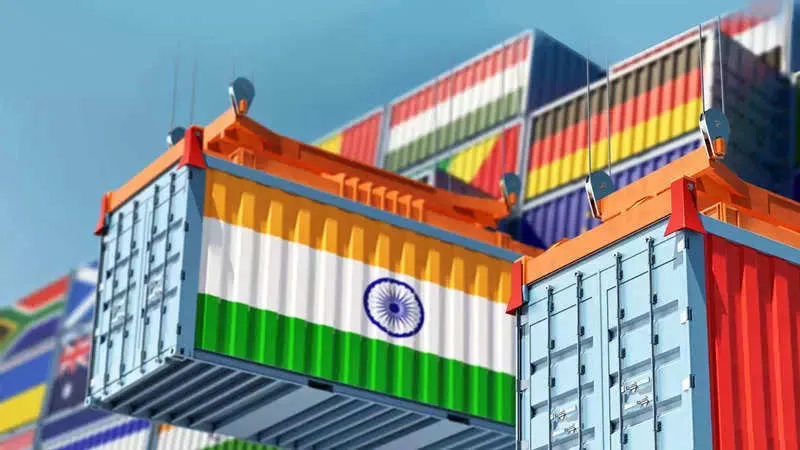
NEW DELHI — The Indian government has operationalised the inventory-based cross-border ecommerce export framework under the Foreign Trade Policy (FTP) 2023, enabling eligible ecommerce entities to undertake export-only inventory operations through registered Exporters-on-Record (EORs). The framework was notified on August 5 through Notification No. 27/2026-27 and Public Notice No. 25/2026-27, according to a release from the Ministry of Commerce and Industry, following an earlier amendment to India's FDI policy that permits inventory-based ecommerce operations exclusively for exports.
Separately, the Central Board of Indirect Taxes and Customs (CBIC) has operationalised new courier export rules removing the ₹10 Lakh value cap per consignment — a change the ministry said would let D2C brands ship high-value products globally without restrictive caps, while also introducing a streamlined, legally backed return-to-origin mechanism for uncleared or rejected shipments.
How the New Exporter-on-Record System Works
Under the framework, registered Exporters-on-Record will procure goods from Indian Sellers-on-Record against confirmed overseas orders only — speculative inventory build-up purely for export purposes is not permitted. The Directorate General of Foreign Trade (DGFT) has introduced a new application form, ANF-9A, for EOR registration, requiring entities to register and report any changes in registration details within 30 days. Export inventory must be separately identified, digitally recorded, and cannot be diverted for sale in the domestic market.
Safeguards for Sellers and Payment Timelines
The ministry said the framework places primary responsibility on the Exporter-on-Record for maintaining export inventory, ensuring goods match seller-declared specifications, and complying with destination-country regulatory requirements, including product testing, certification, packaging and labelling. Payment to Indian sellers must be made within a prescribed timeline and cannot be made contingent on receiving payment from overseas buyers — a safeguard aimed at protecting smaller sellers from cash-flow risk in cross-border transactions. Exporters-on-Record will also be required to obtain an annual compliance certificate from an independent Chartered Accountant, Cost Accountant, or another DGFT-specified professional.
Returned or rejected consignments must be re-exported, returned to the seller, or disposed of according to prescribed procedures, formalising a reverse-logistics process that has historically been a friction point for Indian sellers trying to compete on international marketplaces. "The framework is expected to facilitate greater participation of Indian manufacturers, traders and MSMEs in global ecommerce supply chains by providing access to organised fulfilment networks while ensuring transparency, timely payment, effective pass-through of export benefits and robust regulatory oversight," the commerce ministry said in its notification.

Targeting a Long-Standing Gap in India's Export Mix
The move addresses a gap industry groups have flagged for years: India's ecommerce exports have significantly lagged the size of its domestic ecommerce market. According to an EY report cited by Inc42, ecommerce exports from India stood between $4 Bn and $5 Bn in FY23 — a small fraction of the sector's overall potential, given that India's ecommerce market is projected to become a $345 Bn opportunity by 2030. Removing the courier consignment value cap in particular is expected to matter for higher-value categories such as electronics, home goods and premium fashion, where the previous ₹10 Lakh ceiling forced exporters into costlier, more cumbersome shipment structures.
Besides D2C brands, the ministry said hardware and electronics startups engaged in cross-border manufacturing stand to benefit from faster turnaround times and reduced friction on imported components under the new rules — a secondary but significant effect given the government's parallel push to build domestic electronics and hardware manufacturing capacity.
Why It Matters
For India's fast-growing base of D2C brands and export-oriented MSMEs, the new framework removes two of the most cited operational obstacles to scaling overseas — restrictive per-consignment value caps and the absence of a clear, government-backed structure for handling returns. Combined, the changes are designed to formalise what has often been an ad hoc, fragmented export process into a more organised, fulfilment-network-driven system, positioning ecommerce exports as a more deliberate lever in India's broader export growth strategy rather than a peripheral channel.
• The government operationalised the inventory-based cross-border ecommerce export framework under FTP 2023 on August 5, 2026.
• CBIC removed the ₹10 Lakh per-consignment value cap on courier exports.
• A new Exporter-on-Record (EOR) registration system via form ANF-9A is now in effect.
• Payments to Indian sellers must be made on schedule, independent of overseas buyer payment.
• India's ecommerce exports stood at $4-5 Bn in FY23, against a domestic ecommerce market headed toward $345 Bn by 2030.