For much of the artificial intelligence boom, public attention has been fixed on the visible layer. People compare ChatGPT with Gemini. Businesses debate which AI assistant is smarter. Consumers test image generators and productivity tools, treating each new model as the latest milestone in a technological revolution. The chatbots have become a global spectacle, complete with personality tests, benchmarking wars, and breathless headlines about artificial general intelligence.
Yet beneath every chatbot response and every AI-generated image sits an infrastructure network so expensive that only a handful of companies on Earth can afford to build it. And while the world watches the software race, Google has quietly positioned itself as perhaps the most aggressive builder of the physical foundation on which the entire AI economy will run.
The numbers tell the story. Alphabet, Google's parent company, has boosted its annual capital spending forecast to between $180 billion and $190 billion to meet soaring AI-driven demand . That is not a typo. Nearly $200 billion in a single year. To put that figure in perspective, it represents a more than one hundred percent increase in capital spending, and the company has cautioned that 2027 spending could rise even higher . Most of this money is flowing directly into AI data centers, custom chip development, and the sprawling network of computing resources required to train and serve the next generation of artificial intelligence models.
This is not the behavior of a company merely trying to compete in AI. This is the behavior of a company attempting to build the digital highways on which the entire AI economy may eventually run.
The Real AI Arms Race Is Happening Inside Data Centers
Most consumers never see the facilities driving artificial intelligence. Hidden behind secure perimeters, industrial fences, and nondescript building facades are massive data centers containing hundreds of thousands of processors working in parallel. Training advanced AI models requires extraordinary computational power, and demand continues to rise as models become larger and more sophisticated. Every major technology company now faces the same challenge: securing enough infrastructure to support future growth without falling behind competitors.
Google appears determined not to lose that race. In May 2026, the company announced an enormous capital raise totaling $80 billion to fund its AI infrastructure push . The funding structure is complex and unprecedented. It includes a $10 billion private placement to Warren Buffett's Berkshire Hathaway, split evenly between Class A and Class C stock. It includes $30 billion in concurrent public offerings. And it includes a massive $40 billion at-the-market offering program scheduled for the third quarter of 2026 .
The announcement drew immediate criticism from Wall Street veterans. Jim Cramer, the CNBC host, warned that the at-the-market offering would "turn the stock into a real slog if not careful" . Renowned short-seller Jim Chanos questioned the fundamental necessity of the raise, pointing out that Alphabet already had $126 billion in cash and marketable securities on its balance sheet as of March 31, 2026 . Why raise $80 billion when you already have $126 billion in the bank?
The answer reveals something important about Google's strategy. The company is not just spending on AI. It is restructuring its entire financial posture for an AI-dominated future. In early 2026, Alphabet announced an unusual 100-year bond sale. In 2025, the company sold about $37.5 billion in bonds after years of being one of the least frequent borrowers in the technology industry. By the end of 2025, Alphabet's total long-term debt had climbed to $46.5 billion . The company has also reduced its stock buybacks, freeing up additional cash for infrastructure investment.
Google is borrowing, issuing equity, and pulling every financial lever available because its leadership believes that the AI infrastructure buildout is the single most important investment opportunity of the decade. The company that controls the most compute capacity, the most efficient chips, and the most strategically located data centers will have an insurmountable advantage in the AI era. Google is spending like it intends to be that company.
The Blackstone Partnership: $5 Billion and 500 Megawatts of Compute
One of the most significant moves in Google's infrastructure strategy has received relatively little attention in the consumer press. In May 2026, Blackstone, the world's largest private owner of data centers, committed $5 billion in equity capital to a new artificial intelligence infrastructure company backed by Google .
The joint venture aims to bring the first 500 megawatts of compute capacity online by 2027, with plans to scale significantly over time . When leverage financing is included, the total investment size is expected to reach approximately $250 billion . The new company, which has not yet been named, will be helmed by Benjamin Treynor Sloss, who most recently served as Google's chief programs officer . Blackstone will hold a majority stake, while Google will supply the new company with its tensor processing units, the custom chips purpose-built for processing artificial intelligence computations .
This partnership reflects a growing trend across the technology industry where software giants increasingly partner with infrastructure investors to accelerate AI expansion. Building data centers requires enormous capital commitments, specialized energy resources, and long-term planning. Technology companies bring the expertise and the demand. Investment firms bring the capital and the real estate portfolios. By combining forces, they can expand capacity faster than either could independently.
The joint venture will compete directly with so-called neocloud providers like CoreWeave and Nebius Group, companies that supply computing power to AI service providers. Many of those competitors rely heavily on NVIDIA's graphics processing units. Google's venture will run entirely on its own TPU chips . This is not just an infrastructure play. It is a vertical integration play, with Google controlling everything from the silicon to the servers to the software stack.
Google Is Betting Big on Its Own Chips
Perhaps the most important aspect of Google's AI strategy receives surprisingly little attention from the general public. The company has spent years developing custom silicon designed specifically for artificial intelligence workloads, and that effort has now expanded into one of the most ambitious semiconductor programs in the world.
Google's seventh-generation TPU, codenamed Ironwood, debuted in April 2026 as what the company calls the first Google TPU for the age of inference . The distinction between training and inference is critical to understanding Google's strategy. Training a frontier AI model is a one-time event that requires enormous compute for weeks or months. Inference, by contrast, runs continuously, serving every query from every user. As AI products reach hundreds of millions of users, inference becomes the dominant expense. Inference is where the volume is, and volume is where custom silicon's cost advantages compound.
Ironwood delivers ten times the peak performance of the previous generation TPU v5p. Each chip is equipped with 192 gigabytes of HBM3E memory and memory bandwidth reaching 7.2 terabytes per second. The chips can scale to superpods containing 9,216 liquid-cooled units, producing 42.5 FP8 exaflops of computing power . Google plans to build millions of Ironwood units in 2026 alone. Anthropic, the AI company behind the Claude model, has committed to using up to one million TPUs. Meta has also signed a lease agreement for Google's TPU capacity .
Google's chip strategy now involves an extraordinary network of partners. Broadcom, the market leader in custom AI accelerators with more than seventy percent market share, signed a through-2031 agreement to design and supply TPUs and networking components . MediaTek, the Taiwanese chip designer, is responsible for cost-optimized inference versions of the TPU v8, codenamed Zebrafish, with designs that are reportedly twenty to thirty percent cheaper than alternative solutions . Marvell Technology is in talks to develop two new chips: a memory processing unit and an inference-optimized TPU, which would add a third design partner to Google's custom silicon supply chain . Intel has also signed a multi-year agreement to supply Xeon processors and custom infrastructure processing units for Google's AI data centers .
On the manufacturing side, TSMC is the sole foundry for all of Google's custom chips. Every design, regardless of which partner created it, eventually flows through TSMC's fabrication plants . This creates a tightly integrated structure where Google, the world's largest AI software company, also functions as one of the most sophisticated semiconductor design and procurement organizations on the planet.
The strategic rationale is clear. Every hyperscaler that depends on a single chip supplier faces pricing risk, supply risk, and the strategic vulnerability of building a business on someone else's silicon. By diversifying across multiple design partners while maintaining a single foundry relationship, Google insulates itself against disruptions while creating competitive pressure among its suppliers. Broadcom, MediaTek, and potentially Marvell will compete to offer Google the best performance at the lowest cost, and Google will capture the savings.
The Shift From Training to Inference Changes Everything
The broader industry context makes Google's strategy even more intelligible. The custom application-specific integrated circuit market is growing faster than the GPU market. TrendForce projects that ASIC sales will increase forty-five percent in 2026, compared with just sixteen percent growth in GPU shipments . Counterpoint Research projects that Broadcom will hold roughly sixty percent of the custom AI accelerator market by 2027, with Marvell at approximately twenty-five percent. The market itself is expected to reach $118 billion by 2033 .
Why is custom silicon growing faster than GPUs? Because inference workloads are fundamentally different from training workloads. Training requires maximum flexibility, which is why NVIDIA's GPUs, with their general-purpose architecture and mature CUDA software ecosystem, have become the industry standard. Inference, however, is more predictable and repetitive. Custom chips designed specifically for inference can achieve lower cost per query than general-purpose GPUs, even if they are less versatile. At Google's scale, shaving even a small percentage off the cost of each AI-powered search query or Gemini conversation translates into billions of dollars in annual savings.
Google serves billions of AI-augmented search queries, Gemini conversations, and Cloud AI API calls every day. The company's total TPU shipments are projected to reach 4.3 million units in 2026 and surge to more than 35 million units by 2028 . That is not a niche experiment. That is a wholesale transformation of Google's computing architecture, moving from general-purpose servers to purpose-built AI accelerators.
NVIDIA is not standing still. The company invested $2 billion in Marvell at the end of March 2026, partnering through NVLink Fusion to integrate Marvell's custom chips and networking with NVIDIA's interconnect fabric . The move positions Marvell at the intersection of both the GPU and ASIC ecosystems. NVIDIA is also promoting its own inference capabilities, arguing that its GPUs remain competitive even in workloads where custom chips have theoretical advantages.
But the structural trend favors the custom chip players. Training a frontier model is a single event. Inference runs forever. As AI moves from research labs into every corner of the economy, inference volumes will dwarf training volumes. The companies that control inference silicon will capture the lion's share of the economic value created by AI. Google intends to be one of those companies, and its semiconductor program is designed to ensure that outcome.
The Consumer Side: Googlebook and Fitbit Air
While infrastructure dominates investment discussions, Google is simultaneously working to strengthen its consumer ecosystem. The company is building endpoints for its AI services, creating new categories of devices that serve as gateways to its Gemini intelligence.
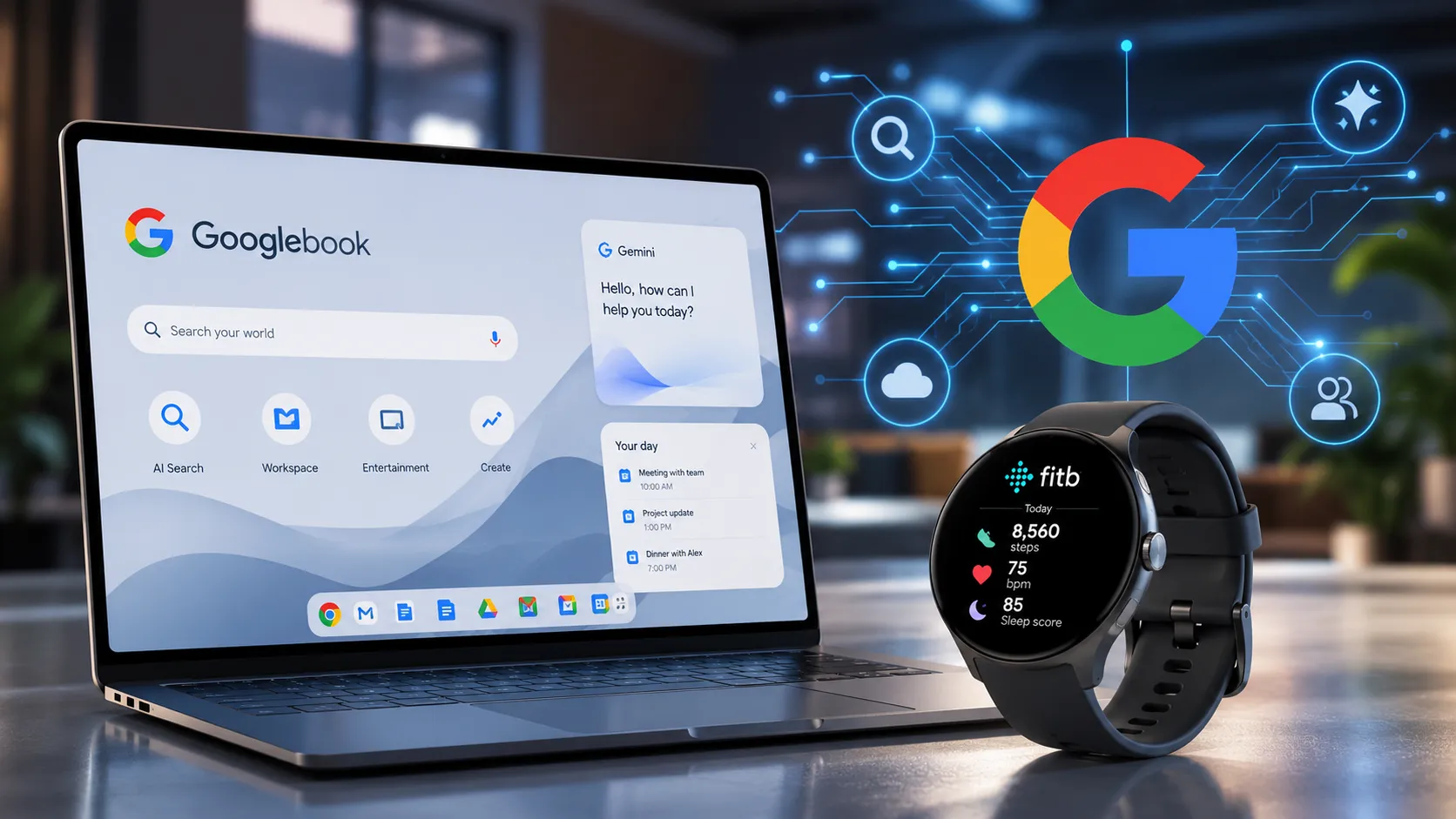
In May 2026, at The Android Show: I/O Edition, Google unveiled Googlebook, a new line of notebooks powered by Gemini intelligence . The timing was deliberate. Chromebooks were first introduced by Google on May 11, 2011. The Googlebook announcement came nearly exactly fifteen years later . The company describes Googlebook as combining the best features of ChromeOS and Android, allowing users to run Android applications directly on the laptop while maintaining a ChromeOS-like experience.
The AI features are the differentiator. Googlebooks include a Magic Pointer with Gemini Intelligence that, when wiggled on the screen, displays AI-powered recommendations. The cursor transitions from a standard pointer to an AI cursor, with Google claiming that the Google DeepMind team worked on this functionality . Users can also design their own widgets by providing Gemini with natural language prompts. The AI can create customized dashboards by pulling information from Gmail, Calendar, and web searches, organizing everything from travel arrangements to restaurant reservations in a single desktop view.
Google is not building Googlebooks alone. The company confirmed partnerships with Acer, Asus, Dell, HP, Lenovo, Intel, and Qualcomm to bring Googlebooks to market . The laptops will use high-end materials and be available in multiple sizes, positioning them as premium alternatives to Apple's MacBook lineup. The first Googlebooks are expected to launch in the autumn of 2026.
At the same time, Google is expanding its wearable portfolio with the Fitbit Air, a $100 screenless fitness tracker that marks the first major Fitbit launch in three years . The device is designed to compete directly with Whoop, the subscription-based fitness tracker that charges $200 annually for its hardware-free model. The Fitbit Air charges $100 upfront with an optional $10 per month Google Health subscription .
The device is twenty percent lighter than the discontinued Fitbit Luxe. It contains sensors for heart rate, blood oxygen saturation, heart rate variability, temperature, and motion tracking. It can detect signs of atrial fibrillation. It has no screen and no physical buttons, relying instead on haptic feedback and a small indicator light. The battery lasts approximately seven days between charges .
The software story is as important as the hardware. The Fitbit app has been rebranded to Google Health, and the new Health Coach feature, powered by Gemini, provides personalized guidance based on user data. Rather than simply displaying statistics, the Health Coach translates biometric data into actionable recommendations, generating workout plans, suggesting recovery windows, and analyzing sleep disruptions . Rishi Chandra, who runs Google's wearables and health work, told Bloomberg that the Health Coach represents the next wave of innovation in wearable technology, moving from data collection to data interpretation and action .
These consumer products may seem unrelated to Google's infrastructure spending. In reality, they fit neatly within a broader strategy focused on expanding user touchpoints. Every device becomes another channel through which consumers interact with Google's software, services, and eventually AI capabilities. The more devices Google places in the world, the more data it collects, the more users it retains, and the more demand it generates for its underlying AI infrastructure. The hardware is not a distraction from the infrastructure story. It is the reason the infrastructure story matters.
Why Investors Are Paying Close Attention
The scale of Google's spending reveals how dramatically the economics of technology are changing. For years, investors viewed software as one of the most attractive business models because companies could scale rapidly without massive physical infrastructure requirements. Artificial intelligence is rewriting those assumptions.
Today's AI leaders must spend billions on chips, servers, networking equipment, and energy infrastructure before generating returns. Success increasingly depends on access to resources that resemble industrial assets more than traditional software tools. This reality is creating a new investment landscape where balance sheets matter almost as much as engineering talent.
Google's ability to commit tens of billions of dollars reflects not only confidence in AI's future but also recognition that scale itself may become a decisive advantage. The company's stock has gained approximately twenty percent in 2026 following a sixty-five percent jump in 2025 . Investors have rewarded Google's AI narrative even as capital spending has exploded, suggesting that the market believes the infrastructure buildout will eventually pay off.
But the risks are real. Alphabet's long-term debt has risen sharply. The company is issuing new equity, diluting existing shareholders. Competitors are spending just as aggressively. Microsoft, Amazon, and Meta are all building their own AI infrastructure empires. And the technology itself is evolving rapidly, with no guarantee that today's massive data centers will remain competitive against tomorrow's more efficient architectures.
Jim Cramer's warning about the stock becoming a real slog captures a genuine concern. At-the-market offerings, where shares are sold gradually into the open market, can create persistent selling pressure. The $40 billion ATM program scheduled for the third quarter of 2026 will hang over the stock for months. If AI revenues do not materialize as quickly as expected, investor patience could wear thin.
Yet the alternative to spending is worse. In the AI era, falling behind in infrastructure means falling behind permanently. The companies that control the most compute capacity will train the best models, serve the most customers, and generate the most data for continuous improvement. The AI industry may exhibit winner-take-most dynamics similar to previous technology waves, and Google intends to be among the winners.
The broader transformation extends far beyond Google. Artificial intelligence is evolving from a product category into an economic foundation. Just as previous generations invested heavily in railroads, telecommunications networks, and internet infrastructure, today's technology giants are investing in the systems required to power AI-driven economies. Data centers, custom chips, and cloud platforms are becoming the equivalent of digital utilities for the modern era.
That is why Google's latest investments matter. The story is not simply about an $80 billion debt deal, a new laptop platform, or a cheaper wearable device. It is about one of the world's most powerful companies making a massive bet that the future of technology will belong to those who control the infrastructure behind artificial intelligence. The public sees chatbots. The smart money sees data centers. And Google is spending accordingly.