Ghazal Alagh — From a Mother’s Desperation to India’s Fastest‑Growing FMCG Unicorn
The Problem That Became a Mission
In 2016, Ghazal Alagh was a new mother living in Gurugram. Her infant son developed severe eczema — red, inflamed, itchy patches that wouldn’t respond to over‑the‑counter creams. Paediatricians prescribed steroid‑based ointments, but every application led to temporary relief followed by rebound flares. Worse, she discovered that most “gentle” baby products in the Indian market contained parabens, sulphates, mineral oils, and artificial fragrances — ingredients linked to long‑term skin sensitisation.
She searched for genuinely toxin‑free alternatives. The few international brands that met her standards were either unavailable in India or priced beyond reach. Local organic brands lacked credibility or scientific backing.
That moment of maternal frustration sparked an idea. Ghazal, who had a background in IT and had worked at NIIT, teamed up with her husband Varun Alagh, a seasoned marketer who had previously led digital strategy at Samsung and Coca‑Cola. Together, they decided to build a brand that parents could trust without reading ingredient labels twice.
In December 2016, Mamaearth was born — named to honour the planet (earth) and motherhood (mama). The initial product line included just two SKUs: a tear‑free baby shampoo and a gentle body lotion, both formulated without the “no‑no list” of 2,500+ harmful ingredients.

The Content‑to‑Commerce Flywheel
Mamaearth did not launch with a massive advertising budget. Instead, Ghazal and Varun deployed a strategy that would later become the gold standard for D2C brands in India: content‑to‑commerce.
The idea was simple but powerful. Instead of paying for interruptive ads, they would educate consumers about toxin‑free living through blogs, videos, and social media content. This content would drive organic traffic, build trust, and convert readers into customers. Once purchased, the product quality would generate word‑of‑mouth and repeat purchases.
Ghazal personally wrote the first 50 blog posts on Mamaearth’s website, covering topics like “How to read a cosmetic ingredient label,” “Why parabens are bad for babies,” and “Ayurveda meets modern dermatology.” Varun, meanwhile, reached out to mommy bloggers and parenting influencers, sending them free samples in exchange for honest reviews.
The turning point came in 2017, when a popular parenting influencer’s video about Mamaearth’s onion hair oil went viral. The video was not sponsored — the influencer had genuinely loved the product. Within a week, the onion hair oil sold out three times. Mamaearth realised that influencer‑driven, authentic storytelling was not just a growth hack; it was their core distribution channel.
By 2019, Mamaearth had partnered with over 5,000 micro‑influencers, 500 macro‑influencers, and celebrities like Shilpa Shetty and Sameera Reddy. The “content‑to‑commerce” flywheel reduced customer acquisition costs by 60% compared to traditional D2C peers while generating engagement rates 3x higher than industry average.
The Unicorn Journey
Mamaearth’s growth trajectory caught the attention of venture capital. In 2018, they raised a seed round from Fireside Ventures. Series A followed in 2019, Series B in 2020, and by 2021, Mamaearth had raised over $100 million from investors including Sequoia Capital, Sofina, and Stellaris Venture Partners.
In January 2022, Mamaearth became India’s first D2C FMCG unicorn after a $80 million Series F round led by Sofina at a valuation of $1.07 billion. The milestone was remarkable for several reasons:
Speed: From launch to unicorn in just 5 years.
Profitability: Unlike many unicorns, Mamaearth turned EBITDA positive within 3 years.
Woman‑led: Ghazal was the public face of product and brand, while Varun managed operations — a balanced husband‑wife partnership that became a brand asset.
The company’s parent entity, Honasa Consumer, went public in November 2023, listing on the BSE and NSE at a valuation of over ₹10,000 crore (~$1.2 billion). The IPO was oversubscribed 7.6 times, with strong retail participation. Ghazal and Varun together held over 40% of the company, making them one of India’s wealthiest self‑made couples.
Expanding Beyond Baby Care
While Mamaearth started with baby products, the brand quickly expanded into adjacent categories:
Skin care: Face washes, serums, moisturisers featuring ingredients like vitamin C, niacinamide, and hyaluronic acid.
Hair care: The onion oil range became a cult favourite, generating over ₹200 crore in annual revenue by itself.
Body care: Lotions, scrubs, and deodorants.
Colour cosmetics: A late entry in 2022, leveraging the “safe beauty” positioning.
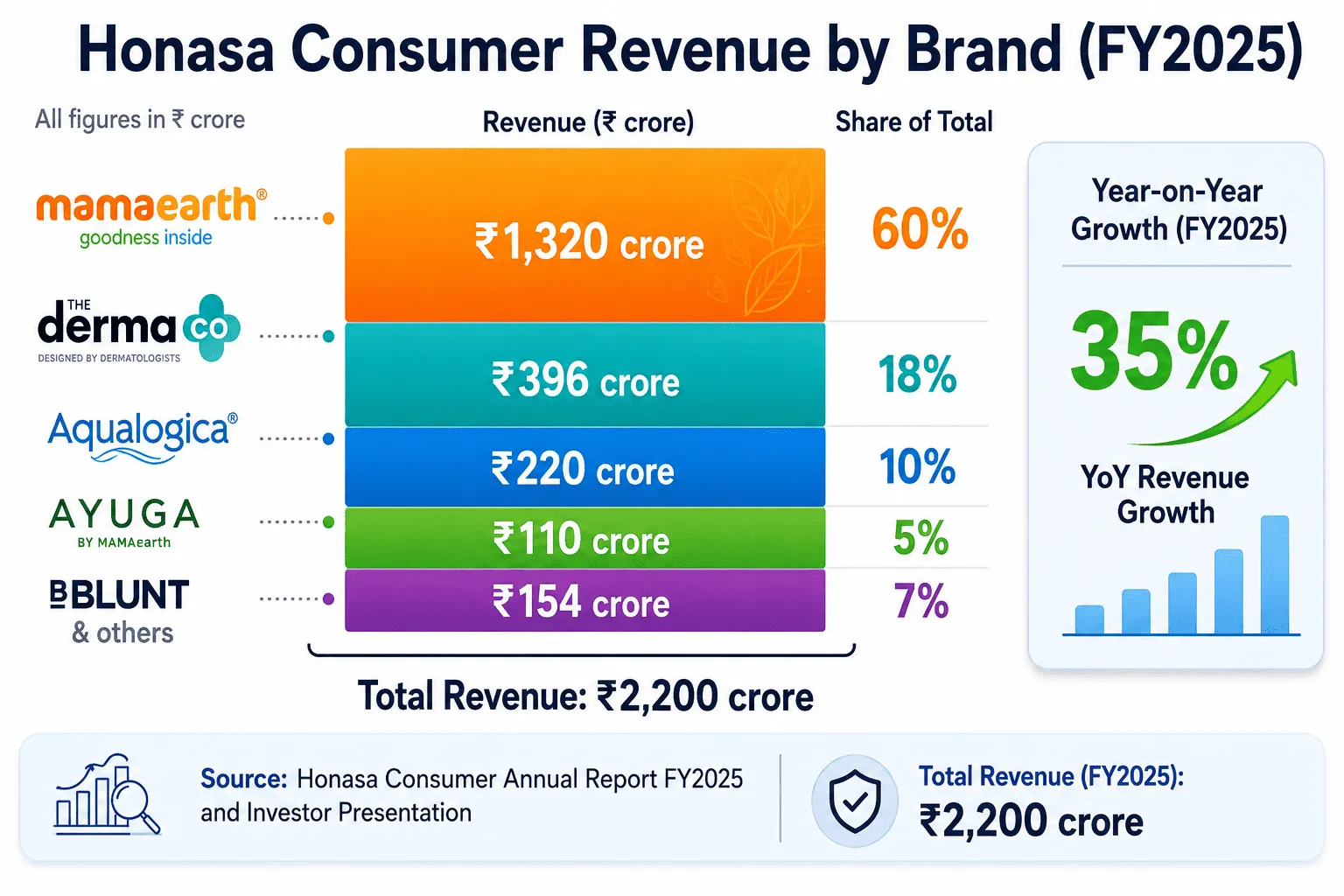
By 2025, Mamaearth had over 200 SKUs and contributed approximately 60% of Honasa’s total revenue. The remaining 40% came from other brands under the Honasa umbrella: The Derma Co. (clinical skincare), Aqualogica (hydrating skincare), Ayuga (ayurvedic), and BBlunt (professional hair care).
This multi‑brand strategy allowed Honasa to address different price points and consumer segments while sharing supply chain, digital marketing, and distribution infrastructure.
Ghazal’s Leadership Philosophy
Unlike many founder‑CEOs who focus on spreadsheets and investor relations, Ghazal Alagh has positioned herself as the “chief product storyteller.” She personally leads product development, drawing insights from customer reviews, social media comments, and even her own family’s needs.
Her philosophy rests on three pillars:
Radical transparency: Mamaearth publishes its ingredient list and sources publicly. Every product page includes a “Good Stuff, Bad Stuff” table explaining why each ingredient is included or excluded.
Community‑first innovation: The company’s best‑selling product — onion hair oil — came from a customer suggestion on Instagram. Ghazal institutionalised a feedback loop where any idea that gets 500+ upvotes on the community portal goes to R&D.
Profitability with purpose: She has consistently rejected investor pressure to discount heavily. “If we discount, we devalue trust,” she told YourStory in 2024. “Our customer pays for quality, not for coupons.”
Her leadership style is described as hands‑on but empowering. She still tests every new formula on herself and her children before signing off.
Challenges and Controversies
Mamaearth has not escaped criticism. In 2023, a consumer group alleged that some products contained trace amounts of preservatives not listed on the label. The company voluntarily recalled the batch, conducted an independent audit, and found the contamination was limited to raw material from a single supplier. Ghazal addressed the issue publicly in a video, explaining the corrective actions — a response that many praised for transparency.
Another challenge is competition. Nykaa, Wow Skin Science, Minimalist, and international brands like The Ordinary have entered the natural/toxin‑free space. Mamaearth’s response has been to invest in brand loyalty (the “Mamaearth Family” rewards programme has 5 million active members) and continuous innovation (launching 30+ new products annually).
Post‑IPO, the stock has been volatile, reflecting broader market skepticism of high‑valuation consumer companies. However, Honasa remains profitable with consolidated revenues of ₹2,200 crore in FY2025, a 35% year‑on‑year growth.
Lessons for D2C Founders
Solve a personal pain point: Ghazal built for a problem she experienced deeply — a guaranteed source of customer empathy.
Content is not a cost; it’s an asset: The content‑to‑commerce model created lasting SEO and trust advantages.
Husband‑wife teams can work: Clear role separation (Ghazal: product/brand, Varun: operations/finance) prevented conflict.
Go public as a profitable company: Mamaearth’s IPO was successful because the business had proven unit economics, not just growth.
The Road Ahead
As of 2026, Ghazal Alagh continues as the Chief Product and Brand Officer of Honasa Consumer. She has also become a regular “shark” on Shark Tank India, where her empathetic yet sharp feedback has made her a fan favourite. Through the show, she has mentored dozens of young D2C founders, especially women.
Her next ambition: international expansion. Mamaearth recently launched in the UAE, Singapore, and the US (via Amazon). She is also building a “clean beauty” certification standard for India, hoping to regulate a market currently flooded with false “natural” claims.
From a desperate mother to a unicorn builder, Ghazal Alagh has redefined what Indian D2C can achieve — and she’s just getting started.