Geetha Manjunath — Using AI to Revolutionize Breast Cancer Detection in India
The Personal Tragedy That Became a Mission
In 2010, Dr. Geetha Manjunath was at the peak of her corporate career. She had a PhD in Computer Science from the Indian Institute of Science (IISc), Bengaluru, and had spent over a decade at HP Labs and Xerox Research, leading teams in artificial intelligence and machine learning. She was well‑published, well‑respected, and well‑compensated.
Then, within six months, she lost two young cousins — both in their early 30s — to breast cancer. Both had been diagnosed at Stage 3 or 4. Both had undergone painful treatments. Both had left behind young children.
Geetha was devastated. But unlike most relatives who grieve and move on, she asked a question: Why were these cancers detected so late?
She researched the answer and discovered a grim reality. In India, breast cancer is the most common cancer among women, with over 200,000 new cases diagnosed annually. Yet, nearly 50% of patients die within five years — a mortality rate almost double that of the United States. The primary reason: late detection.
Mammography, the gold standard for breast cancer screening in the West, has severe limitations in India:
Radiation exposure — women are reluctant to undergo repeated screenings.
Pain and discomfort — the breast compression is a major deterrent.
High cost — ₹2,000–₹5,000 per screening, unaffordable for most.
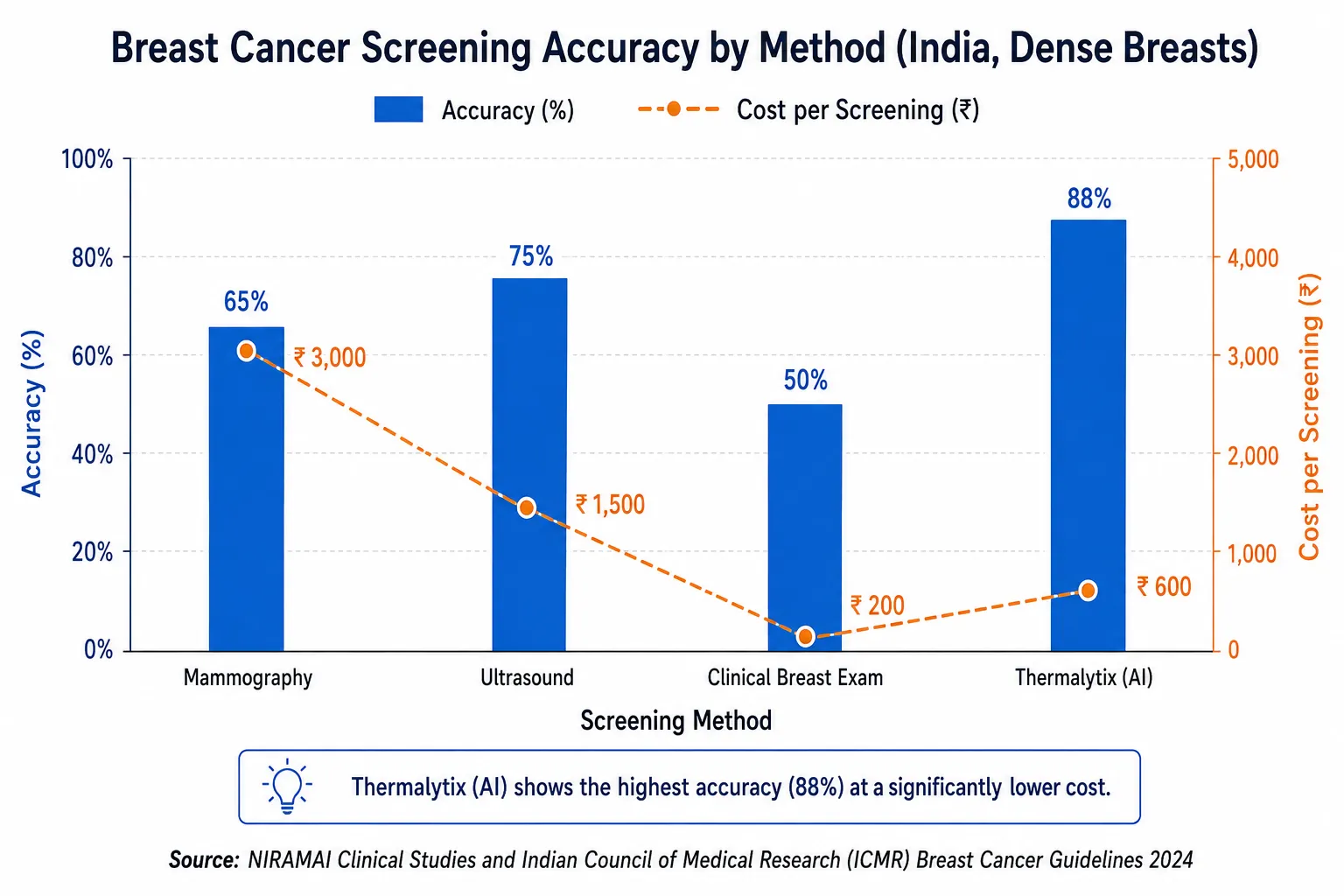
Poor accuracy in dense breasts — Indian women typically have denser breast tissue, which reduces mammography sensitivity to as low as 60%.
Lack of infrastructure — mammography machines are expensive, bulky, and unavailable in rural areas.
Geetha realised that a new approach was needed — one that was affordable, accessible, painless, and radiation‑free. And she had the skills to build it.
From Corporate Labs to a Garage‑Style Startup
In 2012, Geetha quit her job at Xerox Research. She was 42 years old, had a young child, and no safety net. Her family thought she was crazy. Her colleagues thought she was throwing away a brilliant career. But she had a vision: use thermal imaging + AI to detect breast cancer.
The science was not new. Cancerous tissues have higher metabolic activity and increased blood flow, making them slightly warmer than surrounding healthy tissue. Thermography (thermal imaging) can detect these temperature differences. But traditional thermography had a major problem: high false positives (normal variations in temperature were mistaken for cancer) and high operator dependency.
Geetha’s insight was to apply machine learning to thermal images. Instead of a human looking at a thermal map and guessing, an AI model could be trained on thousands of confirmed cases to recognise the subtle thermal signatures of malignancy.
She founded NIRAMAI Health Analytix (a Sanskrit‑derived name meaning “no disease”) in 2016. The initial “lab” was her home office in Bengaluru. She used her savings to buy a thermal camera and wrote the first version of the AI algorithm herself.
The first breakthrough came in 2018, when NIRAMAI received a grant from the Biotechnology Industry Research Assistance Council (BIRAC). With that funding, Geetha hired a small team of engineers and clinicians and conducted the first clinical validation study at a hospital in Bengaluru. The results were stunning: Thermalytix (the name of the device) had a sensitivity of 95% (correctly identifying cancer) and a specificity of 85% (correctly ruling out healthy tissue) — compared to mammography’s 70% sensitivity in dense breasts.
How Thermalytix Works
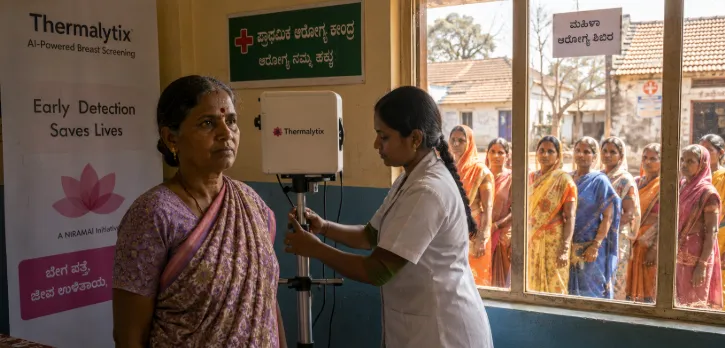
Thermalytix is a non‑invasive, radiation‑free, portable device that consists of:
A thermal camera — similar to those used in fever screening but with higher resolution.
A patented positioning stand — ensuring consistent image capture across patients.
An AI engine — running on a laptop or tablet, analysing the thermal patterns.
The screening process takes about 15 minutes. The patient removes her upper clothing, stands in front of the camera, and the technician captures a series of thermal images from different angles. No compression, no radiation, no pain. The AI then produces a report indicating the probability of malignancy (low, medium, high) and highlights suspicious regions on a colour‑coded map.
The device is portable and can be set up in any room with a power outlet. It costs approximately ₹5 lakh per unit, compared to ₹50 lakh–₹1 crore for a mammography machine. The per‑screening cost to the patient is targeted at ₹500–₹1,000 — making it affordable for mass screening.
Most importantly, Thermalytix works equally well on all breast types, including dense breasts. A peer‑reviewed study published in the Journal of Breast Imaging (2023) showed that Thermalytix combined with clinical examination had a higher sensitivity than mammography alone (92% vs 79%) for cancer detection.
From Pilot to Scale: Deployment Across India
By 2020, NIRAMAI had completed multiple clinical trials and received regulatory approvals from India’s Central Drugs Standard Control Organisation (CDSCO). The company began deploying Thermalytix in:
Corporate wellness centres (Infosys, Wipro, Biocon) for employee screening.
Government hospitals in Karnataka, Tamil Nadu, and Maharashtra.
Rural health camps in partnership with NGOs.
The COVID‑19 pandemic actually accelerated adoption. Thermalytix required no physical contact, could be operated with minimal training, and did not consume scarce PPE — making it ideal for screening in low‑resource settings.
As of 2025, NIRAMAI has screened over 500,000 women across 15 Indian states. Of these, over 10,000 were flagged as high risk, and subsequent biopsies confirmed cancer in nearly 2,000 cases — all detected at Stage 1 or 2, where treatment is far more effective and less expensive.
Geetha’s proudest moment came in 2024, when the Government of India included Thermalytix in the National Health Mission as a pilot for breast cancer screening in 10 districts. If successful, the device could be deployed in over 1,000 primary health centres across the country.
Overcoming Regulatory and Market Hurdles
The path to scale has been anything but smooth. Geetha faced three major hurdles:
1. Regulatory skepticism: India’s medical device regulators had never approved an AI‑based cancer screening tool. Geetha spent three years collecting clinical evidence, conducting multi‑centre trials, and educating bureaucrats. The approval finally came in 2022.
2. Doctor resistance: Some radiologists viewed Thermalytix as a threat to their practice. Geetha positioned it as a triage tool — not replacing mammography or biopsy, but identifying high‑risk patients who need further testing. Most doctors have now accepted this complementary role.
3. Funding challenges: Deep‑tech medtech is not a favourite of Indian venture capitalists, who prefer asset‑light software startups. Geetha raised money from impact investors and grants (BIRAC, Tata Trusts, USAID) rather than traditional VC. To date, NIRAMAI has raised only $15 million — a fraction of what a software unicorn would raise — but has used it efficiently.
Geetha’s Leadership Philosophy
Dr. Geetha Manjunath is not a typical startup founder. She is a scientist first, entrepreneur second. Her leadership style is defined by:
Evidence obsession: Every claim about Thermalytix is backed by peer‑reviewed data. She refuses to exaggerate.
Patient‑centric design: She personally watched hundreds of screening sessions to understand patient anxiety and comfort.
Frugal innovation: NIRAMAI’s office is modest, salaries are reasonable, and marketing is minimal. Every rupee goes to R&D.
“I didn’t get into this to become a billionaire,” she told Forbes India in 2025. “I got into this to save lives. If we can reduce breast cancer mortality in India by 20%, that’s 20,000 women a year who will see their children grow up. That’s my ROI.”
Challenges and Critiques
No medical innovation is without critics. Some radiologists argue that Thermalytix’s 15% false positive rate (85% specificity) means that for every 100 screened women, 15 will be unnecessarily anxious and may undergo invasive biopsies. Geetha acknowledges this but counters that mammography’s false positive rate in dense breasts is even higher (20–25%), and that Thermalytix’s low cost enables repeat screening, which reduces false positives over time.
Another challenge is the lack of long‑term outcome data. Thermalytix has only been in use for 5–6 years; the ultimate proof will be whether regular screening reduces mortality. NIRAMAI is conducting a 10‑year longitudinal study to provide that evidence.
Finally, scaling to rural India remains difficult. While the device itself is portable, the AI engine requires a laptop with a GPU, which needs reliable electricity — still a challenge in remote villages. Geetha is working on a solar‑powered, offline version.
Lessons for Entrepreneurs
Turn personal pain into purpose: The loss of her cousins gave Geetha the motivation to persevere through a decade of rejection.
Don’t chase VC validation: Grants and impact investors can be better partners for deep‑tech social impact.
Regulatory approval is a moat: Once you have it, it’s hard for competitors to copy you quickly.
Complement, don’t compete: Position your innovation alongside existing systems rather than against them.
The Road Ahead
As of 2026, Dr. Geetha Manjunath is 56 years old. NIRAMAI is preparing for international expansion, starting with Southeast Asia and Africa, where breast cancer mortality is similarly high and mammography infrastructure is lacking. The company is also developing an AI model for ovarian cancer detection using similar thermal imaging principles.
Her net worth is modest (estimated ₹50 crore) — she has given away much of her equity to employees and the NIRAMAI Foundation, a non‑profit that provides free screening to below‑poverty‑line women.
Geetha’s legacy will not be measured in billions of dollars but in lives saved. And by that measure, she is already one of India’s most successful women entrepreneurs — even if the world is still catching up.