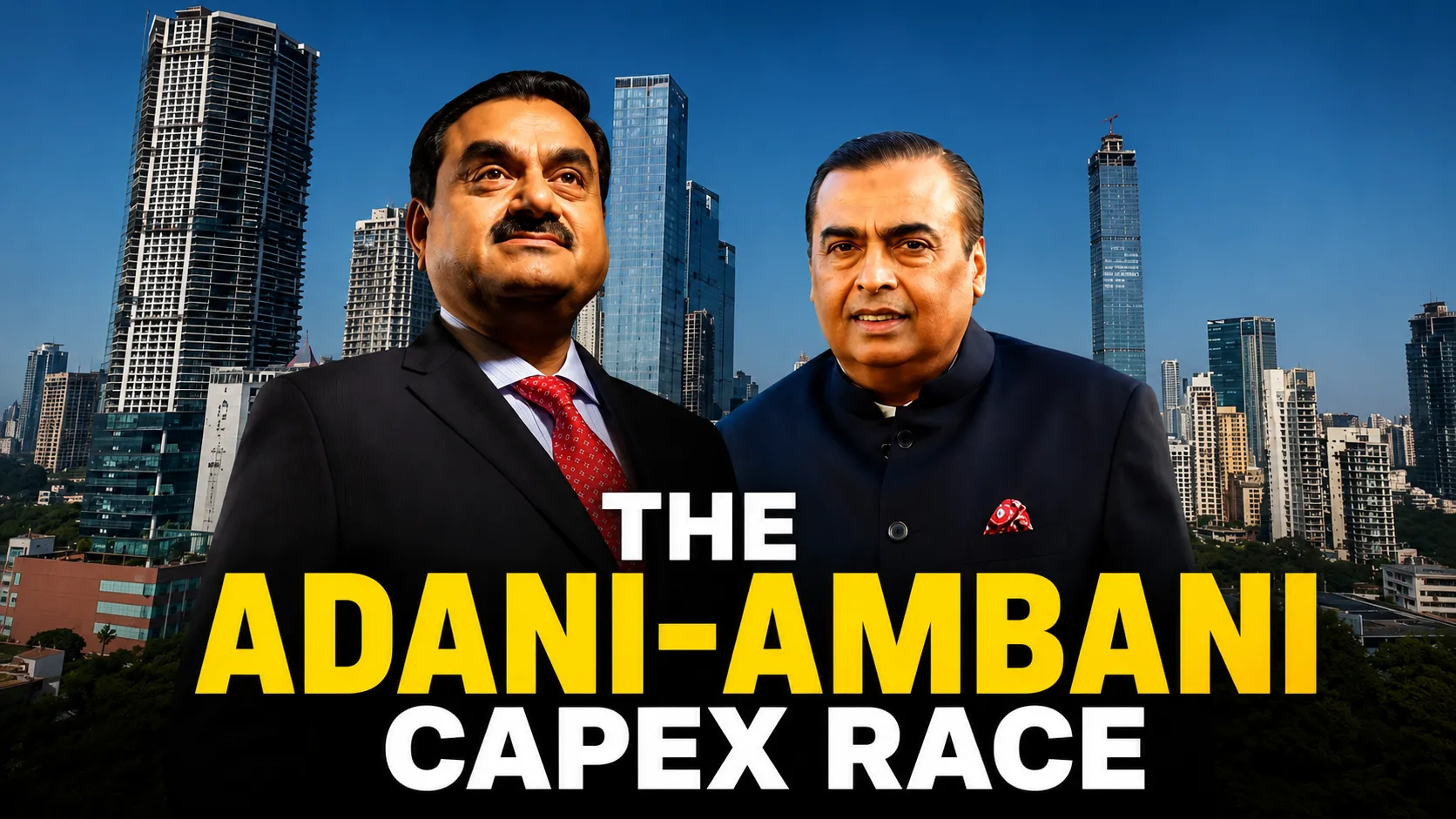
Gautam Adani, the Ahmedabad-born founder and chairman of the Adani Group, has reclaimed the title of Asia's richest person, according to the latest wealth tracking data reported by Forbes. His net worth has climbed to an estimated $89.2 billion, propelling him past both Reliance Industries chairman Mukesh Ambani and SoftBank's Masayoshi Son to sit atop the continent's wealth rankings once again. For a business empire that just three years ago was fighting to convince global investors it was not built on inflated numbers, the milestone marks one of the most dramatic corporate comeback stories to emerge from India in this decade.
The scale of the turnaround is difficult to overstate. Adani Group's listed companies — spanning ports, airports, power generation and transmission, city gas distribution, renewable energy, cement, and media — have delivered gains ranging between 23 percent and 56 percent through 2026 alone. That kind of synchronized rally across an entire conglomerate's stable of stocks is rare even in bull markets, and it reflects a level of investor conviction that would have seemed almost unthinkable in the immediate aftermath of the crisis that engulfed the group in early 2023. To understand the significance of this moment, it helps to rewind to January 2023, when the US-based short-seller Hindenburg Research published an explosive report accusing Adani and his companies of stock manipulation and accounting fraud on a scale it described in the most severe terms. The report triggered a rout across Adani Group shares, erasing tens of billions of dollars in market value within days and briefly knocking Gautam Adani out of the world's top ten richest individuals altogether. The Adani Group strenuously denied every allegation, calling the report a calculated attack timed to damage a follow-on public offering, but the damage to investor sentiment was immediate and severe. What followed was a prolonged rebuilding process. Indian regulators, including the Securities and Exchange Board of India, opened investigations into the claims. The matter eventually reached India's Supreme Court, which ruled in the Adani Group's favour, finding that the allegations levelled by Hindenburg had not been established on the evidence presented. That judicial vindication became the first pillar of the group's recovery, restoring a measure of institutional confidence even as questions lingered in some corners of the global investment community. The second and arguably more consequential pillar came only weeks ago, when the United States Department of Justice moved to dismiss fraud-related charges that had been brought against the Adani Group. Those charges centred on an alleged $250 million bribery scheme connected to solar energy supply contracts — allegations that had cast a long shadow over the conglomerate's standing with international lenders, insurers, and institutional investors, many of whom had grown cautious about doing business with the group while the matter remained unresolved in a US court. The dismissal removed what had become the single largest overhang on the stock, and the market responded almost instantly. By the time the dust settled, Adani's personal wealth had reportedly increased by close to $10 billion in the weeks following the DOJ's decision alone. That surge, layered on top of a broader 2026 rally driven by strong operational performance across the group's ports and energy businesses, was enough to vault Gautam Adani back past Mukesh Ambani, whose Reliance Industries has itself had a strong year but not one strong enough to keep pace with the Adani rally's velocity. It is worth placing this rivalry in context. Adani and Ambani have long been characterised, both in Indian financial media and by global observers, as the twin poles of Indian big business — two men whose empires, ambitions, and government relationships have shaped the country's industrial trajectory for a generation. Their positions atop the wealth rankings have swapped back and forth multiple times over the past several years, a seesaw that says as much about the volatility of concentrated, largely domestically-listed conglomerate wealth as it does about the underlying businesses themselves. What makes the current swing notable is less the fact of the change and more the specific catalyst behind it: a legal vindication in a foreign jurisdiction translating almost overnight into tens of billions of dollars of market capitalisation. Beneath the headline wealth figure lies a business empire that has grown considerably more diversified and more international since its founding in 1988 as a modest commodities trading firm. Today, the Adani Group controls Mundra Port, India's largest port by cargo volume, situated in Adani's home state of Gujarat. It is India's biggest private airport operator, running terminals that handle a significant share of the country's domestic and international air traffic. Its power generation and transmission arms span thermal, solar, and wind assets across multiple states, and its renewable energy division has positioned itself as a central player in India's stated ambition to dramatically expand its clean energy capacity by the end of this decade.
The group's international footprint has also expanded, not without controversy. Adani owns Abbot Point, a coal export terminal in Australia, and the associated Carmichael coal mine — a project that has drawn sustained opposition from environmental groups and become a lightning rod in debates over fossil fuel expansion even as global energy transition commitments intensify. More recently, the group has signalled ambitions in Vietnam, where it is reportedly keen to invest in infrastructure, energy, renewable power, and emerging technologies including artificial intelligence, part of a broader strategy to position Adani entities as infrastructure partners for fast-growing Southeast Asian economies. Domestically, the Adani Group has also been moving aggressively into the data centre business, tapping directly into the artificial intelligence infrastructure boom that is reshaping capital allocation decisions across the technology and industrial sectors worldwide. AdaniConnex, a joint venture between the Adani Group and a US-based data centre operator, has become one of the vehicles through which the conglomerate is positioning itself to capture demand from hyperscale computing customers in India, a market that industry analysts expect to expand rapidly as generative AI adoption accelerates across Indian enterprises and global technology firms alike. There is also a political dimension to the Adani story that observers of Indian business cannot easily set aside. Gautam Adani has long been characterised as an ally of Prime Minister Narendra Modi, and the group's investment plans have, at various points, intersected directly with the government's electoral and policy calendar. Reports indicate that some of the Adani Group's infrastructure investment plans are proceeding in the run-up to state elections later this year in Bihar, a state that accounts for one of the largest blocs of parliamentary seats in India and is considered pivotal to the fortunes of Modi's coalition government. Whether or not that timing is coincidental, it underscores how closely intertwined large-scale private infrastructure investment and electoral politics have become in contemporary India — a dynamic that both admirers and critics of the Adani Group point to when explaining its rapid growth trajectory. For the diaspora and for Indian business watchers globally, the Adani story carries significance well beyond one man's net worth. It is, in many ways, a live case study in how quickly reputational and regulatory risk can be priced in — and subsequently priced back out — of a conglomerate's market valuation. Institutional investors who exited Adani Group positions during the Hindenburg-triggered sell-off, and those who stayed the course betting on eventual vindication, have experienced starkly different outcomes. That divergence is likely to be studied by risk managers and India-focused fund managers for years to come as a template for how allegations, litigation, and eventual resolution interact with market sentiment in emerging-market conglomerates. Looking ahead, the central question for the Adani Group is whether this renewed wealth and market confidence can be sustained. The conglomerate's growth strategy remains heavily capital-intensive, spanning ports, airports, power, green hydrogen, cement, data centres, and now international infrastructure bets in markets like Vietnam. Each of those bets carries its own execution risk, regulatory complexity, and financing requirements. Credit rating agencies and global lenders will be watching closely to see whether the group's improved market standing translates into cheaper access to capital, which in turn would determine how aggressively it can pursue its next phase of expansion. For now, though, the numbers speak for themselves. Gautam Adani sits at $89.2 billion and the top of Asia's wealth rankings, a position that seemed almost fanciful for large parts of 2023 and 2024. His journey back to the summit — via a Supreme Court vindication, a dismissed US prosecution, and a synchronized rally across a sprawling industrial empire — will likely be remembered as one of the defining Indian business narratives of this decade, a reminder of how quickly fortunes can turn in an economy as dynamic, and as closely watched, as India's. The broader implications of Adani's resurgence extend well beyond the personal fortunes of one businessman. Adani Group companies collectively represent a meaningful share of India's infrastructure backbone, and the group's ability to raise capital on favourable terms has direct downstream effects on the pace at which the country can build out its ports, power grids, airports, and renewable energy capacity. When Adani Group stocks were under pressure during the 2023 crisis, credit rating agencies grew more cautious, borrowing costs rose, and several planned expansion projects were reportedly slowed or reassessed. The reversal of that dynamic in 2026 — with the group's market capitalisation rising and its access to global capital markets improving — carries implications for India's broader infrastructure investment cycle, not merely for Adani's personal net worth.