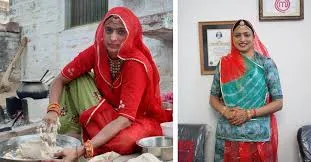
Chapter 1: Born into Simplicity, Raised in the Kitchen
Kaushalya Chaudhary was born on March 31, 1995, in Kuri village, near Bhopalgarh in Rajasthan's Jodhpur district. She grew up far from the world of venture capital and business schools. Her life was like that of most girls in rural India: school in the morning, chores in the evening.
Growing up in a humble farming family, Kaushalya's childhood was shaped by necessity. As the eldest of four siblings, she often found herself in the kitchen, especially when her mother was busy in the fields. Her mother worked on the farm while her father held a job, leaving Kaushalya to care for her siblings and handle household responsibilities after school. Cooking wasn't a choice—it was a necessity. But it slowly became a passion.
"When my mother came home tired, I would cook something for her. The joy on her face when she liked my food, that's when I started falling in love with cooking," she recalls.
Kaushalya once dreamed of becoming a doctor. She studied science in Class 12 and was full of hope. But life had other plans. Marriage came right after her board exams—she was married at 19. Her first thought was fear: the fear that she would be confined to the four walls of a home and never be able to build an identity of her own.
"I suddenly found myself doing farm work like my mother. That's when I asked myself: why did I study for 12 years if I was to end up here again?"
She felt boxed in. With few job opportunities in her village and social norms that didn't permit daughters-in-law to work outside, Kaushalya, the only daughter-in-law of their home, had no obvious path forward. Her grandmother and mother-in-law worried: if she went out to work, who would do the household chores? Who would take care of the guests?
But Kaushalya refused to accept that fate.
Chapter 2: The ₹7,500 Gamble
In 2017, Kaushalya Chaudhary did something that seemed insane to everyone around her. She decided to start a YouTube channel.
With the help of her savings and family support, she bought a smartphone for ₹7,000. She had no ring light, no fancy camera, no AI tools, and barely any internet. She set up a makeshift studio in her village kitchen, learned video editing through handwritten notes, and spent nights on the roof just to upload a single video.
At the time, her husband was unemployed, and they were raising a child. Managing household expenses while pursuing content creation required enormous effort and determination.
But she persisted. She set up a stand made of a cardboard box and aluminium wire to hold her phone. With a single kadai, a phone camera, and that makeshift stand, she began sharing her recipes.
"We had very limited internet access, it took around 5-6 hours to upload one video," Kaushalya says.
Initially, she shared her recipes in Hindi. But the videos failed to gain traction. She was unsure and thought about quitting.
Then her grandmother gave her a simple idea that changed everything: make videos in her own language—the language she speaks at home.
Kaushalya switched to Marwadi, a local Rajasthani dialect. The shift led to a surge in viewership. Her subscriber count crossed 1 lakh within a month.
"It felt really nice to see people supporting my language and food on such a big platform," she says.
Authenticity found its audience. Her videos felt like watching a family member cook in their kitchen. They were simple, honest, and deeply rooted in tradition. Today, her YouTube channel Sidhi Marwadi Kitchen has over 1.6 million subscribers. Some of her most viewed recipes include popular Rajasthani dishes like gatte ki sabzi, dal baati, churma, and bharwa mirch.
Chapter 3: MasterChef India and the Turning Point
In 2023, Kaushalya received a call that would change her life: an invitation to audition for MasterChef India.
She was initially sceptical. But she auditioned in Jodhpur and was later shortlisted for the Delhi round. Eventually, she made it to the top 12 contestants.
"I used to watch the show and get recipe inspiration. Being part of it pushed me to do better," she says. "Being selected gave me more motivation to fulfil my dream."
On MasterChef, Kaushalya faced a choice. She could try to make international cuisine—the safe, expected path. Instead, she chose to represent her roots.
"Why aren't we representing our roots on a national platform? The food our ancestors embraced and passed down to us was well-researched. There's a reason why our cuisine has lasted generations. So when I got the opportunity to present it to the world, I thought—why not?"
"It also gave me a chance to send a message that you don't have to fit into a mould. You can represent your individuality on a global platform," she said.
But the most important lesson came from interacting with contestants and judges. She noticed how many people longed for authentic, home-style flavours—something increasingly difficult to find in packaged food.
"Spices and oils are the main ingredients of any food item, hence I decided to start a business of these two items," she says.
Chapter 4: The Birth of Sidhi Marwadi
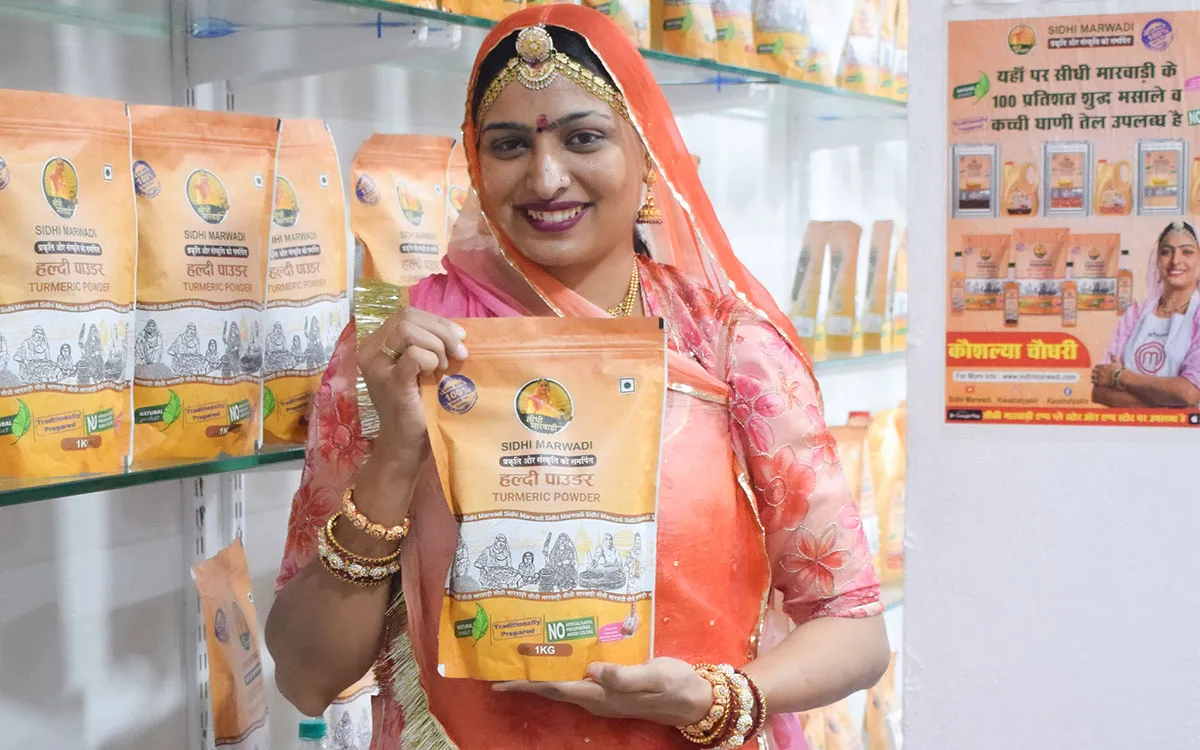
On March 8, 2024—International Women's Day—Kaushalya Chaudhary launched her brand, Sidhi Marwadi, named after her YouTube channel.
The premise was simple but powerful: sell only things that are good enough for your own family to eat. No preservatives. No additives. Just authentic local flavours and nutrition, made the traditional way.
She started small—selling three types of masalas, four varieties of oil, and 15 other kitchen essentials. A small factory was established right in her village, where raw materials were procured directly from farmers. The spices were ground using a 'ghatti' (a traditional grinding stone). The oils were prepared using the 'ghani' method—the traditional cold-press technique that preserves the natural properties of seeds.
"Our products are 100% pure and pose no harm to human health. There are no additives—just authentic local flavours and nutrition," Kaushalya asserts.
She personally oversees the spice-grinding process to ensure that purity remains uncompromised.
The response was immediate and overwhelming. Early product batches sold out within days of launch. Word spread on its own.
Chapter 5: The Women-Centric Revolution
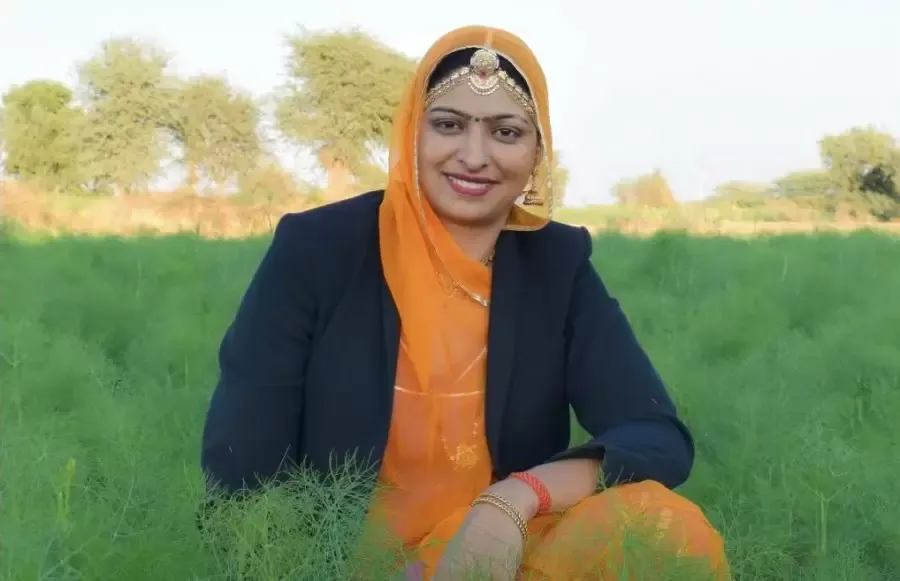
Today, Sidhi Marwadi has 50 outlets spanning from Jaipur to various other major cities and towns across Rajasthan, Gujarat, Maharashtra, and other states. Notably, 30 of these outlets are managed by women. More than 35 rural women are actively associated with the brand's operations—from food preparation to packaging.
The business generates a turnover running into crores of rupees.
"Kaushalya has not only carved a niche for herself as a successful entrepreneur but has also emerged as a symbol of self-reliance for women," ETV Bharat noted.
But the social impact goes beyond employment. Kaushalya explained that Sidhi Marwadi provides a robust market platform for local farmers. The brand directly sources raw materials from farmers, ensuring they get fair prices for their produce.
And she's not stopping there. She is planning to launch an app that will connect rural women to the online marketplace and help establish their identity on an international stage.
Chapter 6: Going Global
The brand has already made significant strides beyond domestic markets. It has been receiving enquiries from several countries regarding the procurement of its spices and oils.
"We are currently focusing on scaling up our production capacity. We intend to enter the international market soon, thereby allowing the authentic taste of Marwar to reach every corner of the globe," she stated.
The company aims to establish 100 outlets through a franchise-led model, cementing its presence in the fast-growing clean-food sector.
Chapter 7: The Lessons
Kaushalya Chaudhary's journey offers powerful lessons for anyone who dreams of building something from nothing.
First: Authenticity is your greatest asset. When Kaushalya switched from Hindi to Marwadi, her channel exploded. People don't just want content—they want truth.
Second: Start with what you have. She didn't wait for investors or fancy equipment. She started with a ₹7,500 phone, a cardboard box stand, and a dream.
Third: Traditional knowledge is valuable. In a world obsessed with the new, Kaushalya proved that the old ways—stone grinding, cold-pressed oils, traditional recipes—have immense market value.
Fourth: Build for impact, not just profit. Kaushalya's business isn't just about making money. It's about empowering women, supporting farmers, and preserving culinary traditions.
The Final Verdict: A ₹7,500 Phone, a Crore-Rupee Empire
June 2026 finds Kaushalya Chaudhary at the helm of a growing empire. From a village kitchen in Kuri to 50 outlets across India. From a ₹7,500 phone to a turnover running into crores. From a homemaker confined to four walls to a global entrepreneur empowering 35+ rural women.
"Kaushalya's journey reflects the daily struggles rural women face. What makes her story unique is her unwavering will to persevere and her resilience to fight the odds and make a name for herself," SheThePeople noted.
When Kaushalya was married at 19, she feared she would never build an identity of her own. Today, she has not just built an identity—she has built an empire, a movement, and a legacy.
And she's just getting started.
"Our products are 100% pure and pose no harm to human health. There are no additives—just authentic local flavours and nutrition." – Kaushalya Chaudhary
"You don't have to fit into a mould. You can represent your individuality on a global platform." – Kaushalya Chaudhary
"Kaushalya has not only carved a niche for herself as a successful entrepreneur but has also emerged as a symbol of self-reliance for women." – ETV Bharat


