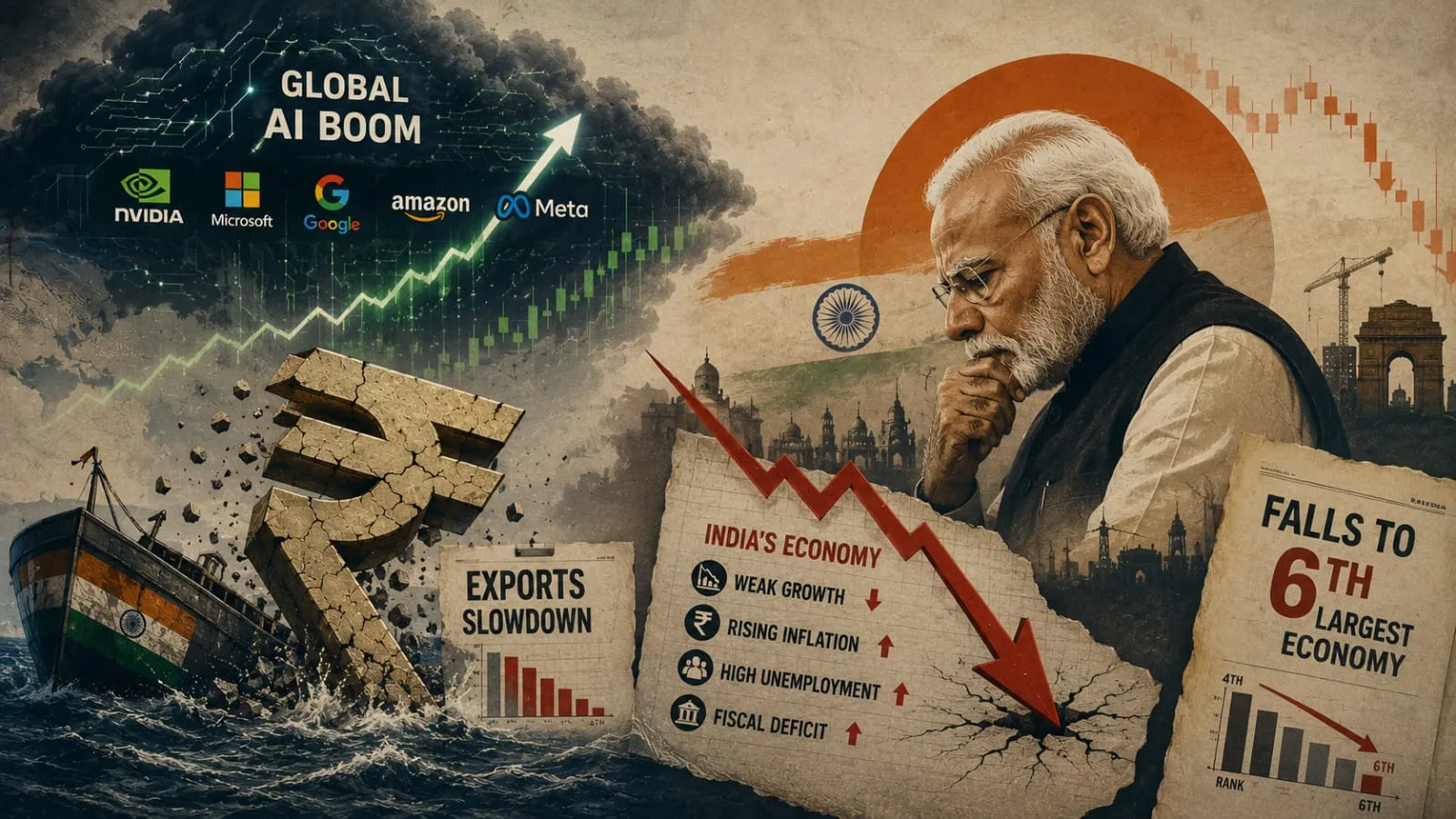
A Tale of Two Headlines
When the Indian government shares its economic vision, the narrative is polished and grounded in unmistakable momentum. The updates point to a nation modernizing at a breakneck pace—powered by a concrete infrastructure push, thriving local shopping districts, and real growth rates that consistently outpace its major global peers. Policymakers point to sprawling highway systems, new rapid transit networks, and an entrepreneurial energy that pulses through metropolitan centers like Mumbai and Delhi. To the casual observer, the country looks like an unstoppable locomotive, charging toward its self-proclaimed destiny as a modern, digitized global superpower.
Yet, step inside any international trading hub, and a sharply contrasting reality emerges. Beneath the upbeat domestic headlines, the Indian Rupee has weathered a painful structural slide, breaking past the significant psychological threshold of ₹96 against the US dollar. The red charts on currency trading screens present an urgent counter-narrative to the celebratory growth forecasts broadcast at home.
This downward pressure isn't just standard market volatility or a temporary speculative glitch. It exposes a massive global shift: while Western and East Asian economies ride a historic, multi-trillion-dollar Artificial Intelligence (AI) and semiconductor supercycle, a noticeable chunk of foreign capital is choosing to look elsewhere. The global financial architecture is being redrawn, threatening to leave India's traditional labor-heavy, back-office service models searching for a new identity. The resulting capital movement highlights a widening gap between paper growth projections and the ground realities of international investor sentiment.
The AI Capital Drain: Why the Global Tech Boom Impacts the Rupee
For two decades, India’s economic blueprint relied on a highly dependable, globally celebrated formula: serving as the world's premier back-office. By providing an incredible, near-limitless supply of cost-effective, English-speaking engineering and IT talent, the country became an irreplaceable anchor for software maintenance, database management, customer care, and business process outsourcing. Entire generations of middle-class families built their prosperity on this services foundation.
However, the rapid maturity and deployment of generative AI has disrupted this exact paradigm. Global tech giants, venture capital funds, and institutional asset managers are aggressively shifting their priorities. They are no longer simply looking for low-cost human operations to handle software maintenance or customer triage. Instead, they are funneling hundreds of billions of dollars toward high-density data centers, advanced AI infrastructure, and semiconductor fabrication hubs.
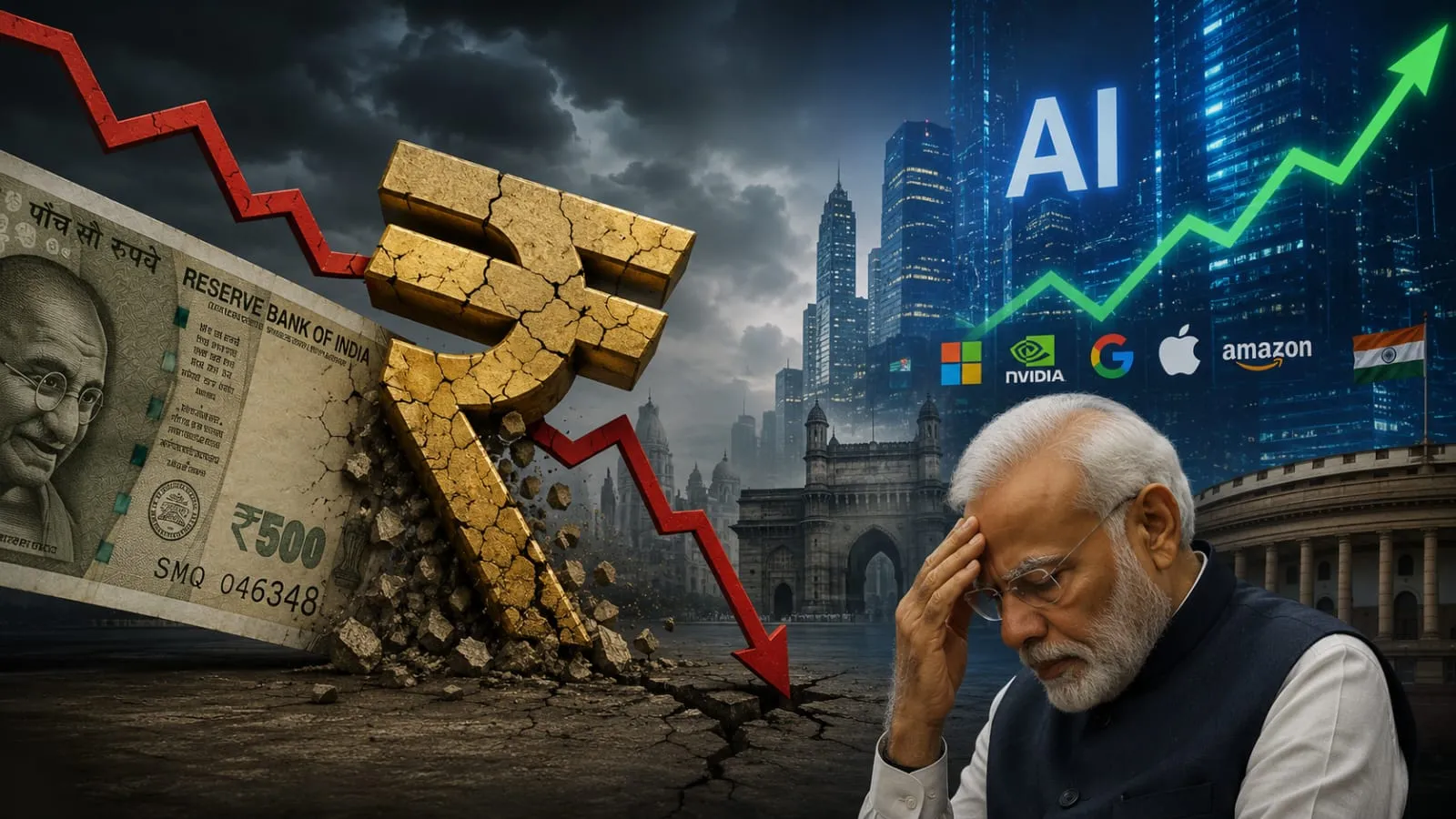
This sudden shift in global attention has triggered a massive capital reallocation that directly impacts the local currency:
* The Equity Flight: Hardware-centric tech markets like Taiwan and South Korea—the physical engines actually building and powering the global AI boom—have witnessed historic surges in foreign institutional investment. Conversely, global portfolio investors have aggressively pared back their exposure to Indian equities. Foreign Portfolio Investors (FPIs) pulled out over ₹2.2 lakh crore from the Indian equity market in the first five months of 2026 alone. This relentless capital flight represents an immense rotation of funds away from markets seen as lagging in the high-stakes global AI space.
* The Currency Pressure: The mechanism of this equity flight translates directly into a weakened currency ecosystem. As foreign institutional investors sell off their Indian stocks, they liquidate their rupee-denominated assets and convert them back into US dollars to deploy them into safer developed assets or global AI tech hubs. This constant, high-volume conversion creates heavy, systemic selling pressure on the rupee. Stripped of the foreign capital that once balanced the nation's financial books, the rupee has been left highly vulnerable to international market shocks.
The Perfect Storm: Rising Energy Costs and Bottlenecks
The structural challenge of the global AI capital drain has collided head-on with a familiar, deeply entrenched macroeconomic vulnerability: energy dependence. India remains highly sensitive to international energy shocks, relying on imports for nearly 89% to 90% of its crude oil requirements.
With global oil prices surging past the $100-per-barrel threshold due to ongoing geopolitical conflicts and instability in West Asia, the national import bill has expanded drastically. Inelastic imports like crude oil require a massive, continuous outflow of US dollars. Every dollar tick upward in oil prices adds billions to the annual import bill, rapidly widening the nation's current account deficit and placing heavy downward pressure directly on the local currency. This is exacerbated by a record gold import bill, which has almost doubled over the last few years to a staggering $71.98 billion, accounting for nearly 9% of India's total import bill and creating a secondary forex flashpoint.
At the same time, domestic structural hurdles make it incredibly difficult for the country to pivot quickly and catch alternative economic trends, such as the widely discussed "China Plus One" manufacturing strategy. Despite aggressive industrial incentives, high-profile corporate marketing campaigns, and government production-linked incentive programs, international businesses looking to set up manufacturing plants frequently run into a wall of localized friction.
Corporate executives point out that complex regulatory compliance, local infrastructure bottlenecks, land acquisition delays, and administrative red tape can still make setting up physical factories slower and more tedious than it needs to be. While a digital tech start-up can launch in days, building a heavy industrial factory requires navigating overlapping bureaucratic jurisdictions. As a result, agile competitors in Southeast Asia are capturing manufacturing shifts at a faster rate, leaving India unable to fully offset its IT service vulnerabilities with immediate physical export revenues.
The Human Impact: Managing a K-Shaped Reality
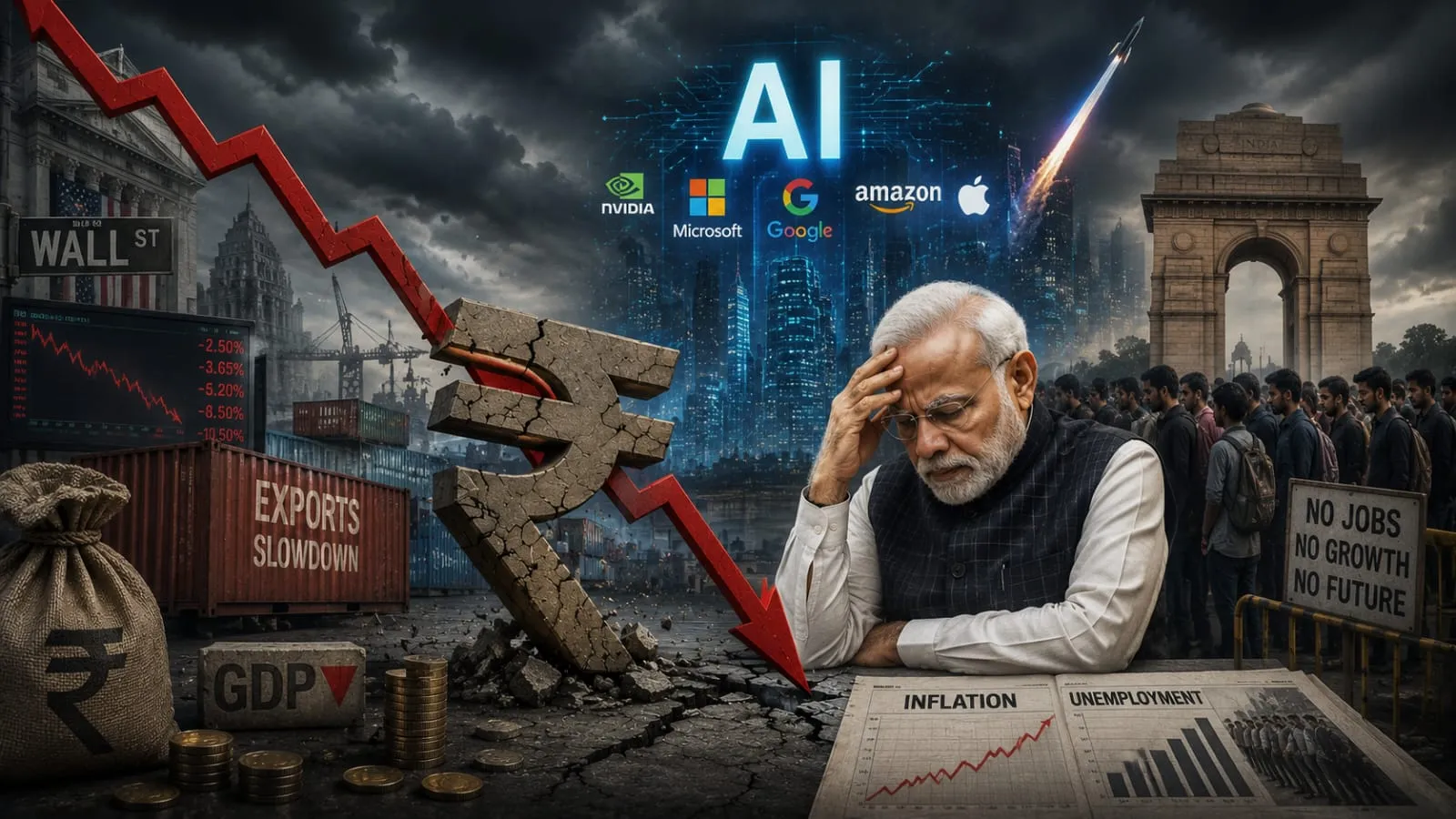
Inside the country, this mix of a slipping currency, institutional capital flight, and rising energy costs has created a noticeable, often painful disconnect on the ground. A weaker rupee means essential imports—ranging from crude oil and chemical fertilizers to essential electronics and tech components—instantly become more expensive in local terms. These realities pass straight through to the consumer, stoking localized inflation that directly squeezes the everyday household budget. From the cost of a commute to the price of basic groceries, ordinary citizens are feeling the immediate pinch of global financial shifts.
The result is a highly visible, K-shaped economic divide that challenges the unified narrative of national progress. The urban affluent segment, holding real estate assets, corporate equity, and global investments, sees its wealth steadily climb, insulated by high-earning sectors. On the flip side, rural families, agricultural laborers, and daily-wage workers find that their everyday earnings simply buy less at the local market, making it harder to keep pace with the rising cost of living.
In response to these shifting winds and depleting foreign exchange reserves, Prime Minister Modi has actively encouraged a sense of economic mindfulness and structural discipline. The government has leaned on tactical trade adjustments and public appeals aimed at curbing non-essential dollar outflows—such as high luxury gold consumption and discretionary overseas spending—to help protect the nation's capital balance during external shocks.
Adapting to the Tech Era
Despite the current currency pressure and persistent capital outflows, the country is far from defenseless. India maintains a substantial cushion of roughly $681 billion in foreign exchange reserves, controlled tightly by the central bank. While these reserves have faced a sharp, multi-billion-dollar drop due to active currency market interventions to stabilize the rupee, they still give the Reserve Bank of India plenty of defensive firepower to prevent any erratic, chaotic collapse of the exchange rate.
However, defensive currency market intervention is a temporary shield, not a permanent cure. The ultimate lesson of this economic cycle is clear: a vast labor pool and a strong legacy IT service sector are no longer a guaranteed ticket to the top in a global economy increasingly defined by automation, hardware dominance, and high-end computing.
To reverse capital trends and foster long-term stability, India's economic strategy has to aggressively evolve. This means cutting through bureaucratic red tape to speed up industrial manufacturing, resolving structural issues within the domestic energy grid to support clean power, expanding computing infrastructure to build indigenous AI capabilities, and re-skilling the workforce for an era ruled by chips and algorithms.
The rupee’s slide isn’t a sign of permanent defeat—it is a timely structural wake-up call. It proves that genuine economic resilience is built not by leaning on the service successes of yesterday, but by adapting entirely to the high-tech realities of tomorrow.