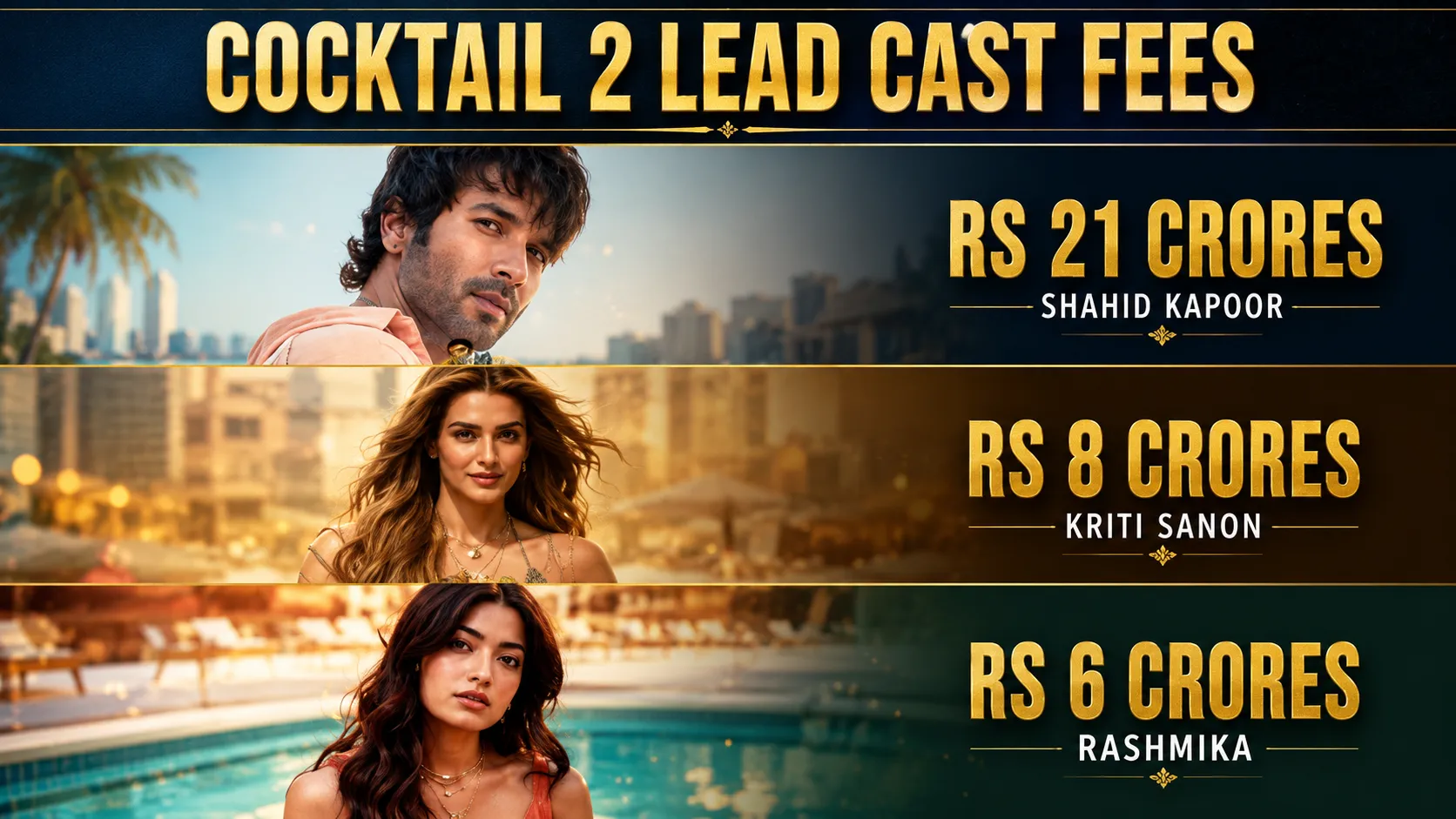
The three leads charged ₹35 crore combined, with Shahid Kapoor's ₹21 crore alone exceeding what Kriti Sanon and Rashmika Mandanna earned together.
The numbers landed like a bombshell, and the timing — just days before the film's theatrical release — could not have been more awkward.
Shahid Kapoor, Kriti Sanon, and Rashmika Mandanna are splitting ₹35 crore for Cocktail 2. But the money is nowhere near equal. Shahid takes home ₹21 crore — a figure that, on its own, exceeds the ₹14 crore that Kriti (₹8 crore) and Rashmika (₹6 crore) earn combined. Just Shahid's fee beats the combined earnings of both actresses.
The disparity is stark. It is also, by Bollywood standards, entirely normal. And that is precisely the problem.
The Numbers That Shocked the Industry
According to Bollywood Hungama's exclusive report, the three leads collectively charged ₹35 crore for Cocktail 2. The highest paid was Shahid Kapoor at ₹21 crore, followed by Kriti Sanon at ₹8 crore and Rashmika Mandanna at ₹6 crore.
For Shahid, ₹21 crore is his biggest theatrical paycheque to date. Theatre is riskier than streaming, and producers are betting his name pulls in massive crowds. For Kriti, ₹8 crore is also her career-best for a theatrical release. After Mimi, Bhediya, and Teri Baaton Mein Aisa Uljha Jiya, her value kept climbing — but she is still earning less than half the male lead.
Rashmika's ₹6 crore reflects a different equation. She is already a pan‑India sensation, thanks to Pushpa, Animal, and Chhaava. She has a massive fan following across the South and the Hindi belt. Yet her Bollywood payday is lower — a reminder that the industry still treats South actresses differently, especially in Hindi originals.
The full budget for Cocktail 2 stands at ₹150 crore. Actors got ₹35 crore; ₹20 crore went to print and publicity; and the rest, ₹95 crore, covered production. Around 63% of the budget actually goes into making the movie. Star salaries are less than 25% of the spend — healthier than most major Bollywood releases.

The Ironic Twist
Here is where the story gets uncomfortable.
Shahid Kapoor's last undisputed theatrical blockbuster was Kabir Singh in 2019. His subsequent outings — Jersey, Bloody Daddy, Deva — failed to make a significant impact at the box office. Teri Baaton Mein Aisa Uljha Jiya (2024), opposite Kriti Sanon, was a moderate success, but nothing close to the ₹300‑400 crore club.
Kriti Sanon, by contrast, has maintained a far stronger commercial track record in recent years with films such as Crew and Teri Baaton Mein Aisa Uljha Jiya, while her Tere Ishk Mein generated considerable industry buzz.
Rashmika Mandanna, meanwhile, has emerged as one of the most bankable female stars in the country, having been part of mega‑blockbusters such as Animal, Pushpa 2: The Rule, and Chhaava.
The trade source put it bluntly: "Both these actresses have headlined or featured in films whose box‑office collections far exceed those of Shahid Kapoor's recent releases. Yet, such is the skewed economics of Bollywood that male stars continue to command significantly higher fees, often irrespective of their recent theatrical performance".
The Debate That Refuses to Die
The pay disparity once again brings the industry's long‑running pay‑parity debate into sharp focus.
Female actors have repeatedly argued that remuneration should be linked more closely to current box‑office pull and audience appeal rather than entrenched star hierarchies. Yet, as the Cocktail 2 pay structure suggests, Bollywood's compensation model continues to favour male stars even when the numbers tell a different story.
Kriti Sanon herself has been vocal about this issue. In a recent interview, she highlighted the ongoing struggle for pay parity, noting that female leads are often the first to face salary cuts when production budgets are tightened, even as male stars command the lion's share of the finances. "Patriarchy is still deeply ingrained in the industry," she said.
She pointed out that producers often negotiate down female actors' fees while cutting corners. The pattern is consistent: a male star's fee is treated as non‑negotiable; a female star's fee is treated as an expense to be minimized.
Why the Gap Persists
Producers offer a simple defense: male leads drive opening weekend collections. Female leads, they claim, do not.
The data increasingly contradicts this. Films led by women — Crew, Queen, Mimi, Gangubai Kathiawadi — have performed strongly in recent years. Yet the industry's logic is slow to change.
The argument is also circular. Female stars are paid less because they are perceived as less bankable. They are perceived as less bankable because they are given fewer big‑budget films with strong theatrical releases. They are given fewer such films because producers are reluctant to bet big on female leads. The cycle reinforces itself.
There is also the matter of star entourages. For big films, actors' entourages now eat up 10‑12% of production budgets. Male stars, with their larger teams and higher lifestyle expectations, drive up costs — but the producers pay anyway, because they are seen as essential to the film's commercial viability.
Shahid's Perspective
To be fair, Shahid Kapoor's fee of ₹21 crore for a theatrical release is not exorbitant by Bollywood standards. Stars like Salman Khan, Aamir Khan, and Shah Rukh Khan routinely command ₹50‑100 crore per film. Shahid is not in that league. ₹21 crore reflects his seniority and market value within the Cocktail 2 trio.
Shahid has also drawn bigger paycheques for streaming projects. He reportedly earned more for Farzi, Bloody Daddy, and Farzi 2 on OTT. Streaming pays top dollar because there is zero box‑office risk. Theatrical hits matter more for an actor's legacy — and ₹21 crore for a theatrical release is a sign that he still has the pull to bring people to the theatre.
But the fee differences — ₹21 crore, ₹8 crore, ₹6 crore — still look harsh. And the irony that the actresses have delivered stronger box‑office numbers in recent years only sharpens the contrast.
The Film Itself
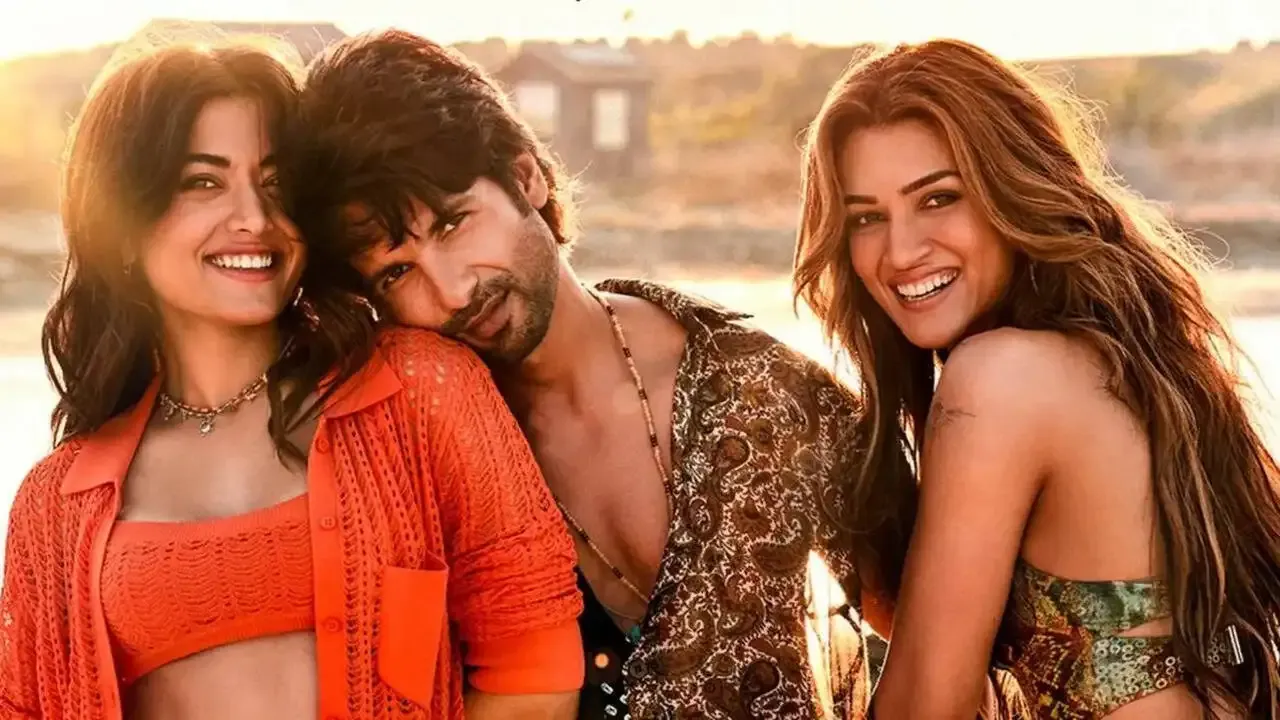
Cocktail 2 is not a sequel to the 2012 original. Kriti Sanon clarified during the Times Now Summit 2026 that it is a franchise — "a vibe" rather than a continuation.
"There are two girls and one boy. The language and vibe are in a similar zone, similar world, but a very different story and very different characters," she explained. "There's absolutely no relation to Cocktail otherwise, except that it has a mix, a cocktail of emotions, friendship, drama, music, and amazing locations".
Directed by Homi Adajania and produced by Dinesh Vijan under Maddock Films, the film has been shot over 70 days across real locations, with large chunks filmed in Europe. The scale is lavish — among the most expensive rom‑coms in Hindi cinema. Insiders say Maddock's strong brand image has already recovered about 50% of the budget through pre‑sales alone.
The trailer and songs — Jab Talak, Mashooqa, Tujhko — have already become the talk of the town. The film releases in theatres on June 19, 2026.
The Bottom Line
Cocktail 2 is a test case. If the film succeeds, the actresses' quotes will rise. If it fails, the gap will be blamed on everything except the pay disparity. Either way, the conversation is no longer being ignored.
The industry is changing — slowly. Producers are beginning to recognise that female stars can drive box‑office collections. Streaming platforms have already proven that content, not gender, determines viewership. Theatrical releases are following suit, but the pace is glacial.
For now, the numbers speak for themselves: ₹21 crore for Shahid Kapoor. ₹8 crore for Kriti Sanon. ₹6 crore for Rashmika Mandanna. The disparity is indefensible. And it is finally being called out.