Protecting intellectual property has historically been one of the most labor-intensive and expensive bottlenecks in the corporate world. For an enterprise or research institution looking to launch a new product, proving an invention's novelty requires legal teams to manually comb through hundreds of thousands of dense, confusing technical documents. This tedious process frequently delays time-to-market schedules, jacks up legal expenses, and can result in critical oversights that expose a company to costly patent infringement lawsuits.
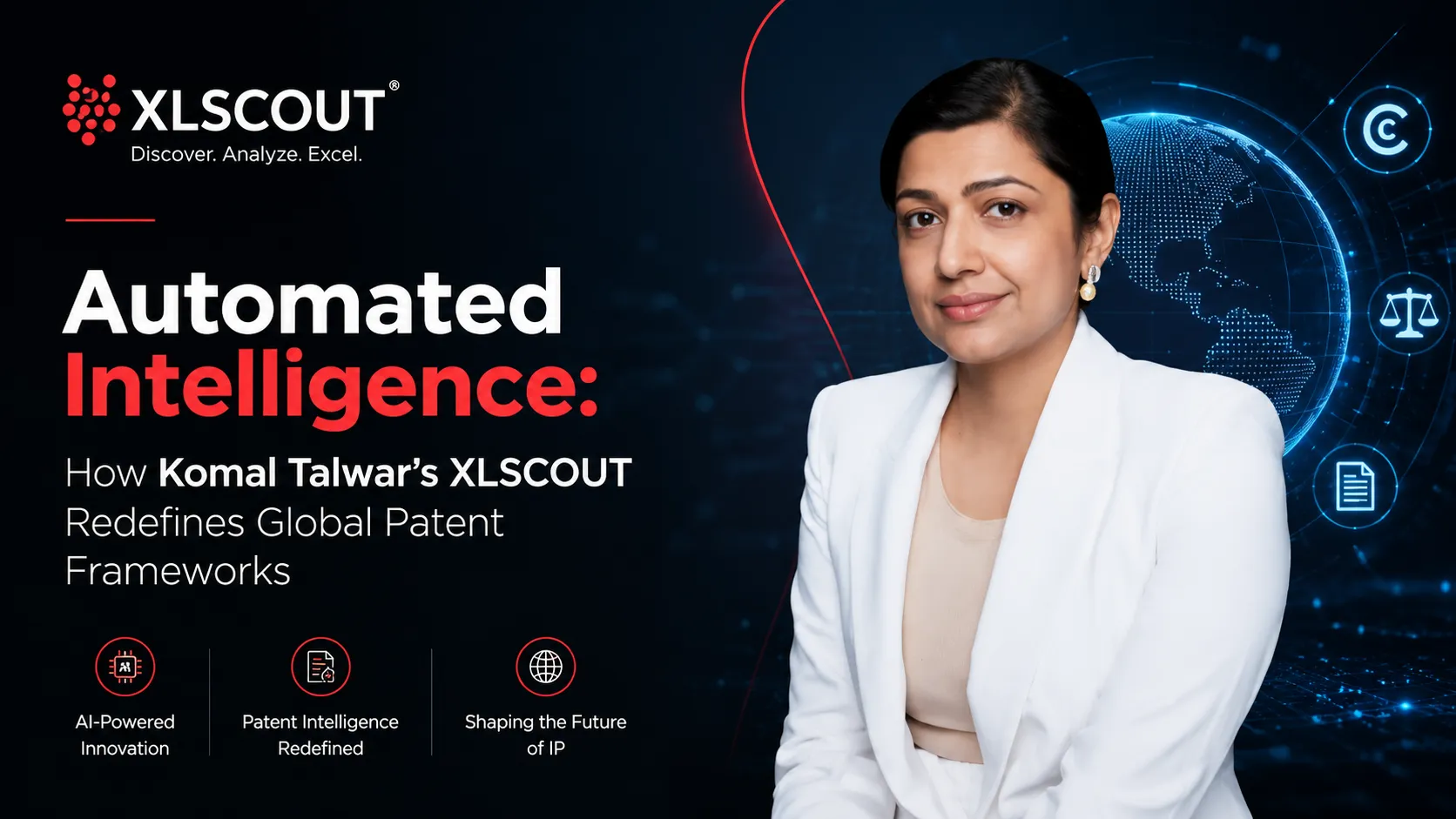
To eliminate this operational friction, tech entrepreneur and IP strategist Komal Sharma Talwar co-founded XLSCOUT, an SOC 2 Type II certified, AI-powered patent intelligence platform. Built through collaborative research with prestigious universities in the United Kingdom and Canada, the platform infuses Generative AI and customized Large Language Models (LLMs) into the core workflows of patent management.
By replacing slow, manual searches with instantaneous, context-aware machine learning, the enterprise platform is fundamentally shifting how global entities validate, draft, track, and monetize their technological inventions.
Processing Global Knowledge at Scale
The true engine behind XLSCOUT is its massive data architecture. Rather than operating in localized data silos, the platform aggregates a comprehensive international technology index to give users a true 360-degree view of the global innovation landscape.
Platform Data Matrix:
Global Patent Vault: Over 170 million comprehensive patent records sourced across 100-plus countries.
Jurisdictional Reach: Full analytical integration spanning more than 106 legal jurisdictions worldwide.
Non-Patent Literature: Over 220 million bibliographic entries, scientific journals, and technical whitepapers to guarantee absolute novelty checking.
For deep-tech developers and IP lawyers, having this volume of data mapped into a singular semantic neural network changes everything. Instead of searching via rigid keywords that often miss hidden conceptual overlaps, researchers can simply type out a natural language summary of their invention. XLSCOUT's specialized embedding models—such as ParaEmbed, which the company open-sourced on Hugging Face—instantly decode the technical intent, cross-referencing millions of documents within seconds to identify potential legal hurdles or engineering conflicts.
Driving Massive Efficiency Across the R&D Lifecycle
The commercial impact of introducing generative AI into the legal tech space is measurable and immediate. Traditional prior-art validation and drafting procedures that once dragged on for weeks are now compressed into hours.
The platform's connected LLM suites provide specialized modules for every phase of the corporate innovation lifestyle:
Ideacue 10X: Accelerates the early brainstorming phase, helping corporate engineering teams evaluate the technical strength and patentability of their ideas before dedicating capital to development.
Novelty Checker & Invalidator LLM: Conducts rapid automated screening to evaluate the unique standing of a new application, or conversely, helps legal teams identify prior art to challenge an competitor's overly broad patent claims.
Drafting LLM: Automates early-stage patent application writing by up to 50%, using an intelligent conversational chatbot that adapts seamlessly to the specific stylistic writing preferences of individual law firms.
ClaimChart LLM: Transforms infringement discovery by systematically mapping product overlap features directly against complex patent claims, transforming neglected corporate assets into active licensing revenue.

Shifting Global Dynamics and Corporate Security
This AI-driven transition arrives at a crucial moments for global manufacturing hubs. For instance, in mature economies like Japan—where the national share of global patent applications has seen steady declines over the past two decades—corporate leaders are aggressively looking for tools to reignite innovation speeds. This explains why Japanese enterprises now constitute more than half of XLSCOUT’s active global customer base, which includes over 200 world-class multinational companies.
Because patent research demands absolute confidentiality prior to filing, Komal Talwar has anchored the platform around rigorous digital security protocols. Achieving an SOC 2 Type II certification ensures that proprietary corporate ideas are fully insulated inside dedicated, secure sandboxes. With continuous penetration testing, comprehensive background screenings, and mandatory non-disclosure agreements across all engineering operations, the platform delivers enterprise-grade protection alongside its rapid analytical processing.
By transforming patent repositories from dormant legal archives into active, searchable blueprints for future technology, XLSCOUT ensures that organizations can navigate the fast-moving global landscape with agility. Under Komal Talwar's leadership, the platform is proving that AI is not just an optimization tool for the intellectual property sector—it is the foundational engine that will power the next generation of global technological breakthroughs.


