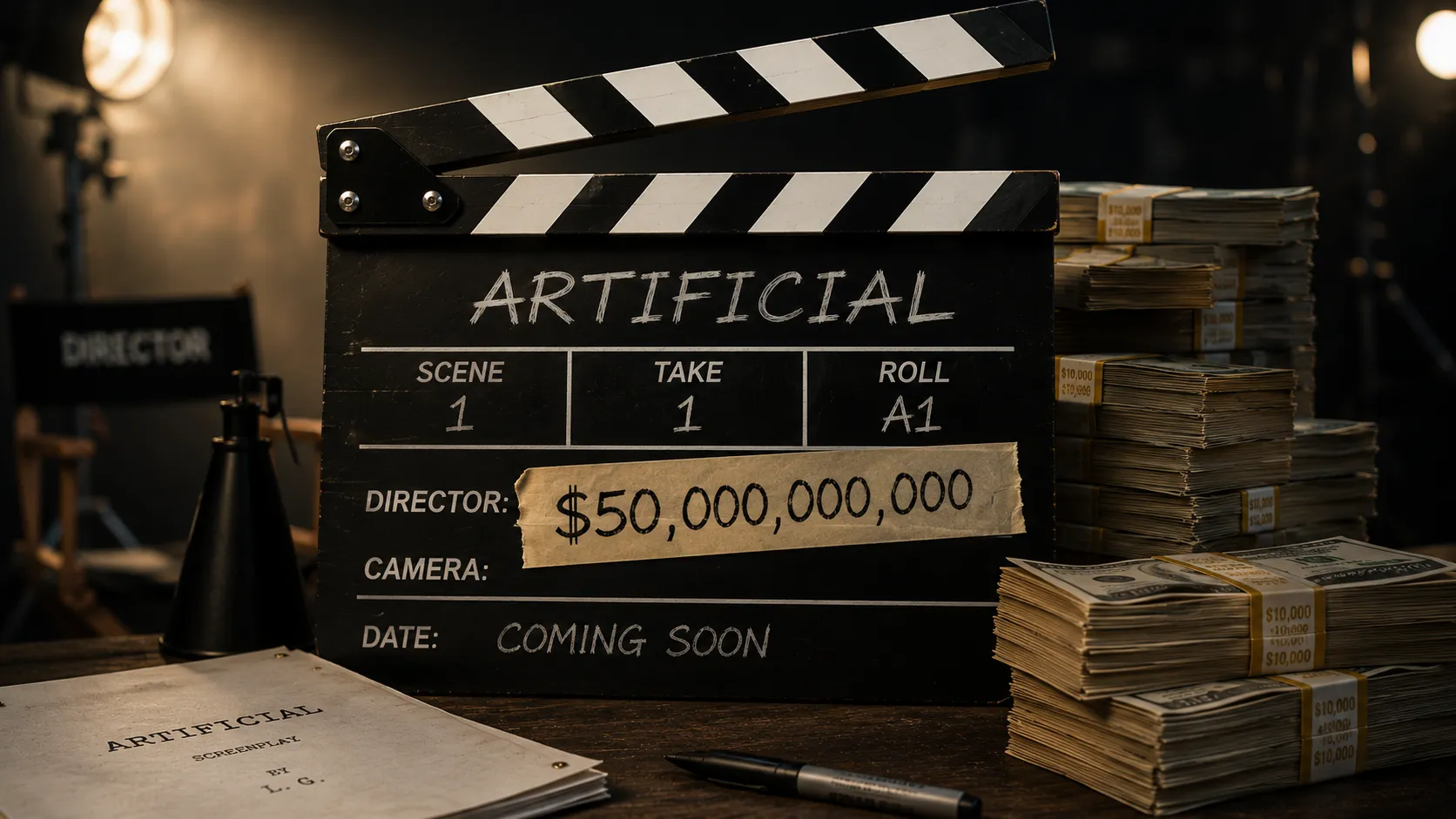
Amazon spent a year developing a $40 million biopic about Sam Altman, starring Andrew Garfield. Then it invested $50 billion in his company. Now it no longer wants to release the film. Test screenings were positive. The script was known from the start. The only thing that changed was the money.
The story of "Artificial" is not about a bad movie. By all accounts, it is quite good. The nearly completed $40 million biopic, directed by Oscar-nominated Luca Guadagnino (Challengers, Call Me By Your Name) and starring Andrew Garfield as OpenAI CEO Sam Altman, had tested very positively with audiences. It was circling an awards-qualifying run over Christmas before a wider release in early 2027. It assembled a cast deep enough to make any studio executive salivate: Monica Barbaro as former OpenAI CTO Mira Murati, Yura Borisov as co-founder Ilya Sutskever, Ike Barinholtz as Elon Musk, alongside Mark Rylance, Jason Schwartzman, and Billie Lourd.
The film works. That may be the real difficulty.
Because "Artificial" dramatizes the week in November 2023 when OpenAI's board fired Altman and then reinstated him days later. Described as a Social Network for the AI age, the film reportedly portrays Altman and Elon Musk as its least sympathetic figures — the characters audiences are meant to dislike. One computer scientist in the script describes Altman as "one of the most manipulative people on the planet". The hero of Simon Rich's script is Ilya Sutskever, the co-founder who led the movement to oust Altman.
That is a difficult film to release once you have become one of OpenAI's largest financial backers.
The $88 Billion Question
Amazon knew exactly what it was commissioning. The studio greenlit the film last year, fast-tracked it, and had reviewed every iteration of Rich's script before Guadagnino joined the project. Amazon had seen all the early iterations of the script. The studio put some $40 million behind a story it understood from the start.
Then came February 2026. Amazon committed to investing an eye-popping $50 billion in OpenAI as part of a "multi-year strategic partnership" that would vastly expand OpenAI's use of Amazon Web Services and develop custom AI models for Amazon. The deal followed an earlier $38 billion cloud computing contract between the two firms signed just last year.
Suddenly, a $40 million film became an $88 billion problem.
"It is not hard to see what is really being protected," the Times of India observed. A studio that just put $50 billion into OpenAI walking away from a nearly finished $40 million film is not a creative decision. It is a commercial one. Amazon's official explanation makes no mention of the partnership. The statement reads less like a withdrawal than a tribute: "We have the utmost respect and admiration for Luca Guadagnino as an award-winning filmmaker," a spokesperson said. "We believe that 'Artificial' will be better served if it were released by a different studio".
The Politics of Power
The timing and context make the decision even more revealing. Prime Video and Amazon MGM Studios chief Mike Hopkins reportedly pulled the plug after viewing a cut of the film. The filmmakers were told on Tuesday, June 16, according to two people close to the film. Amazon had already tested the movie in four markets, and the team was working on determining a release date.
The film had been in post-production. It was nearly finished. It was good.
Then it was gone.
The decision is not just about money — it is about relationships. Altman and Amazon CEO Jeff Bezos are known to be friendly; Altman attended Bezos' wedding in Venice last year. Both are also busy cultivating a positive relationship with the Trump administration. Altman was one of a number of U.S. tech leaders who appeared with Trump at the G7 summit earlier this week.
The Daily Beast framed the decision as one of the starkest examples of Big Tech siding with business interests over creative freedom. "Amazon ditched a film portraying Sam Altman as a schemer after striking major deals with his company," the outlet reported.
The 'Social Network' Precedent
The stakes for Altman are not abstract. The Social Network was also a Garfield film — he played Eduardo Saverin, the betrayed co-founder of Facebook. That film's version of Mark Zuckerberg, played by Jesse Eisenberg, defined how the public saw him for years: as a brilliant but ethically compromised genius.
A similar origin story is precisely what Altman risks inheriting from "Artificial." The film reportedly shows him as a schemer intent on turning OpenAI from a nonprofit into a money-making machine. It depicts the 2023 boardroom coup that briefly ousted him. It asks uncomfortable questions about power, money, and the future of AI.
Those questions are even more uncomfortable when the distributor has just signed an $88 billion partnership with the subject of the film.
"Few films assemble a cast this deep without an awards run in mind," the Times of India noted. "Artificial" had all the hallmarks of a prestige project. Guadagnino is an Oscar-nominated director. Garfield is a two-time Oscar nominee. The supporting cast is stacked. The script was written by an Emmy-winning SNL alum. The film had tested well. It was poised for a Christmas awards run.
Now it has no home.
The Search for a New Home
Amazon is now shopping the film to other studios. The question is which studio will distribute an unflattering portrait of the most powerful figure in artificial intelligence.
Warner Bros and Paramount had both previously passed on Rich's script over concerns it was "dull," according to Puck. But that was before Guadagnino was attached, before Garfield signed on, before the $40 million was spent, and before the test screenings proved the film worked. The calculus may be different now.
Yet the same dynamics that made Amazon uncomfortable will apply to any major studio. Distributing a film that portrays Altman as a schemer could complicate future business relationships with OpenAI, which is partnering with almost every major tech company. The AI industry is consolidating rapidly, and Altman is at its center.
There is also the question of the film's portrayal of Elon Musk. Played by Ike Barinholtz, Musk is reportedly one of the least sympathetic characters. Musk, who co-founded OpenAI and has since become one of its most vocal critics, is not likely to appreciate an unflattering portrayal. And Musk has a history of using his platform to attack critics.
The Bottom Line
Amazon spent a year developing a $40 million film about Sam Altman. It fast-tracked the project, reviewed every iteration of the script, and tested it in four markets. The film was nearly finished. It was good. Then Amazon invested $50 billion in Altman's company — on top of a $38 billion cloud deal — and the film became a liability.
Amazon's decision is not about quality. It is about conflict of interest. A studio cannot release a film that portrays its most important business partner as a schemer and expect that partnership to survive. The money is simply too big.
The question now is whether any other studio will pick up the film. "Artificial" had all the ingredients of an awards contender: a top-tier director, a starry cast, a timely subject, and strong test screenings. But those same ingredients make it radioactive. Distributing an unflattering portrait of the most powerful figure in AI carries risks that few studios may be willing to take.
The Social Network defined Mark Zuckerberg for a generation. "Artificial" could do the same for Sam Altman. But unlike Zuckerberg, Altman may not have to endure the portrayal. His biggest business partner just made sure of that.