When a tropical cyclone is forming over the Bay of Bengal, every minute of warning matters. India has spent years building AI systems that can predict where the storm will hit, how strong it will be, and who needs to evacuate .
The numbers are staggering. India's cyclone forecasting tools, including the Advanced Dvorak Technique, now provide path prediction accuracy up to 96 hours ahead of landfall with 200-kilometer accuracy . That extra day of warning can mean the difference between life and death for coastal communities.
The AI revolution in disaster preparedness is not limited to cyclones. An indigenous AI-based landslide early warning system now provides alerts up to three hours before slope failures in Himalayan regions. Deployed at more than 60 sites across Himachal Pradesh, the system uses low-cost sensors measuring soil moisture, rainfall, humidity, and temperature. Data feeds into a machine learning model with over 90% accuracy .
These are not laboratory experiments. They are operational systems that have moved from research to reality . The Indian Land Data Assimilation System (ILDAS), funded by ISRO, estimates floodplain inundation using coupled models and remote sensing data, improving river basin management in the Ganga and Brahmaputra regions .
The Global Push: Early Warnings for All
India's efforts are part of a larger global initiative. The UN-backed Early Warnings for All (EW4All) initiative aims to cover everyone on Earth with timely, life-saving alerts by 2027 . Its AI sub-group, convened by the International Telecommunication Union, integrates artificial-intelligence tools across the four pillars of early-warning systems: risk knowledge, detection and forecasting, warning dissemination, and preparedness .
The initiative has already produced measurable results. Pilot countries have improved lead times for tropical-cyclone and flash-flood warnings by an average of 30 minutes . Algorithms now tailor SMS, radio, or app alerts to last-mile users, increasing the likelihood of timely action .
Perhaps the most innovative tool is the Early Warning Connectivity Map (EWCM) , a joint initiative by ITU, Microsoft, Planet Labs, and the Institute for Health Metrics and Evaluation. The project uses AI and satellite imagery to map where people live and whether they are connected to mobile networks. In the Solomon Islands, the maps revealed entire cities completely out of reach of existing alert systems. As Microsoft's Chief Data Scientist Juan Lavista Ferres noted: "If the people are not in any map, there's no way for you to help them" .
The EWCM identifies populations invisible to traditional alert systems—exactly the people most vulnerable to climate disasters .
India's AI Climate Ecosystem
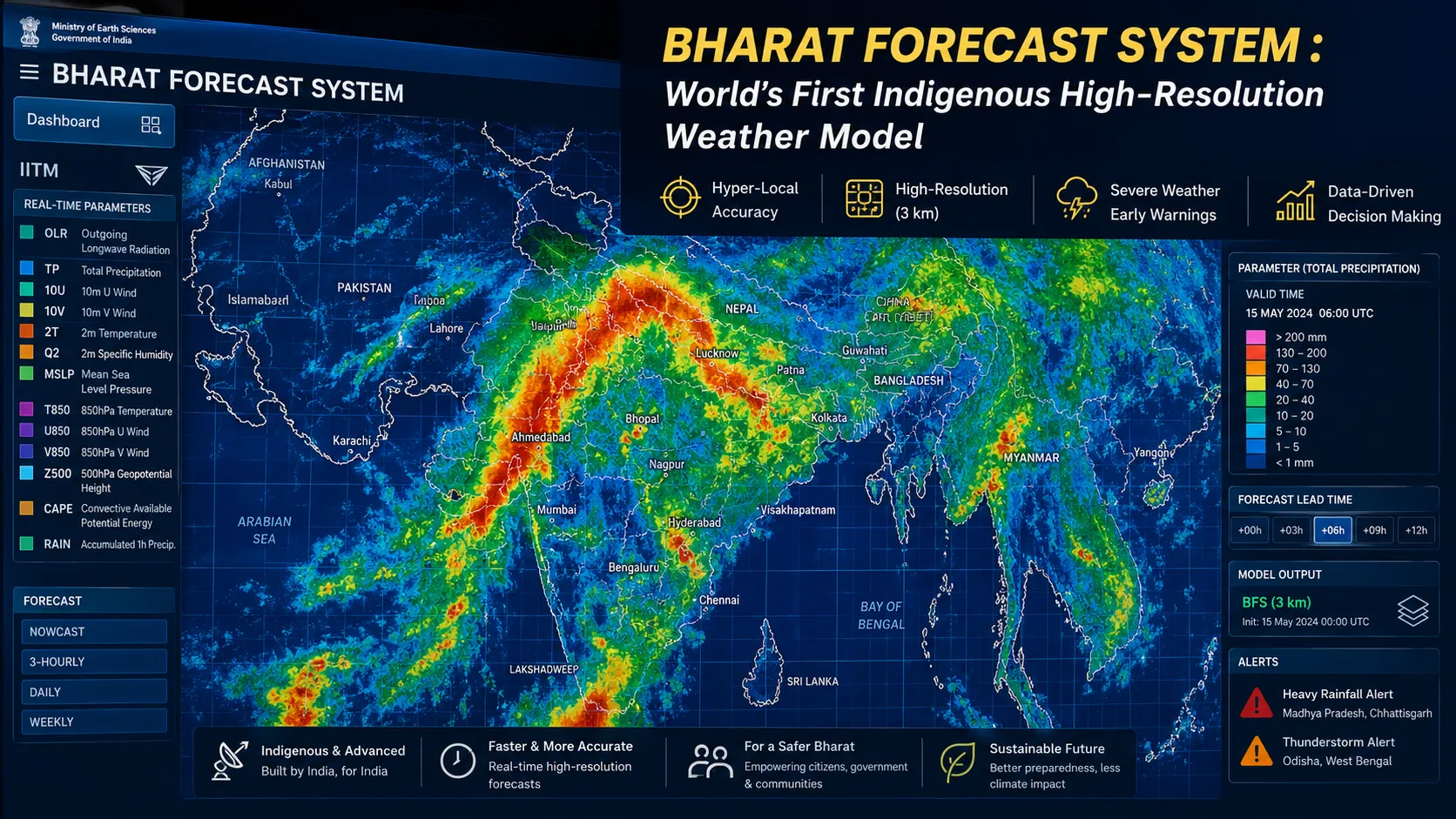
India is building a comprehensive AI climate infrastructure. The Bharat Forecasting System (BharatFS) , launched in May 2025, provides 6km resolution weather predictions—double the previous 12km resolution—covering nearly all gram panchayats . Farmers can access these forecasts through apps like e-Gramswaraj, Meri Panchayat, and Mausam gram.
The MausamGPT chatbot is being developed to advise farmers and others about climate and weather in natural language . The India Meteorological Department has created a dedicated AI research team and signed agreements with IITs, NITs, ISRO, and DRDO for AI research collaboration. Scientists receive training in AI through workshops and courses, including an annual training course every May .
The AI infrastructure is substantial. The Ministry of Earth Sciences has installed high-power computing systems with 22 PetaFLOPS capacity, with about 10% dedicated to AI work. There are separate GPUs for AI and machine learning research in weather forecasting. The investment reflects a national commitment to AI-driven climate resilience .
IIT Bombay's SpADANet (Spatially Aware Domain Adaptation Network), an AI model that improves cyclone and hurricane damage assessment from aerial images, has achieved over 5% better accuracy than existing methods in classifying damage levels using limited labeled data .
The model addresses a critical constraint: disaster agencies lack labeled data and computing power. SpADANet makes AI-driven damage assessment accessible at scale .
A National Problem Solvers Registry
The government is also building the talent pipeline. Microsoft, in collaboration with 1M1B Foundation, has partnered with the MeitY Startup Hub to launch a nationwide network of Green Skills and Applied AI for Climate Action Centres of Excellence . Five centres are being established across Bengaluru, Noida, Lucknow, Shillong, and Hyderabad.
The first centre has already launched in Bengaluru. In its first year, the programme aims to engage 20,000 youth, with plans to scale to 100,000 by 2030. It also targets the creation of over 50 AI-led climate innovation use cases and aims to connect 10,000 young participants to jobs, internships, and livelihood opportunities .
A key feature is the creation of a National Problem Solvers Registry , a curated pool of top-performing youth innovators. This platform is expected to enable governments and industry stakeholders to tap into emerging talent capable of addressing state and national-level challenges. The top 100 high-potential innovations will receive support through the MeitY Startup Hub ecosystem, including mentorship and grant-linked funding .
Equip: AI That Reads 100 Resumes in 7 Minutes
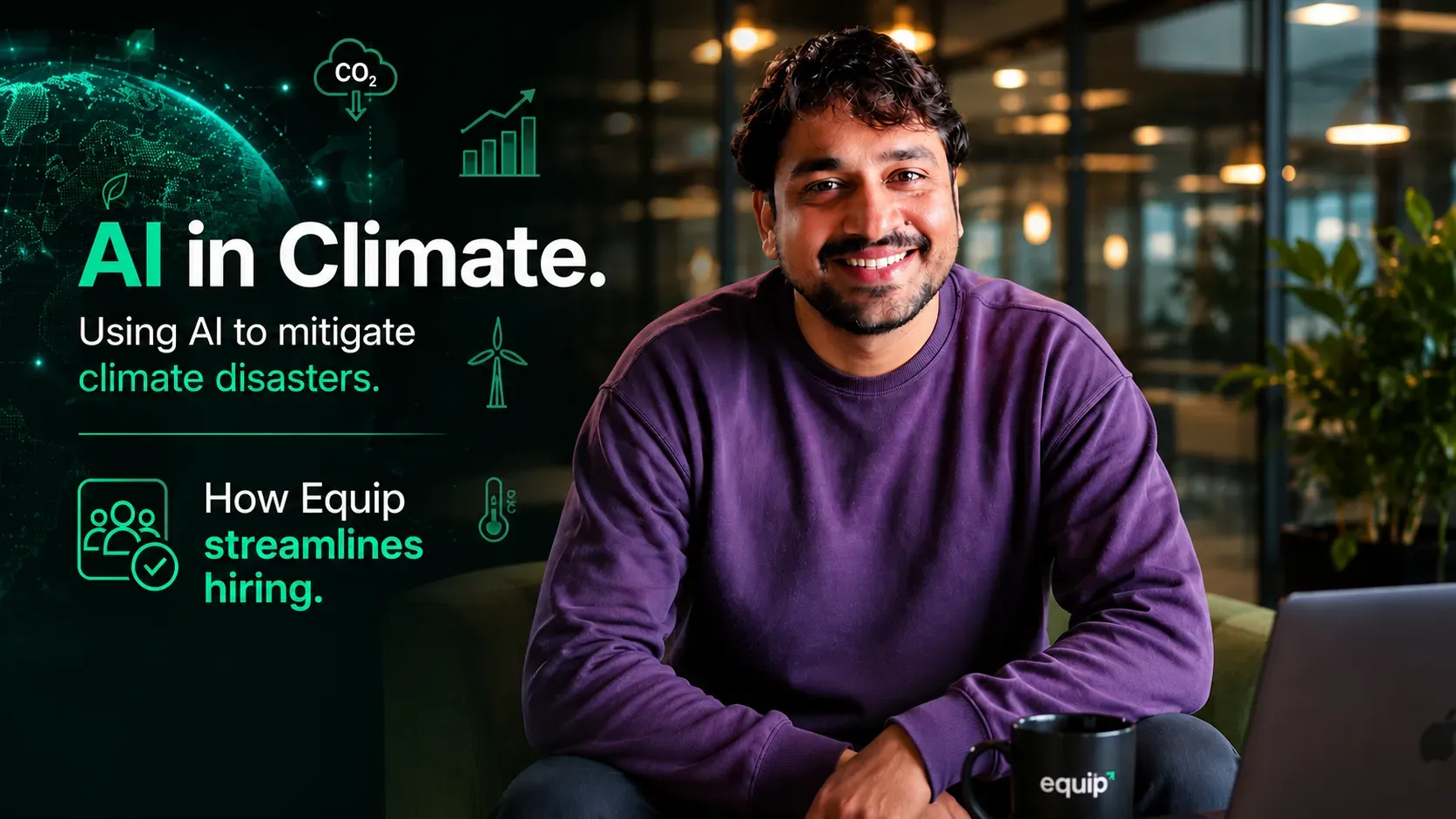
While AI predicts cyclones, another Bengaluru-based startup is using the same technology to solve a different problem: hiring at scale . Equip was founded in 2020 by Jayanth Neelakanta, a PhD in theoretical and mathematical physics from Syracuse University . The platform uses AI to screen resumes, assess skills, and conduct interviews, compressing early-stage hiring into a largely automated workflow .
The company's origin story is unconventional. Equip didn't start as a recruitment product. Its origins go back to Auto Proctor , an AI-based exam monitoring tool built by Neelakanta in 2020 during the shift to online exams. Built originally as a Google Forms add-on, it scaled to around seven lakh users in three months, run by a solo founder. That unexpected traction brought him into Y Combinator. But more importantly, it surfaced a new use case. Companies began using similar workflows for hiring. The overlap between exam integrity and candidate evaluation was hard to ignore .
That transition shaped Equip into what it is today: a platform that moved from proctoring tests to evaluating talent across hiring pipelines .
The Equip Platform: Four Modules, One Workflow
Equip is structured across four core modules: resume screening, skill assessments, AI-led interviews, and candidate sourcing .
The first layer, resume screening, is free to use. Recruiters set role requirements, and the system filters candidates based on those parameters. Applicants can apply directly or through a LinkedIn integration, answer custom questions, and receive a Job Fit Score ranging between 10% and 95%, benchmarked against the entire applicant pool. The score comes with an AI-generated explanation of why a candidate fits, or doesn't. Equip can process around 100 resumes in five to seven minutes .
The second layer is skill assessment , which was the company's original product. Tests are built for both technical and non-technical roles—a journalist might be evaluated on writing, an accountant on live spreadsheet tasks, and an HR professional on policy-based MCQs. Tests are auto-generated from a role-and-skill library and are proctored in real time. "We're built for scale. Campus hiring in India means thousands of candidates applying at once; the platform can handle up to 10,000 assessments running simultaneously," Neelakanta says .
The third module is interviews . Candidates can go through one-way assessments or live conversational interviews. In the latter, Google's Gemini powers real-time back-and-forth questioning designed to mimic a human interviewer . The company claims latency is low enough that candidates often don't realise they are speaking to an AI. Importantly, evaluation is based only on responses, not tone, appearance, or delivery style .
The newest addition is sourcing . Recruiters can now search a database of pre-assessed candidates based on role, location, and salary expectations. The database contains around 2.2 lakh candidates, already assessed, so recruiters know what they're good at, what salary they're expecting, and what their notice period is .
The AI Layer: Gemini, OpenAI, and Privacy
Equip doesn't train its own foundational models. It relies on tools like OpenAI for resume analysis and Google's Gemini for conversational interviews. But data handling is tightly controlled . Only role-relevant information is passed into models. Candidate data is not used to train external models and is not returned to providers .
There is also a strong emphasis on privacy. Unlike traditional proctoring systems that store full recordings, Equip processes video locally and only flags and stores data if a violation is detected. Encrypted storage and time-bound retention policies further reduce the window in which candidate data remains accessible. Proctoring data is deleted after three months .
A newer layer of monitoring lets candidates sync their phone camera with their laptop via QR code, widening the detection field during assessments. "Once candidates know they're being watched, scores go down, not because we catch more cheaters, but because they stop trying," Neelakanta says .
The Economics: Lean Team, Wide Reach
Equip operates with just five people: the founder, three engineers, and one marketer . There is no traditional sales team. Most customers come in organically, test the product with free credits, and convert if it fits their workflow .
More than 820 companies currently use the platform , including Wipro, Delhivery, and Shadowfax. About 65% of customers are based outside India. The company has raised $400,000 in pre-seed funding from Better Capital .
Pricing is usage-based: resume screening is free, skill assessments cost $1 per candidate, and AI interviews range between $1 and $3. The sourcing module charges 5% of the candidate's CTC only if a hire is made. India's HR technology sector was valued at $1.2 billion in 2025 and is projected to nearly double by 2034 .
The Five-Year Vision: Hiring in a World of Humans and AI Agents
The longer-term plan is to move beyond hiring workflows into something closer to a professional signal layer. Instead of relying only on resumes, Equip wants to build profiles based on how candidates actually perform across tasks, challenges, and interactions. The aim is to understand skills through behaviour, not just claims on paper .
Neelakanta's vision is ambitious: "We want to do for your professional profile what Facebook and Instagram have done for your personal one. Meta knows what to sell you based on how you interact with the platform. We want to know what job to show you based on how you perform on ours" .
The five-year view goes further. "In five years, workforces will be a mix of humans and AI agents," Neelakanta says. "We're not just thinking about helping recruiters find human candidates; we're thinking about what hiring looks like in a world where both exist" .
The Bottom Line
AI is being deployed across two very different frontiers in India. One is saving lives. The other is saving time. Both are solving the same fundamental problem: how to make better decisions at scale .
In climate, AI is predicting cyclones with 96-hour accuracy, detecting arsenic in groundwater, and mapping populations invisible to traditional alert systems. The goal is universal coverage: every person on Earth protected by an early warning system by 2027 .
In hiring, AI is processing 100 resumes in seven minutes, conducting real-time interviews through Gemini, and building a database of 2.2 lakh pre-assessed candidates. The goal is to reduce noise, surface signal, and make hiring less of a guessing game .
Both applications share a common thread: India is not waiting for AI to arrive. It is building it, deploying it, and scaling it . The technology is not a future promise. It is a current reality. And it is quietly reshaping how the country responds to crises—whether the crisis is a cyclone bearing down on the coast or a recruiter drowning in resumes.