Ten Years: What Was Promised and What Was Delivered
On January 16, 2016, Prime Minister Narendra Modi launched the Startup India initiative with a declaration that was simultaneously inspiring and audacious: India would become a nation of job creators, not merely job seekers. The initiative promised a regulatory environment friendlier to new companies, government support for startup incubators and accelerators, easier access to capital through fund-of-funds mechanisms, and a cultural shift in how the government and society viewed entrepreneurship.
Ten years later, the balance sheet is complex in the way that ambitious policy endeavors always are. The unicorn count, at 132, has exceeded any projection made in 2016. The startup count, at over 207,000, has transformed entrepreneurship from a fringe career choice into a mainstream aspiration for a generation of Indians. The cultural shift — the normalization of founding a company, the erosion of the social stigma around failure, the expansion of what counts as a legitimate and prestigious career — has been genuine and significant.
But the most quietly important transformation of the decade may be one that the Startup India initiative did not explicitly design for, that received less attention than the headline statistics, and that is only now being recognized in its full significance: the growing leadership of women in India's startup ecosystem. If the first decade of Startup India produced 207,000 startups, the story of the second decade may be defined by the women who are increasingly leading them.
National Startup Day 2026: Women at the Center
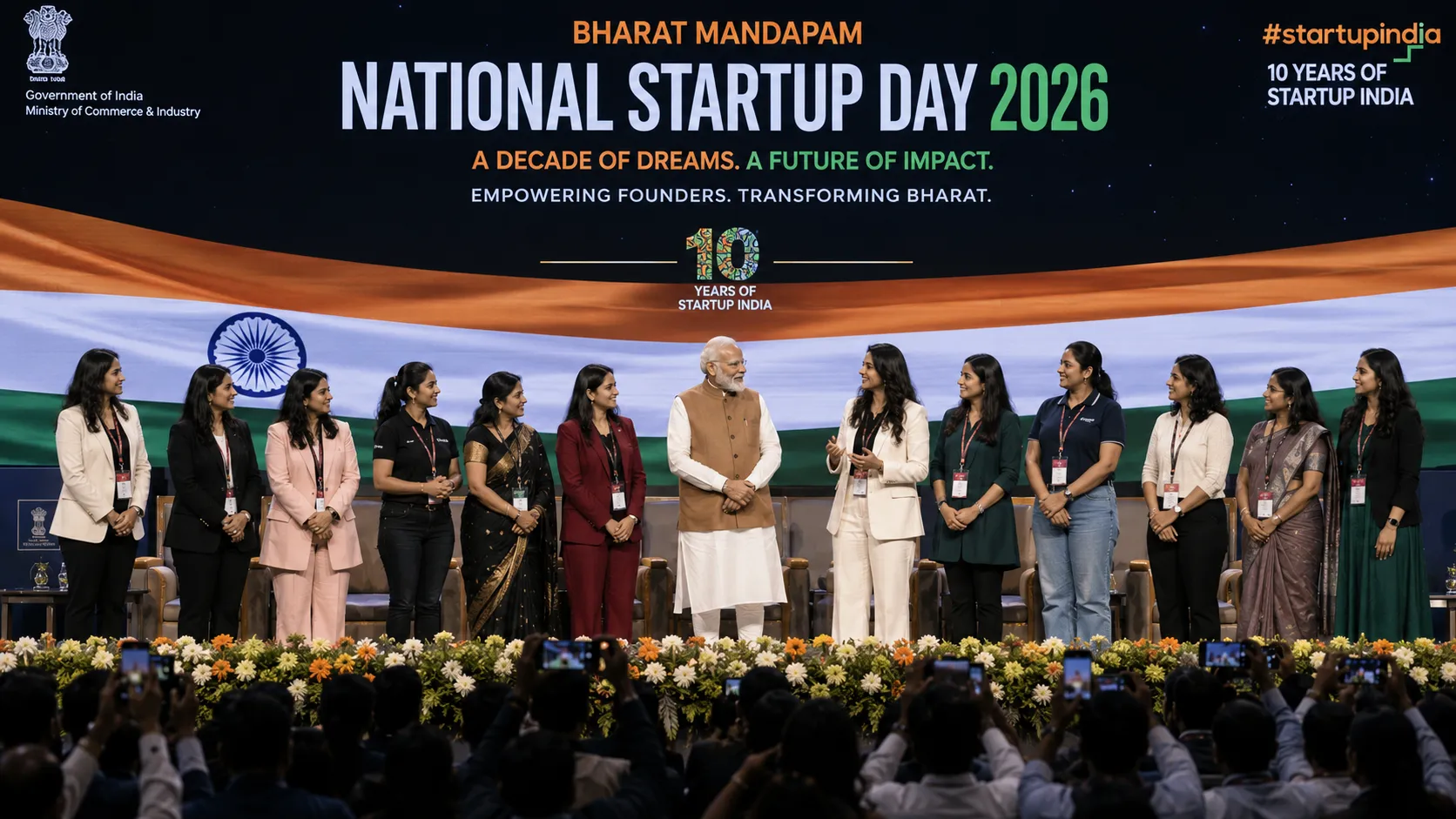
The National Startup Day 2026 celebrations, held at Bharat Mandapam in New Delhi with the Prime Minister's direct participation, placed women entrepreneurs in a position of unusual prominence. The Bharat Startup Grand Challenge 2026, focused on high-impact problem-solving, featured multiple women-led teams among its finalists. The pitching competitions highlighted women founders from cities and sectors that earlier Startup India events had rarely featured. The Prime Minister's interactions with startup founders explicitly included conversations about women's entrepreneurship and the specific challenges women face in accessing capital, networks, and the other resources that startups require.
This centering was not tokenism. It was the recognition of a decade of accumulating evidence: that women-led startups are among the most impactful and resilient performers in the ecosystem, that the structural barriers they face are real and addressable, and that their leadership is not supplementary to the startup story but central to its next phase.
The innovation week events organized as part of the National Startup Day celebrations also reflected this awareness. Multiple sessions addressed the specific challenges facing women founders: access to early-stage capital, navigating the network disadvantages that come from exclusion from male-dominated social and professional spaces where startup deals are informally discussed, and the institutional requirements needed to balance entrepreneurship with the caregiving responsibilities that continue to fall disproportionately on women in India. The candor of these discussions — their willingness to name structural problems rather than simply celebrate individual achievements — was itself a meaningful shift from earlier Startup India events.
The Sectoral Leadership That Has Defined the Decade
The sectors in which women-led startups have been most consistently strong over the past decade illuminate something important about the relationship between lived experience and entrepreneurial insight. They are the sectors where women's specific knowledge — as consumers, as caregivers, as users of systems that were designed without their input — creates genuine competitive advantage.
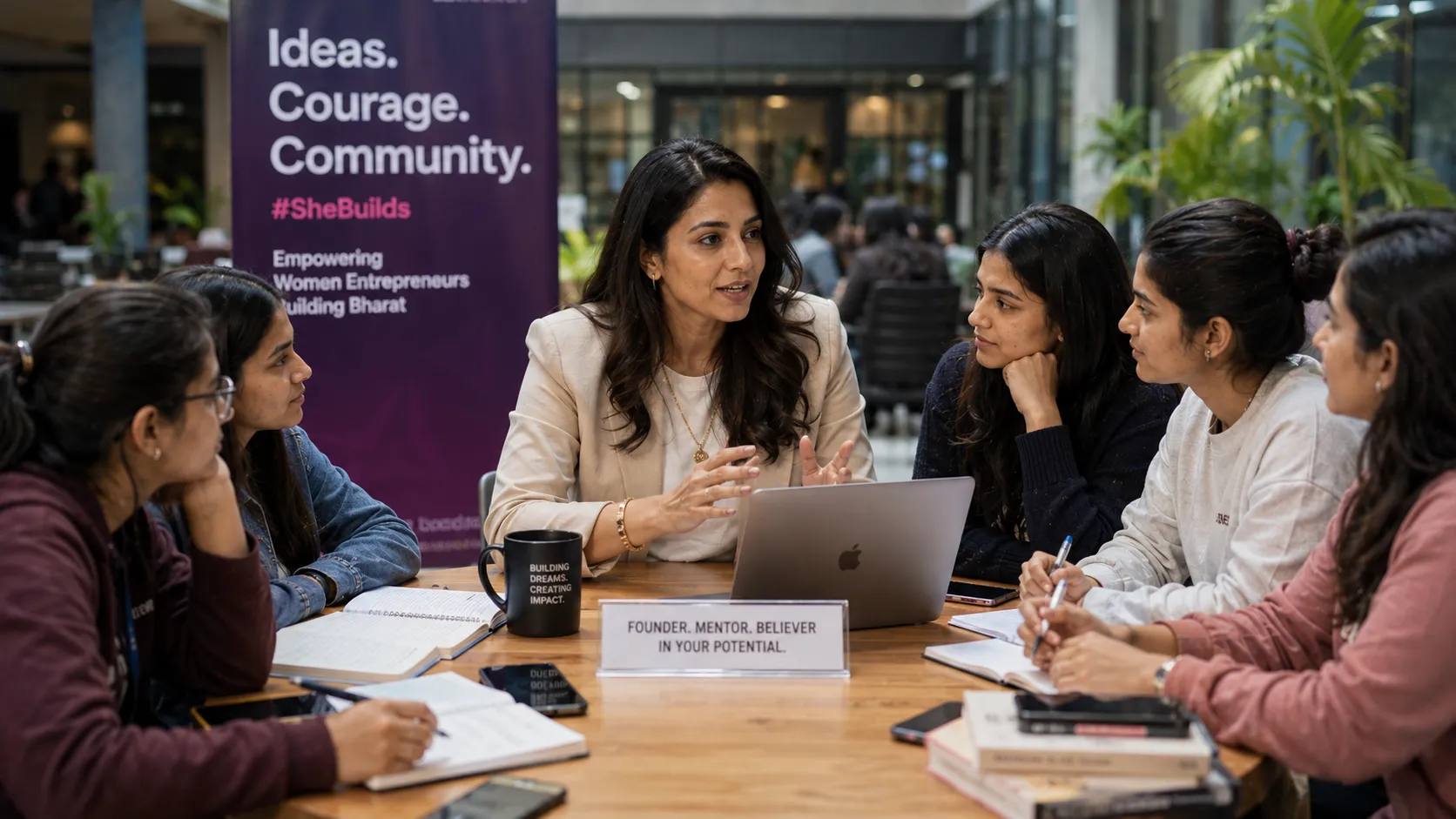
Healthcare and wellness startups led by women have consistently built products that serve women's health needs with a precision and a cultural sensitivity that the mainstream medical establishment has historically failed to provide. From menstrual health platforms to maternal care technology to postpartum mental health support to the ayurvedic-meets-clinical formulations of companies like Gynoveda, women founders have been building in these spaces because they understood the gaps from the inside — gaps that male-dominated founding teams, however analytically thorough, could not have identified with the same clarity.
Education technology startups founded by women have shown particular strength in building for learners and learning contexts that mainstream edtech has often overlooked: early childhood education in Indian languages, vocational training for women entering the workforce, adult literacy for rural women, and educational support for children with learning differences. The empathy and the pedagogical insight these founders bring to product design produces learning experiences that are more effective precisely because they are built by people who understand the learner.
Consumer brand building is perhaps the sector where women founders have achieved the most visible and commercially significant results over the decade. The transformation of India's beauty, personal care, and wellness markets by women-led D2C brands — which we document in detail elsewhere in this edition — represents one of the most consequential economic and cultural developments of the Startup India decade.
The Second Decade: What Must Be Different
If the first decade of Startup India was about demonstrating that Indian women could build extraordinary companies against substantial odds, the second decade must be about removing the odds. The celebration of exceptional achievement against exceptional barriers is inspiring — but the goal is a world in which exceptional achievement does not require exceptional barriers to be overcome.
The second decade's agenda for women's entrepreneurship in India has several specific items. The early-stage capital gap must be closed through a combination of government-backed funding mechanisms, structural reforms to how angel investment networks operate, and the active cultivation of women investors who are positioned to identify and back women founders whose opportunities others miss. The caregiving infrastructure that would allow women to pursue entrepreneurship at the most ambitious level without choosing between their professional ambitions and their family responsibilities must be expanded as a matter of public investment. And the cultural norms that continue to make founding a company a less socially supported choice for women than for men — however much those norms have shifted over the decade — must continue to be challenged through the growing visibility of successful women founders.
For The Impactful Global Indian, National Startup Day 2026 is both a moment of celebration and a moment of recommitment. The decade that has passed has established, beyond reasonable dispute, that India's women founders have the vision, the execution capability, and the market insight to build companies that matter. The decade ahead must build the infrastructure to match the talent — and to ensure that the story of women in India's startup ecosystem is no longer the story of individuals who triumphed despite the system, but of an ecosystem that was transformed by the contributions of its full membership.


