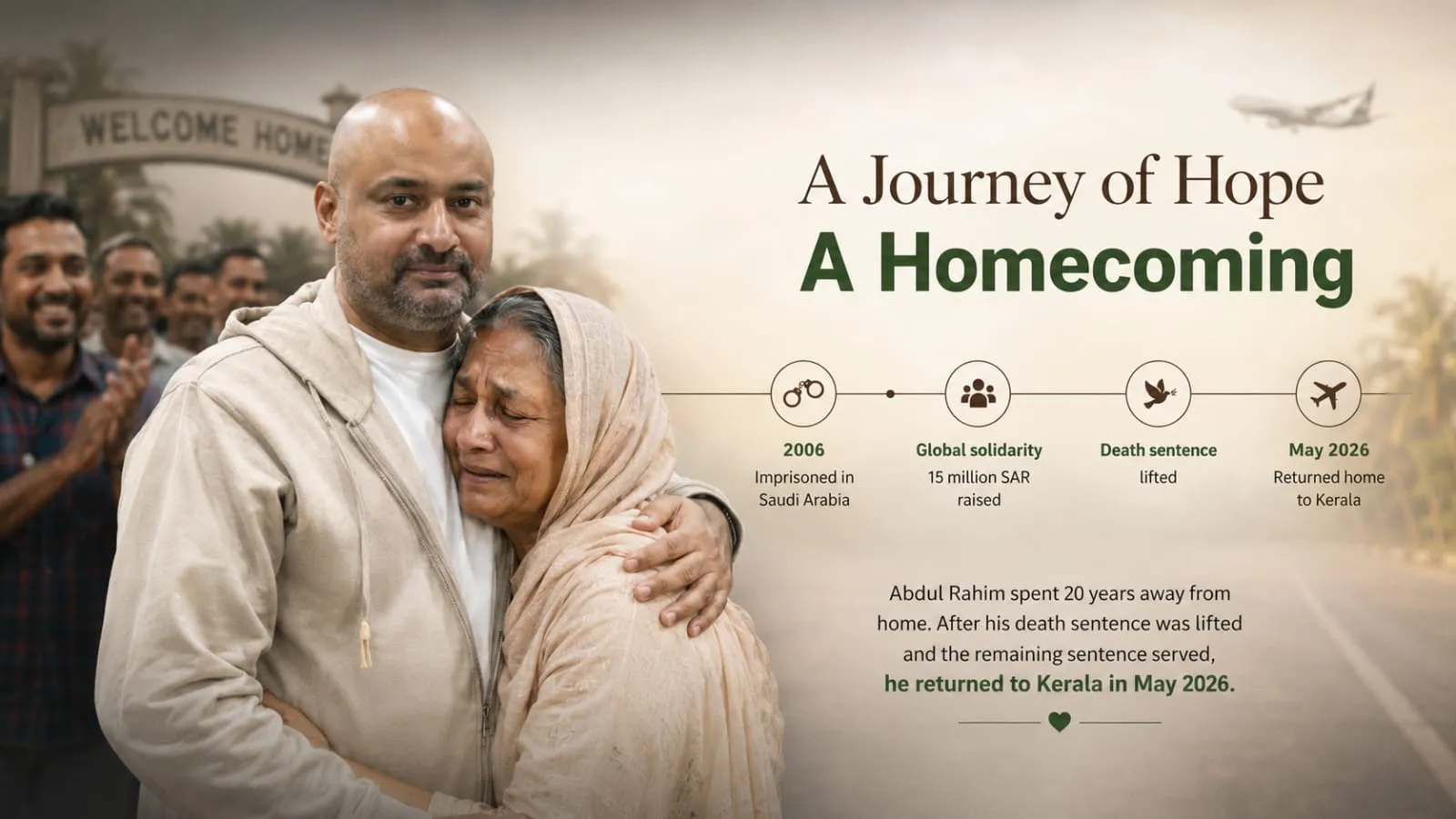
On the morning of May 28, 2026, an Air India flight from Riyadh touched down at Karipur International Airport in Kozhikode. A 20-year nightmare was about to end.Abdul Rahim, a native of Kodampuzha in Kozhikode, walked down the steps of the aircraft. Fighting back tears, he raised a thumbs-up to the waiting crowd of relatives, journalists, and supporters. Businessman Bobby Chemmanur was among the first to embrace him. After nearly two decades inside a Saudi Arabian prison—most of it on death row—Rahim was finally home.
Behind this single moment of reunion lies one of the most extraordinary humanitarian campaigns in modern Indian history. A ₹34 crore crowdfunding miracle. A death sentence lifted. And a diaspora that refused to let one of its own die.
The Day Everything Changed
Rahim had left for Saudi Arabia in November 2006, a young man from a struggling family hoping to earn a living as a driver. He found work with a Saudi family, tasked with caring for their 15-year-old disabled son, Anas Al Shahri, who relied on an external life-support device.One day, during a car journey, the unthinkable happened. According to Rahim's account, the boy asked him to jump a red light. When Rahim refused, the boy became agitated. In the struggle that followed, Rahim's hand accidentally dislodged the tube of the life-support device. The boy lost consciousness and died.
On December 24, 2006, barely a month after he had arrived in the country, Abdul Rahim was arrested.
The Long Wait on Death Row
What followed was a legal ordeal that would stretch across two decades. In 2012, a Saudi court sentenced Rahim to death. An appeal upheld the verdict. For years, the victim's family refused to grant amnesty, and Rahim remained on death row, waiting for a date that never seemed to come but never went away.
His only legal lifeline was a provision under Islamic law known as diyah, or "blood money." Under this system, a victim's family can pardon an accused person in exchange for financial compensation. The amount demanded by the boy's family was 15 million Saudi Riyals—approximately ₹34.35 crore.For a man who had traveled to the Gulf precisely because his family was struggling financially, the sum was impossibly huge. The court set a deadline: April 2024. If the money was not paid by then, the death sentence would be carried out.
The Miracle in Four Days
When news of the deadline reached Kerala, something remarkable happened. The people did not wait for the government. They did not wait for a billionaire. They acted.
The "Save Abdul Rahim" campaign was launched by a coalition of over 60 Malayali organizations in Saudi Arabia, alongside legal aid committees and support groups back home. A dedicated mobile app was created to collect donations. Social media campaigns went viral. And the people opened their wallets.Ordinary citizens. Shopkeepers. Students. Expatriate workers. Business owners. In just four days, the Malayali community—across Kerala, the Gulf, and the world—raised the entire ₹34 crore.
The final tally was even more staggering. By April 12, 2024, total contributions crossed ₹47.87 crore, far exceeding the target. The victim's family accepted the blood money. On July 2, 2024, the Saudi court officially revoked the death sentence.However, Saudi legal procedures required Rahim to complete his 20-year prison term under "public rights" provisions before he could be released. He had already served most of it. The wait was almost over.
The Homecoming
On May 28, 2026, Rahim finally walked out of prison and onto a flight to India. The Indian Embassy in Riyadh, which had consistently pursued his case and monitored his well-being throughout the two decades, confirmed his departure.
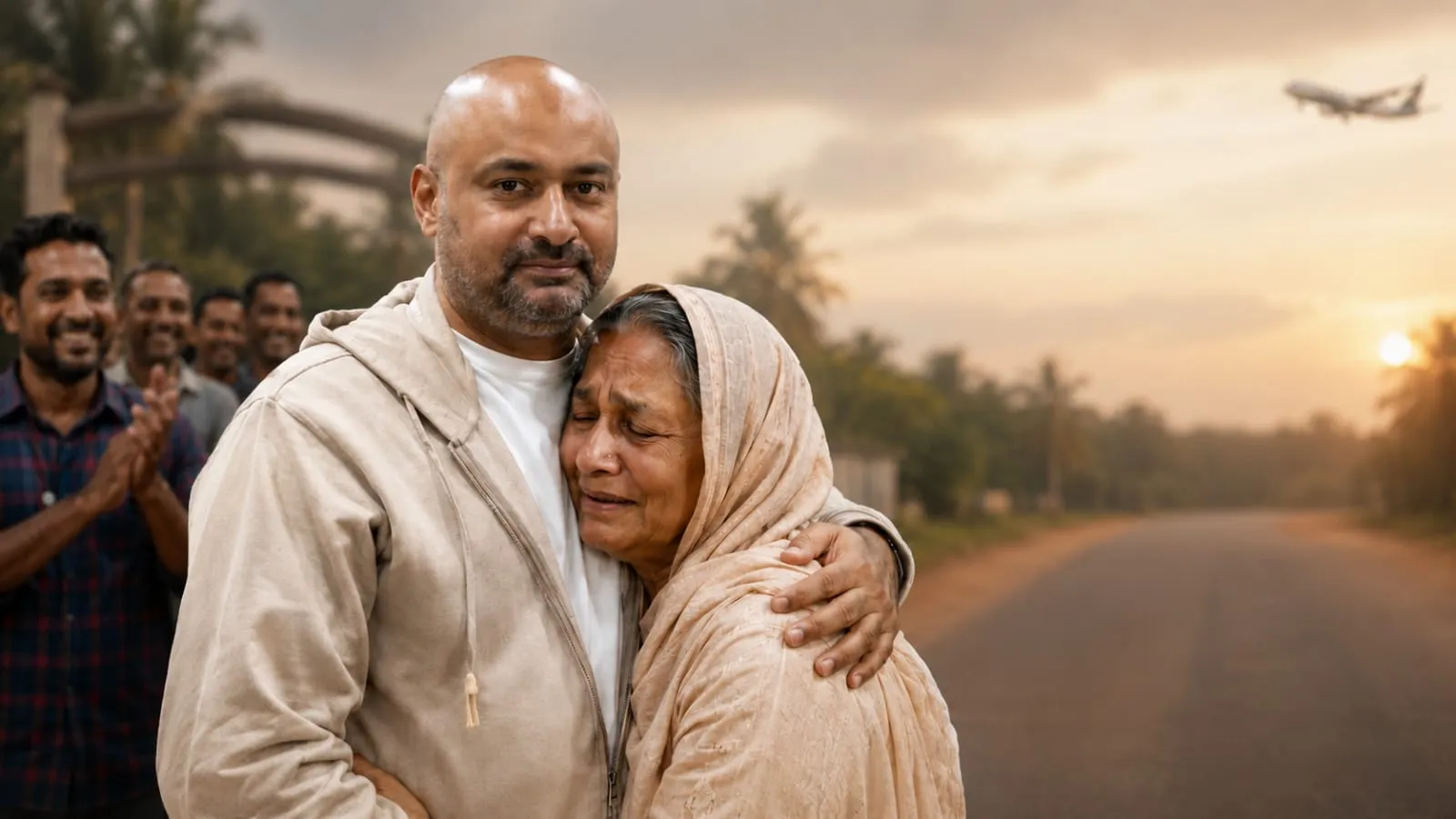
When he arrived at Karipur airport, the emotion was overwhelming. Rahim broke down in tears as he was escorted out by relatives. He later reached his ancestral home in Kodampuzha, where his elderly mother had waited nearly 20 years to see her son again.
The homecoming was filmed from every angle. A mother and son embracing at the doorstep. Neighbors cheering. A thumbs-up from a man who had every reason to have given up.
What the Abdul Rahim Campaign Teaches Us About Humanity
The numbers alone are staggering. ₹34 crore raised in four days. 2.6 million views on a single YouTube short announcing his return (as seen in the link you shared). Over 60 organizations coordinating a legal battle for nearly two decades.
But the real story is not the money. It is what the money represents.In a world increasingly defined by division, the "Save Abdul Rahim" campaign was a reminder of a simpler truth: a community that remembers its own is a community that cannot be broken. The Malayali diaspora did not ask whether Rahim was guilty. They asked whether a man should die for an accident. And they answered with their own hard-earned rupees.
As Rahim himself said, fighting back tears at the airport: "I am thankful to everyone who helped me and made it possible for me to see my mother again".For 20 years, his mother waited. For 20 years, a community fundraised and lobbied and prayed. On May 28, 2026, the wait ended. And a nation that had almost forgotten the meaning of collective action remembered what it looked like.