Every Perfume They Smelled Reminded Them of Somewhere Else. So They Built the Fragrance That Smelled Like Home.
India has some of the oldest fragrance traditions in the world. The attar makers of Kannauj have been distilling flowers and resins into scent for centuries. The country is home to sandalwood forests that have perfumed temples and royal courts for longer than most European perfume houses have existed. And yet, walk into any mall in any Indian city and the perfumes on the shelves either smell of French gardens, Italian citrus groves, or the synthetic amber and oud that defines the Gulf's idea of luxury.
Madhav Narang and Arhum Jain noticed this and found it strange.
The two of them were students at Masters' Union, a business school in Gurugram, when they began asking what would happen if a fragrance brand started not from a place, but from a memory. Not from Paris or Dubai, but from the smell of a tota keri, the small raw mango that Indian children eat with salt on the way home from school. Not from a European forest, but from the specific, evocative smell of the Andaman sea, tinged with the history of the colonial prison that made those waters famous as Kala Pani, the black water that was a sentence and a symbol. Not from a luxury concept, but from the almost transgressive childhood memory of sweet cigarettes, the candy sticks that looked like cigarettes and that generations of Indian children ate while pretending to be adults.
These were not marketing concepts. They were sensory memories that millions of Indians carry without ever expecting to find them in a perfume bottle. Khet was built on the conviction that those memories were worth bottling, and that the people who carried them would recognise their own experience in the scent and feel, for the first time, that a fragrance had been made for them.
The word khet means field in Hindi. It is the ground everything grows from. The name carries both the literal and the metaphorical: rooted in Indian soil, growing toward something contemporary.
What the Flea Markets Taught Them That No Classroom Could
The founding question was interesting. The founding method was the part that made the difference.
Madhav Narang and Arhum Jain had no investors. They had no celebrity endorsements. They had no established name in the Indian fragrance industry, which was already crowded with both legacy brands and a new generation of D2C challengers. What they had was a product they believed in and a willingness to go stand in front of people and hear what those people actually thought about it.
For more than 150 days, they sold Khet at flea markets and pop-up events across India. Not online. Not through a distributor. In person, one conversation at a time. They watched customers pick up the bottles, read the names, smell the samples. They listened to the reactions. They heard what resonated and what did not, what price felt like too much and what experience felt like too little, what the packaging communicated and what it failed to say. They collected this not as market research in the formal sense but as the direct, unfiltered feedback of real people making real decisions about whether to spend their money on what these two young founders had made.
This 150-day immersion was the product development process and the market research and the brand strategy, all at the same time. Most brands commission surveys and focus groups to approximate the kind of understanding that Khet built by actually being present. The founders knew by the end of those 150 days which fragrances to lead with, which aspects of the storytelling landed, and exactly what a premium Indian fragrance brand needed to be to earn the trust of an audience that had been offered everything except itself.
By October 2025, Khet relaunched in a fully rebranded form. The packaging was refined. The fragrance compositions were improved. The storytelling was elevated. Every element of the new brand was built from what the flea markets had taught.
The Fragrances and What They Mean
The Khet lineup is not a collection of scents that happen to have Indian names. Each fragrance is a specific, argued cultural reference that most Indians will recognise before they even open the bottle.
Kala Pani is the most layered. The Andaman Islands were used by the British colonial administration as a penal colony for Indian freedom fighters, and the journey there across the dark waters of the Bay of Bengal was known as Kala Pani, the black water, a crossing from which you might never return. The fragrance evokes that sea, that history, that sense of forbidden distance. It is simultaneously a geography and a moral statement, and it carries a weight that no conventionally named premium fragrance can match.
Tota Keri is something else entirely. The raw mango, the salt, the afternoon heat of a school road, the specific joy of that combination. It is the olfactory equivalent of a childhood photograph. Where Kala Pani is grave and historical, Tota Keri is alive and playful, and the contrast tells you something important about what Khet is doing: not a single mood, but the full emotional range of Indian experience.
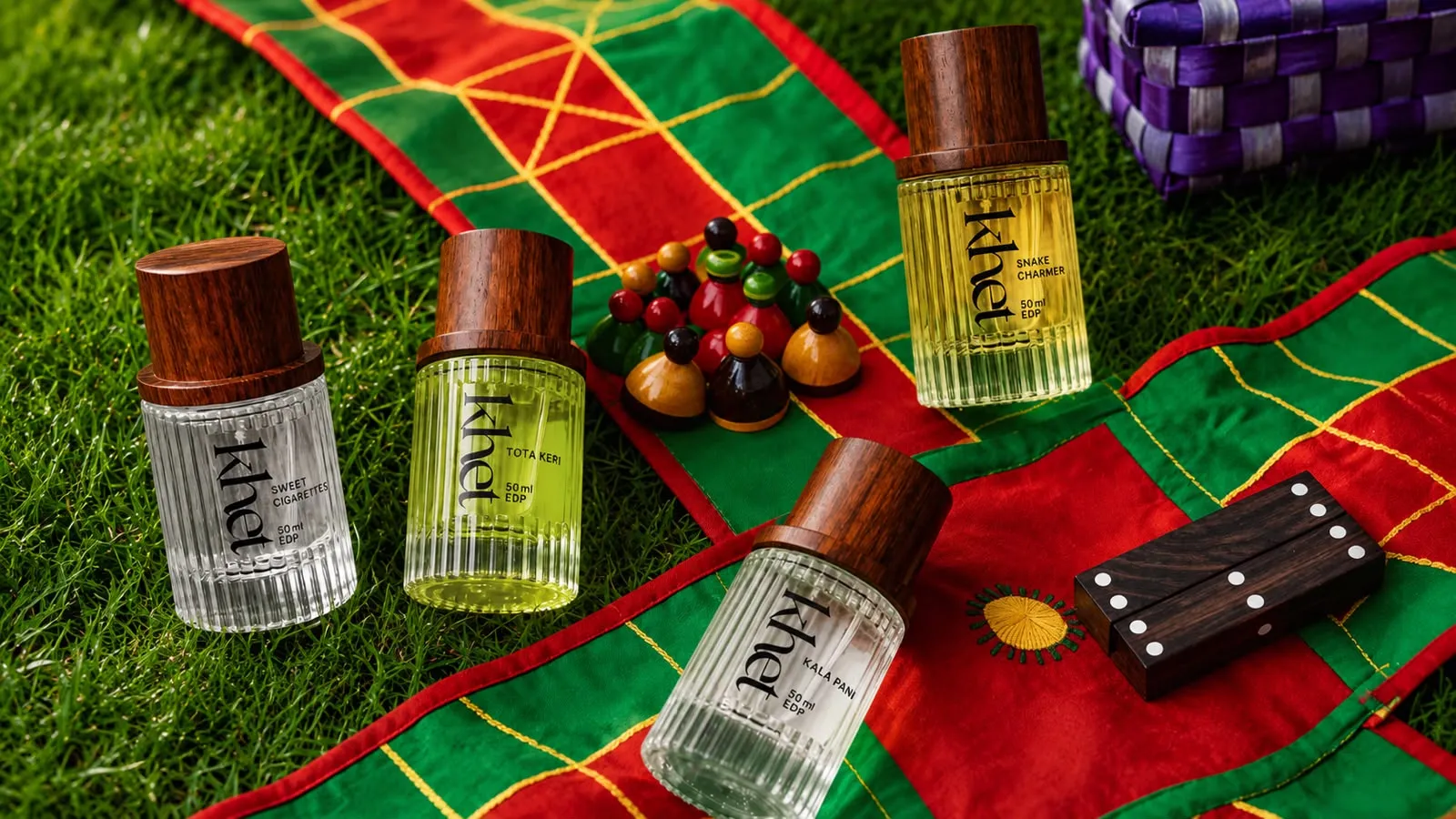
Sweet Cigarettes borrows its name from the candy sticks that were a staple of Indian childhoods before anyone thought to question whether giving children candy shaped like cigarettes was a peculiar thing to do. The fragrance carries something of that transgressive innocence: sweet and slightly forbidden, nostalgic and mischievous at once.
Snake Charmer is the most cinematic. The itinerant performer, the pungi, the cobra rising from the basket, the specific atmosphere of a street performance that is both art and livelihood. It places you somewhere specific in India's sensory landscape and dares you to say you have not been there.
Together these four fragrances do something that most Indian brands have never attempted. They treat Indian cultural memory not as a backdrop or a theme but as the primary subject. They do not make Indian-inspired fragrance. They make Indian fragrance, and they stand behind the distinction.
The Numbers Behind the Nostalgia
Since the October 2025 relaunch, Khet has sold over 4,000 orders and generated more than ₹61 lakh in revenue. The brand is now valued at ₹15 crore. For a bootstrapped company founded by two people who were still in their early twenties when they started, operating in one of the most competitive consumer categories in India, those numbers represent something more significant than revenue.
They represent proof that the market Khet identified was real.
The Indian fragrance market has long been polarised in exactly the way the founders diagnosed. Mass-market products occupy the lower end of the price range. International luxury brands occupy a tier that most young Indian consumers cannot access. In the gap between them, the ₹1,500 to ₹5,000 price range, there was enormous unserved demand for something that offered meaning and cultural identity alongside quality. Khet's positioning in that gap is not accidental. It was identified through the flea market days and validated through the relaunch.
The response has been particularly strong among urban audiences, international travellers, and the Indian diaspora. This last group is perhaps the most revealing. People who carry India's sensory memories most acutely are precisely the people who no longer live inside them. For an NRI in London or Singapore, a fragrance that smells like Tota Keri is not a novelty. It is a conversation with a part of themselves they left behind when they left. The emotional weight of that conversation is something no amount of marketing budget can manufacture.
The company is growing its team, now at 32 employees, planning international shipping in 2026, and targeting a first offline retail store in 2027. All of this is happening without external funding. Khet Fragrances LLP was formally incorporated on March 17, 2025, with Arhum Jain and Madhav Narang as the only designated partners. The company has no investors because it has not needed any. The business has been growing from the revenue the business generates.
The Bigger Story This Brand Is Part Of
Khet is one company. But the question it is asking is not a small question.
India's relationship with its own creative output in the global consumer market has been shaped for centuries by an extractive logic: Indian materials and craft traditions fed into Western products that were then sold back to India and to the world at a premium, with the conceptual and brand value captured elsewhere. Sandalwood from India perfumed European luxury houses. Cotton from India clothed the world. The intelligence and skill of Indian artisans built products that bore other people's names.
What a generation of Indian founders is now doing, across fragrance and fashion and food and design, is reversing that logic. Not by mimicking Western brand structures, but by building from the inside out: starting with what Indian experience actually is, what it smells and tastes and feels like, and treating that experience as the source of value rather than the raw material for someone else's brand.
Khet is doing this with fragrance in a way that is both commercially rigorous and culturally serious. The flea market discipline, the willingness to spend 150 days in front of real customers before claiming to know what they want, the insistence on naming their fragrances after things that actually matter to the people who will wear them: these are not startup tactics. They are an expression of a specific conviction about what Indian creativity can do when it takes itself seriously.
The perfume industry told India for decades that luxury smelled like Paris. Khet is offering a different answer. It smells like Kala Pani. It smells like Tota Keri. It smells like India, which turns out to be a smell that millions of people have been waiting for someone to bottle.