There Is a Scan Sitting in a Rural Clinic. Nobody Qualified to Read It Is Within 500 Kilometres. This AI Reads It in Under a Minute.
The global shortage of radiologists is one of the most quietly devastating gaps in modern healthcare. In high-income countries, the wait for a specialist to review an imaging scan runs from hours to days. In low- and middle-income countries — where the majority of the world's 8 billion people live — the wait can be indefinite. There are regions where the ratio of radiologists to patients approaches one per million. A chest X-ray taken at a rural clinic may sit unread not because the technology to take it does not exist, but because the trained human to interpret it does not exist nearby.
In those days of waiting, things happen. A tuberculosis case caught early progresses to a more advanced stage. A lung nodule the size of a pea, detectable and treatable, grows. A brain bleed requiring emergency intervention goes unidentified. A stroke patient misses the critical window where intervention changes the outcome from permanent disability to full recovery.
A Mumbai-based company founded in 2016 was built to close that gap. Not by training more radiologists — that takes decades. By building an AI that reads the scan in under a minute, as accurately as a radiologist, in any country, on any standard imaging machine, without a specialist physically present.
That AI is now deployed in 105 countries. It has impacted more than 40 million lives. It holds 18 FDA clearances — the greatest number for lung cancer AI in the United States. TIME Magazine named it one of the most influential companies in the world in 2025. The Bill and Melinda Gates Foundation, AstraZeneca, and Microsoft have each independently chosen it as the AI infrastructure backing their most ambitious global health programmes.
Most people still cannot name it.
What It Does — the Products and the Science
The company was founded by Prashant Warier, Pooja Rao, and Rohit Atluri — a team with backgrounds in data science and healthcare — on a founding thesis that the computational power and training data now available to deep learning algorithms were sufficient to produce AI matching specialist-level performance on medical imaging tasks that were well-defined, high-volume, and underserved by existing human capacity.
That thesis has been validated across three clinical categories.
Chest X-ray AI is the foundational product and the one with the broadest global deployment. Trained on one of the world's largest medical imaging datasets, it reads chest X-rays in under 60 seconds and identifies 28 findings — tuberculosis, pneumonia, pleural effusion, cardiomegaly, lung masses, and nodules among them. In February 2026, the company received FDA clearance for six new chest X-ray indications, expanding its clinical scope significantly. In October 2025, a paediatric TB screening module received regulatory clearance, extending reach into one of the highest-burden TB demographics globally.
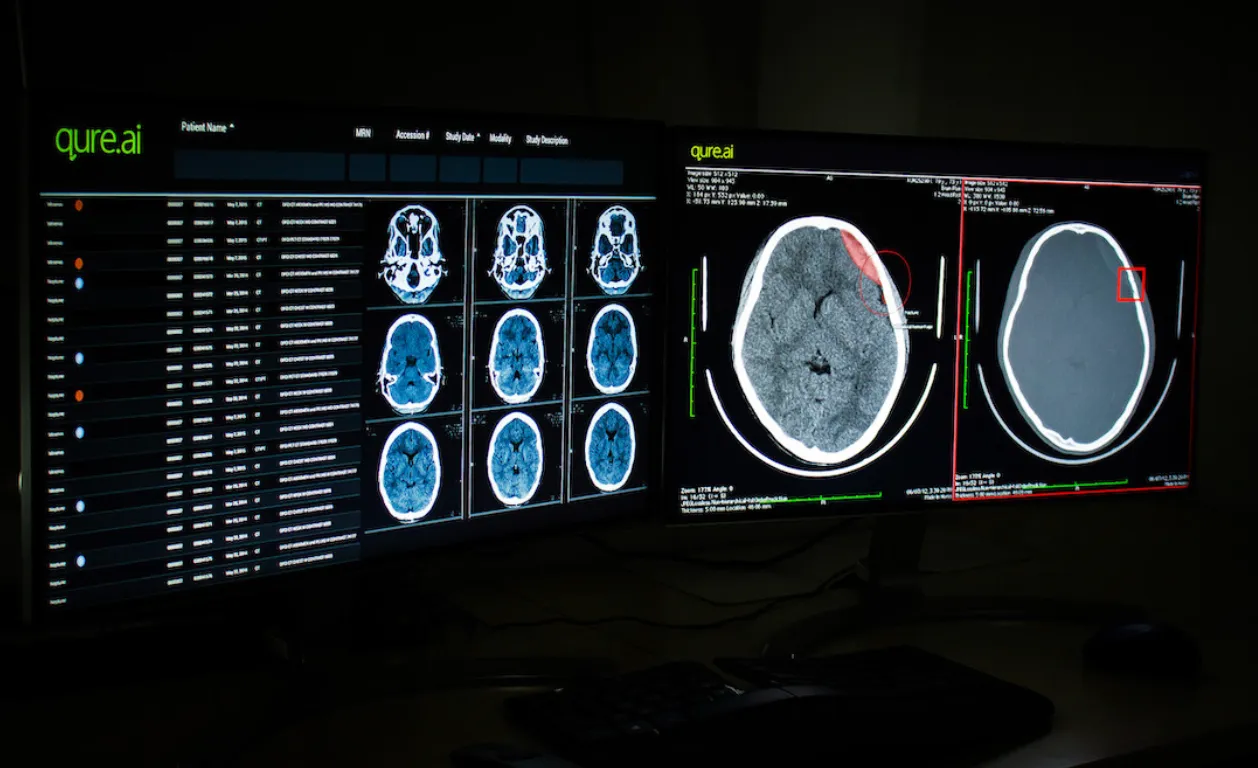
Head CT AI analyses CT scans of the brain for intracranial bleeds, midline shifts, skull fractures, and stroke indicators. For emergency departments where the intervention window is measured in minutes, the ability to triage a head CT scan before the neurosurgeon has reviewed it can determine whether a patient receives treatment in time. A stroke care coordination suite supports hub-and-spoke hospital networks to facilitate timely interventions.
Lung Cancer AI — launched in 2024 as a complete care continuum — covers detection, measurement for progression, and case management across the full clinical pathway for lung nodule management. Rather than alerting a clinician that a nodule exists and leaving the rest to the existing system, it tracks that nodule across imaging studies, flags growth meeting clinical significance thresholds, and triggers coordination to move the patient toward biopsy or intervention.
The deployments that followed this launch confirm the reception: a Canadian health network partnered for province-wide early lung cancer detection in December 2025. A programme in North East London accelerated lung cancer detection in November 2025. The Netherlands has been building momentum through the same period.

The AI Copilot Launched at the World Health Assembly
The most significant product release in the company's recent history is not a detection algorithm. It is Aira — a multi-disease clinical AI copilot launched at the World Health Assembly in Geneva, designed specifically for resource-constrained healthcare settings.
Aira is a care coordination suite that enables patient triage, clinical coordination, and real-time communication across hub-and-spoke healthcare networks. It is designed for contexts where a district hospital serves as the referral centre for a constellation of primary health clinics — where the clinician at the clinic may not be a specialist, and where the decision of whether to refer a patient to the district level depends on rapid assessment that AI can support.
Launching at the World Health Assembly is not a press release moment. It is a statement of mandate. Not hospital software for wealthy markets. Global health infrastructure for communities the formal healthcare system has historically underserved.
CEO Prashant Warier has described the company's orientation precisely:
The Partnerships That Define the Scale
The institutional partnerships assembled are the most tangible measure of what the global health establishment believes has been built here.
AstraZeneca committed to screen 5 million patients as part of the World Economic Forum's EDISON Alliance 1 Billion Lives Challenge, and extended the collaboration into 2026 with an AstraZeneca-Telangana programme for AI lung cancer screening. These are population-scale deployments, not pilots.
Microsoft partnered in November 2025 to increase access to lung cancer detection technology — integrating capabilities into Microsoft's cloud and healthcare data infrastructure for large hospital network adoption at scale.
The Bill and Melinda Gates Foundation granted major global health funding in January 2026 specifically to develop AI-powered point-of-care ultrasound for low- and middle-income countries — extending the platform from X-ray and CT into ultrasound, which is more widely available in community health settings.
VillageReach partnered in May 2026 to strengthen Mozambique's AI-enabled pandemic preparedness system — using the company's TB and respiratory disease AI to build surveillance infrastructure in one of the world's most resource-constrained health systems.
A pharmaceutical company. A technology giant. One of the world's most rigorous philanthropic foundations. A global health NGO. Each independently reached the same conclusion about the technology.
The FDA Number That Defines the Competitive Landscape
Regulatory clearance in medical AI is not a formality. The FDA's process for AI diagnostic tools requires clinical evidence of safety and effectiveness, peer-reviewed validation studies, and technical review that can take years and cost millions. Companies that rush to market without clearance face eventual reckoning from a healthcare system that requires evidence before widespread adoption.
Eighteen FDA clearances — the greatest number for any company in lung cancer AI in the United States — represent 18 completed regulatory dossiers. Eighteen clinical evidence packages. Eighteen products judged, by the world's most stringent medical device regulator, to meet safety and effectiveness standards for clinical use.
In a sector where most companies are still building their first FDA submission, 18 clearances is a distance that reflects years of disciplined investment in evidence-based medicine rather than marketing-led expansion.
The $65 Million Series D — and What It Is Building Toward
In September 2024, a $65 million Series D round closed, led by Lightspeed Venture Partners and 360 ONE Asset, with participation from the Merck Global Health Innovation Fund — bringing total funding to $123 million across nine rounds. The round was earmarked for foundational AI model development, complementary M&A in medical technology, and US and international market expansion.
The US expansion has accelerated. New FDA clearances, the Microsoft partnership, NHS programmes in North East London, and the Canadian health network partnerships are the commercial output of a company that spent its first eight years building technology and is now deploying capital to commercialise it in markets with the highest revenue potential.
The product pipeline is simultaneously expanding. Ultrasound AI — enabled by the Gates Foundation grant — enters a category where the foundation's global health network creates a launch path most companies could not construct independently. The Aira care coordination suite opens categories beyond pure detection into workflow and coordination — the layer health systems need to actually act on what AI detects.

The One Thing That Sets This Apart From Every Other Medical AI Company
The global medical AI landscape has hundreds of companies, dozens of FDA clearances distributed across multiple players, and competitive intensity that has increased substantially as clinical validation evidence has matured. This company is not the only AI that reads chest X-rays. It is not the only company with FDA clearances. It is not the first to detect tuberculosis or lung nodules with deep learning.
What distinguishes it is deployment geography.
Most medical AI companies are built for the United States and Europe first — markets where reimbursement infrastructure, hospital IT systems, and clinical buying processes are familiar and where revenue per deployment is highest. This company built for deployment in 105 countries, including markets where there is no reimbursement infrastructure, where the hospital IT system is minimal, and where clinical buying runs through governments and global health organisations rather than hospital CIOs.
That orientation — toward the places where AI diagnostic support matters most rather than the places where it pays best — is what produced the AstraZeneca partnership, the Gates Foundation grant, the Mozambique deployment, and the World Health Assembly product launch.
40 million lives touched means 40 million imaging studies contributing to an AI model that has seen a global diversity of pathological presentation that no Western-only dataset can match. The most deployed healthcare AI in the world is the most deployed not because it chased the easiest markets. It is the most deployed because it built for the hardest ones first — and built something good enough to win everywhere else as well.
That is what the Indian AI company helping doctors across the world actually is. And that is why, nine years in, it is still the one most people cannot name.