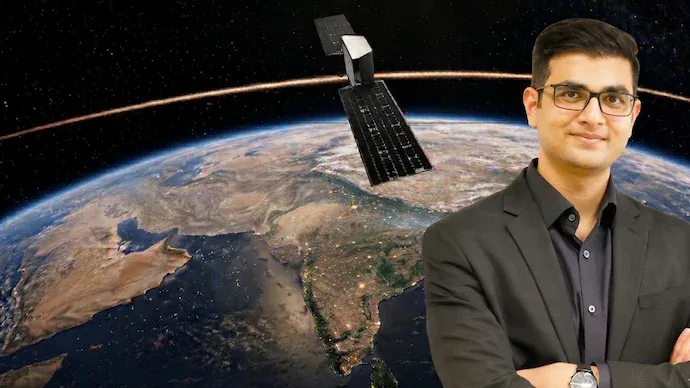
Conventional Satellites See the Planet. Pixxel's Can Read It.
Every satellite currently in orbit looks at Earth the same fundamental way. It captures light in three or four colour bands — red, green, blue, and near-infrared — and produces images that look like very detailed photographs. They are extraordinary tools. They have transformed agriculture, urban planning, disaster response, and intelligence. And they are profoundly limited.
A photograph tells you what a surface looks like. It does not tell you what the surface is made of, what is happening inside it, or what is about to happen to it. A conventional satellite image of a wheat field shows you a green field. It does not tell you that a section of that field has a fungal infection that will devastate the harvest in three weeks. It does not tell you that a gas pipeline running underneath a stretch of land is leaking methane. It does not tell you that a river running copper-brown from a mining operation is contaminating a water supply downstream. It cannot tell you any of these things because it is looking at colour, not chemistry.
Hyperspectral imaging looks at chemistry.
Instead of capturing three or four bands of light, a hyperspectral camera captures hundreds — across the visible spectrum and well into infrared wavelengths that the human eye cannot see and conventional cameras cannot detect. Different materials, different chemicals, different biological states absorb and reflect those wavelengths differently. A healthy crop reflects differently from a stressed one. Methane has a spectral signature. Contaminated water has one. An early-stage mineral deposit has one. The hyperspectral image is not a photograph. It is a chemical fingerprint of everything in the frame.
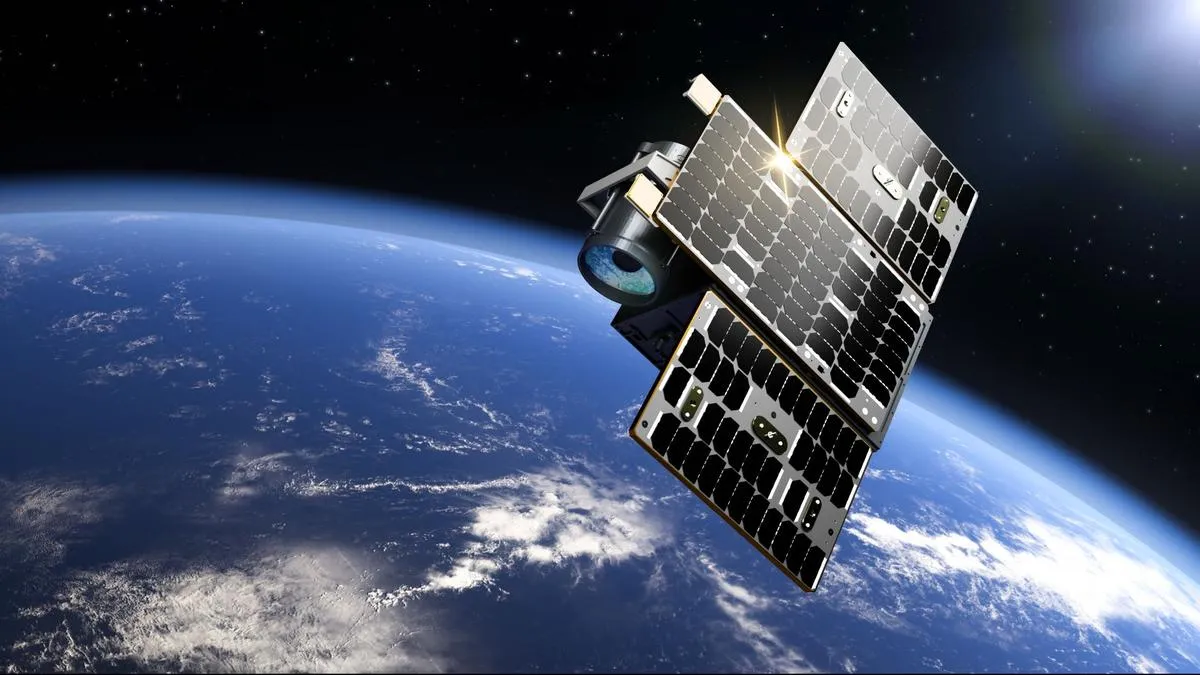
Pixxel was founded in 2019 to put hyperspectral cameras in orbit — and in January and August 2025, it launched all six of its Firefly satellites aboard SpaceX rockets from Vandenberg Space Force Base. The Fireflies are the world's highest-resolution commercial hyperspectral satellites. They orbit at 550 kilometres, image at 5-metre resolution across 135-plus spectral bands, cover a 40-kilometre swath, and revisit every location on Earth daily. They see things that no commercial satellite currently in orbit can see. And the question the company is now answering — in oil fields, in farmlands, in government intelligence programmes — is exactly what that seeing is worth.
Two Undergraduates. A Health Monitor for the Planet.
Awais Ahmed and Kshitij Khandelwal were undergraduates at BITS Pilani in 2019 when they co-founded Pixxel. Ahmed had been the engineering lead for Team Hyperloop India — the only Indian team to win the SpaceX Hyperloop Pod Competition and race their vehicle at SpaceX HQ. That experience gave him a specific and unusual understanding of what it takes to build hardware at the frontier of physics and engineering, and what it costs when the frontier is unfamiliar territory.
What they saw, when they looked at the satellite imaging industry, was the same gap that every specialist in the field had seen but that nobody had yet closed commercially: the data gap between what a colour satellite could tell you and what a hyperspectral satellite could. The satellite industry had been building colour cameras for decades because colour cameras were cheaper, simpler, and good enough for the applications that governments and commercial buyers had built around them. The applications that required hyperspectral data — chemical detection, early crop stress identification, precise mineral mapping, oil and gas pipeline monitoring — were being served by airborne hyperspectral cameras that were expensive to deploy, limited in coverage, and impossible to scale globally.
The founding mission, stated on the company's website and repeated in every investor pitch and public interview, is this: to build a health monitor for the planet.
Not a mapping service. Not a surveillance system. A health monitor — the same concept that applies to a body, applied to a planet. Something that takes readings continuously, identifies abnormalities before they become crises, and provides the data that allows intervention before the damage becomes irreversible.
The Fireflies — What Six Satellites Actually Make Possible
The six Firefly satellites that are now operational in orbit represent a commercial capability that did not exist twelve months ago and that Pixxel's founders have been building toward since 2019.
Each Firefly captures 135-plus spectral bands at 5-metre spatial resolution — making it 6 times sharper than the 30-metre standard of most existing hyperspectral satellites, and the first hyperspectral spacecraft in history to achieve 5-metre resolution commercially. The 40-kilometre swath and daily revisit capability mean that any given location on Earth can be imaged every day, with chemical-level detail, without waiting for a cloud-free window or scheduling a targeted pass.
The applications that this capability enables are specific, documented, and commercially validated.
In agriculture, hyperspectral data can detect crop stress from pest infestation, fungal infection, nutrient deficiency, or drought up to two weeks before visible symptoms appear — giving farmers and agricultural businesses enough lead time to intervene, treat, or adjust planning before the damage is done. Pixxel has MoUs with the Mahalanobis National Crop Forecast Centre and with Save Soil Foundation. Its pricing structure for agricultural clients — approximately $3,000 per month for 100 acres of daily monitoring — reflects the economic value of early intervention compared to post-harvest losses.
In oil and gas, the methane detection and pipeline leak identification capability is the application that has attracted the most commercially significant clients. Methane is the second most potent greenhouse gas, and the oil and gas industry accounts for a disproportionate share of global methane emissions — many of which come from leaks and venting that operators themselves cannot precisely locate. Hyperspectral satellites can identify methane plumes by their spectral signature, map their extent, and identify their source with a precision that no conventional satellite can approach.
In mining, the ability to map mineral deposits, monitor environmental impact, detect acid mine drainage in water courses, and assess rehabilitation progress all depend on the kind of surface chemistry information that only hyperspectral data provides. Rio Tinto — one of the world's largest mining companies — is among Pixxel's customers. The value of knowing, from orbit, exactly what a mining site's environmental footprint looks like in chemical terms rather than visual terms is the value of avoiding regulatory violations before they occur rather than responding to them after.
In insurance, the Aurora platform's ability to assess crop damage, infrastructure damage, and natural disaster impact through quantified chemical and physical change data — rather than visual estimation — is the foundation of more accurate and faster claims processing.
Aurora — Making the Planet Queryable
The satellite is the sensor. Aurora is the intelligence.
Aurora, Pixxel's in-house Earth Observation Studio, is a no-code platform that makes hyperspectral data accessible to users who are not remote sensing specialists. Its natural language query interface allows an agricultural analyst to ask "show me which parts of this field are water-stressed" rather than requiring them to understand spectral band mathematics. A ready-to-use model library covers the most common applications — vegetation indices, crop health metrics, water quality indicators, mineral identification — in formats that industry-specific users can apply directly.
The Aurora positioning — making the planet "queryable like Google," as one analyst described it — reflects a product strategy that extends Pixxel's addressable market beyond the specialist remote sensing community into the broader enterprise analytics market. An insurance company does not need to hire a satellite data scientist to assess whether a drought has reduced crop yields in a given region. It needs an interface that answers the question in language it already understands.
The economics of the Aurora model reflect this breadth. Revenue comes from three streams: per-acre or per-image data sales, Aurora platform subscriptions including analytics, and satellite manufacturing contracts for third parties. The margins on data sales — reported at 90 per cent post-launch, with payback under a year per satellite — reflect the fundamental economics of a business where the fixed cost of building and launching the satellite is the investment, and the marginal cost of each additional data product sold from that satellite approaches zero.
The National Constellation Contract — India's Largest Private Space Award
The validation that most precisely captures where Pixxel sits in India's space economy arrived in August 2025: the company led a consortium — with Dhruva Space, PierSight, and SatSure — that was selected by IN-SPACe, India's national space regulator, to design, build, own, and operate India's first national Earth Observation Satellite System under a Public-Private Partnership framework.
The contract: a 12-satellite network representing an investment of more than ₹1,200 crore, developed over four to five years. The constellation will include sub-metre very high-resolution satellites, wide-swath multispectral satellites, Synthetic Aperture Radar satellites, and hyperspectral satellites — a comprehensive Earth observation stack that will serve precision agriculture, water quality monitoring, land-use mapping, disaster assessment, and infrastructure development at national scale.
This is not a pilot or a government study. It is a ₹1,200 crore contract — the largest single commitment to private sector space infrastructure in India's history — awarded to a company founded six years earlier by two undergraduates.
The strategic significance extends beyond the contract value. The requirement that all satellites be manufactured domestically, launched on Indian rockets, and controlled from within India builds Pixxel directly into India's data sovereignty infrastructure. The company that wins this contract becomes the operating backbone of India's national Earth observation capacity for the next decade.
Simultaneously, Pixxel has been awarded a five-year contract by the NRO Commercial Systems Program Office under the Strategic Commercial Enhancements Broad Agency Announcement for Commercial Hyperspectral Capabilities — meaning the United States national intelligence community has chosen Pixxel's hyperspectral data as part of its commercial remote sensing strategy.Two governments, on opposite sides of the planet, have independently concluded that Pixxel's hyperspectral imaging capability is what they need.
What the Planet Actually Needs
There is a version of Pixxel's story that is a startup funding story — $95 million raised, Google and Lightspeed and M&G Catalyst on the cap table, BITS Pilani founders who built something ambitious in a sector India had historically ceded to US and European players.
That story is accurate and worth telling. But it is not the most important version.
The most important version is this: the planet has problems that cannot be seen with the eyes we have currently pointed at it. Methane leaking from infrastructure that nobody is monitoring precisely. Crops failing in patterns that would be visible two weeks earlier if the right data existed. Mineral contamination spreading through water systems in ways that conventional satellites cannot detect until the damage is already done. Deforestation accelerating in ways that aggregate statistics miss but spectral data can catch field by field, hectare by hectare.
These are not abstract future risks. They are happening now, in the regions that are least equipped to respond to them, in the windows where early detection still makes intervention possible.Pixxel's Fireflies are not taking better photographs. They are taking the planet's vital signs — continuously, globally, at chemical resolution — and feeding them into a platform that any government, any company, any research institution with a subscription can query in plain language.That is what a health monitor for the planet actually looks like. And for the first time, from the soil of Bengaluru, it is in orbit.