A College Project. A Terror Attack. Eighteen Years Later: The World's Third-Largest Dual-Use Drone Manufacturer.
In 2007, a group of engineering students at IIT Bombay were building drones out of fascination — the way many engineering students build things, without a business plan or a market or a clear sense of what the technology would eventually become. Their project was an unmanned aerial vehicle. Their motive was curiosity. Their resources were limited.
Then, on November 26, 2008, ten gunmen landed in Mumbai and began a coordinated terror attack that would last four days, kill 166 people, and traumatise a city. As the attacks unfolded, Indian security forces used helicopters for reconnaissance. The helicopters were slow, expensive, and limited in where they could safely go. The students at IIT Bombay watched, and understood in a new and visceral way exactly what their technology could have been useful for.
That understanding changed everything.
"The 26/11 Mumbai attacks underscored the need for advanced aerial surveillance," Ankit Mehta, co-founder and CEO of ideaForge, recalled in an interview with Autonomy Global. "At the time, helicopters were being used for reconnaissance, but he and his team saw how drones could have been a far more effective tool in high-risk situations. This realisation reinforced their commitment to build UAV technology designed for mission-critical applications."
What followed was eighteen years of building in a market that barely existed when they started — a market they had to create through patience, technical capability, and a series of early relationships with India's defence and security establishment that provided both revenue and credibility when no commercial market was ready to pay.
Today, ideaForge Technology Limited — publicly listed on Indian stock exchanges since its 2023 IPO, which raised ₹567 crore at over 50 times subscription — is the pre-eminent UAV manufacturer in the Indian market, ranked third globally among dual-use drone manufacturers in the Drone Industry Insights Global Drone Review 2024. Its customers have completed over 950,000 flights using its drones. One ideaForge UAV takes off somewhere in India every five minutes on average. The company holds more than 80 patents. It employs over 1,000 people.
And now, at exactly the right geopolitical moment, it is taking all of that capability global.
What IdeaForge Actually Makes — and Why the Military Trusts It
The product portfolio that ideaForge has built over 18 years spans the full range of drone applications — from sub-250 gram tactical nano systems to heavy fixed-wing surveillance platforms — and it is anchored by a design philosophy that Mehta has consistently described as "mission-first."
The SWITCH family — most recently the SWITCH 2 — is the company's flagship military UAV. A vertical takeoff and landing (VTOL) hybrid drone that can operate in high-altitude and heavily electronically jammed environments, the SWITCH 2 is already in service with the Indian Army, has completed thousands of operational missions along contested borders, and received a ₹30 crore ($3.39 million) follow-on order in November 2025. The Indian Army's trust in the SWITCH 2 is not ceremonial. It is the trust that comes from a platform that has been physically and digitally stripped down by independent technical committees — who conducted factory visits and verified every component's origin and embedded security — and passed.
The NETRA 5 is ideaForge's latest surveillance platform, featuring advanced AI-driven target identification and modular payload capabilities for security operations. The Q Series handles precision mapping for infrastructure, agriculture, and survey applications. The RYNO Series covers tactical nano and micro missions where minimal footprint and rapid deployment are the requirements.
Underlying all of these platforms is the FLYGHT software ecosystem — ideaForge's drone-as-a-service platform that operates on a pay-per-use model, allowing government agencies and enterprises to access aerial capabilities without hardware ownership, software maintenance, or specialist training requirements.
The significance of this integrated stack — airframe, payload, mission software, and service delivery layer — is that ideaForge is not a hardware vendor. It is a mission capability provider. And that distinction is increasingly what large institutional customers — military commands, disaster response agencies, logistics operators — are willing to pay for.
The Army Contract That Validated Everything
In June 2025, ideaForge won an emergency procurement order from the Indian Army worth approximately ₹137 crore ($16.4 million) for hybrid Mini UAVs — vertical takeoff and landing drones for intelligence, surveillance, and reconnaissance missions supporting counter-insurgency and counter-terrorism operations.
The word "emergency" in Indian defence procurement is not bureaucratic language. It refers to a fast-track procurement pathway used when the operational requirement is urgent and the normal multi-year acquisition process would leave forces without capability they need now. Emergency procurement orders are won by companies that have already been certified, already been tested, and already demonstrated the reliability required for armed forces to stake operational outcomes on them.
The evaluation process for this order included two independent technical committees that conducted multiple factory visits, physically and digitally stripped down each unit to verify component origins, and tested embedded security against the Indian Army's requirement that all critical sub-components come from countries that do not share a land border with India — a requirement that explicitly excludes Chinese-sourced components.
ideaForge's Mini UAV met every standard.
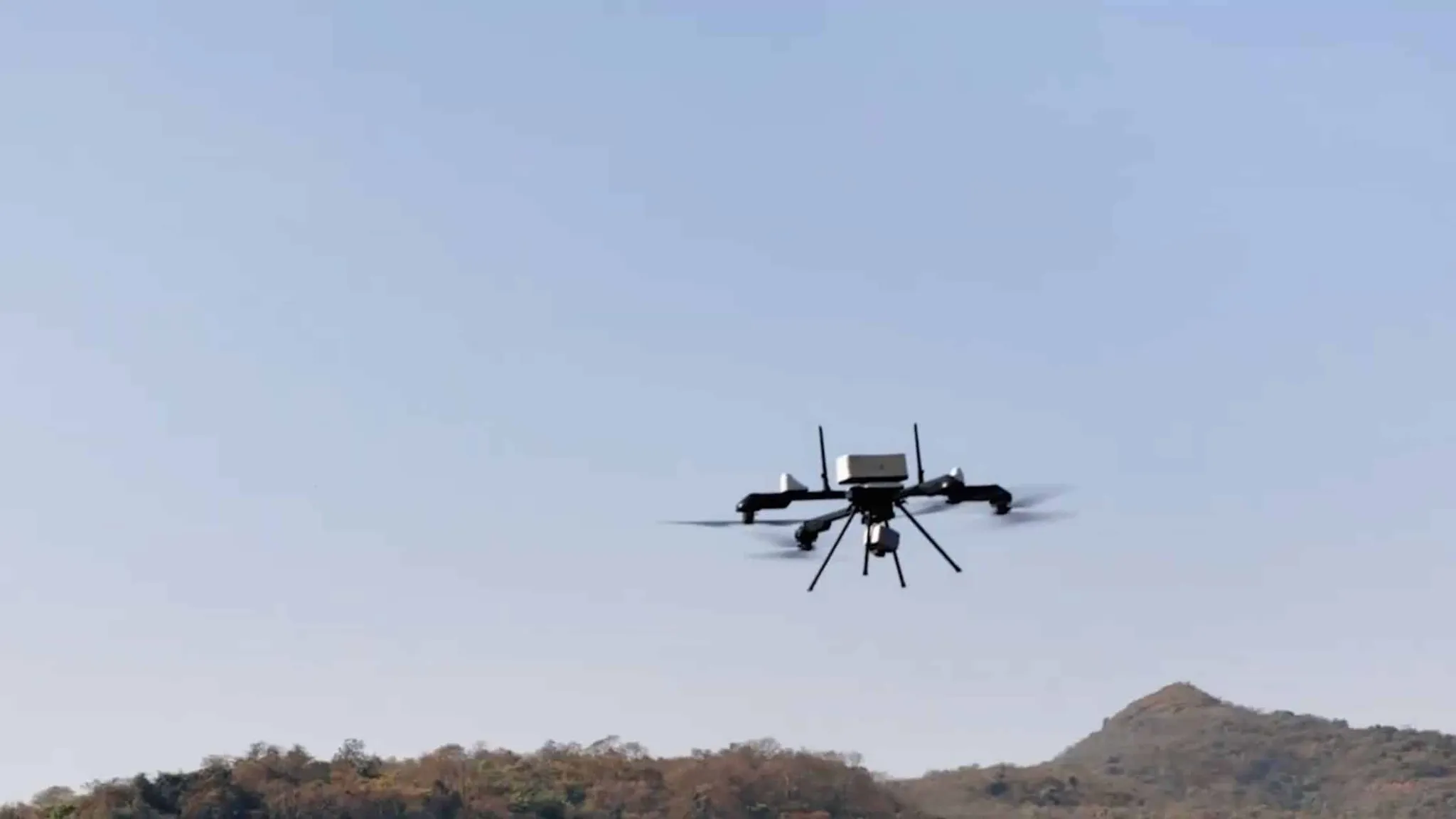
That same trust produced a second order in November 2025: the Zolt tactical drone ($8.5 million) and a SWITCH 2 follow-on ($3.39 million) under capital emergency procurement, following field evaluations that tested performance specifically in high-altitude, heavily jammed environments. Combined with the June order, ideaForge secured approximately $27 million in Indian Army emergency procurement contracts across 2025 alone.
The US Market — and Why the Timing Is Perfect
The most strategically significant development in ideaForge's global expansion is its entry into the United States market — and the specific geopolitical conditions that are making that entry easier than it would have been even three years ago.
The US government has been systematically restricting the use of Chinese-made drones in American security, defence, and civilian applications. DJI — the dominant Chinese drone manufacturer that controls more than 70 per cent of the global consumer and commercial drone market — has been placed on the US Department of Defense's list of companies allegedly working with the Chinese military, and faces restrictions on government procurement. American law enforcement agencies, state governments, and federal departments have been actively seeking non-Chinese drone alternatives that can meet their operational requirements without the cybersecurity and supply chain risks associated with Chinese-origin systems.
This is the market gap that ideaForge is entering.
In September 2025, ideaForge announced a partnership with First Breach, an American manufacturer, to expand its US offerings — a distribution and partnership relationship that provides ideaForge with the domestic market access and US-entity relationships required to compete for American government contracts. Mehta has described the US strategic rationale directly:
The October 2025 deal with Skylark Labs — a $35 million agreement for an AI-powered drone ecosystem — adds a technology partnership dimension to the US expansion. Skylark Labs, which builds AI systems for drone operations, brings software intelligence to ideaForge's hardware platform, producing a combined capability that is specifically designed to compete in the mission-critical, security-focused applications where Chinese alternatives are being excluded.
For the United States, which simultaneously needs trusted drone capability at scale and has limited its options by restricting Chinese suppliers, an Indian manufacturer with 18 years of defence-grade development history, 80+ patents, third-place global ranking, and an explicit supply chain sovereignty story is not a compromise. It is an opportunity.
Beyond Defence: Civilian, Industrial, and Emergency Response
The civilian and industrial dimension of ideaForge's portfolio is the part of the story that most defence-focused coverage misses — and it is increasingly the part of the story that determines long-term commercial scale.
In December 2025, ideaForge signed an MoU with C-DAC to integrate its FLYGHT Drone-as-a-Service platform with India's ERSS-Dial 112 emergency response system, covering police, fire, and medical assistance across the country. The integration enables first responders to deploy aerial surveillance on demand without purchasing hardware, training specialists, or managing maintenance — accessing the capability through a pay-per-use model that fits government budget structures and operational rhythms.
The Q Series mapping drones serve infrastructure, agriculture, and urban planning applications that are entirely separate from the defence customer base. India's Survey of India has been a customer. The mapping and inspection market — mines, railways, power lines, pipelines — provides revenue diversification that reduces dependence on the inherently lumpy procurement cycles of defence contracts.
The long-endurance and cargo drone programmes in development point toward future categories: delivery, industrial inspection, and emergency logistics. These are markets where ideaForge's engineering heritage in autonomous systems, high-altitude performance, and mission-critical reliability translates directly into competitive advantages over consumer drone manufacturers who have not been built to the same standards.
What 18 Years of Building Actually Produces
The ideaForge story is instructive for what it says about the relationship between patient capability-building and strategic timing.
The company spent the first decade of its existence building technology in a market that was not ready for it — developing VTOL hybrid drones, high-altitude platforms, and autonomous mission systems when India had no drone policy, no civilian UAV market, and no established procurement pathway for indigenous defence drones. It survived on DRDO relationships, early defence contracts, and the conviction of its IIT Bombay founders that the technology was real and the market would eventually materialise.
It did materialise. India's Drone Policy 2021 opened the civilian skies. The Production-Linked Incentive scheme provided ₹120 crore in manufacturing support to domestic drone producers. The Make in India defence push created procurement preference for indigenous systems. The Russia-Ukraine conflict demonstrated at global scale how decisive tactical drones had become in modern warfare. And the US-China technology decoupling created the export market opportunity that ideaForge's supply chain sovereignty story is uniquely positioned to serve.
None of these external forces would have benefited ideaForge if it had not spent 18 years building a product that was actually good enough to serve them. Third-ranked globally in the Drone Industry Insights assessment. Over 950,000 customer flights. 80-plus patents. Indian Army emergency procurement trust. A $35 million US AI ecosystem deal.
The world did not wait for ideaForge. IdeaForge waited for the world — and built the entire time it was waiting.