Blinkit Doesn't Sell Groceries. It Sells the End of Planning.
There is a moment that every Blinkit user has experienced. It is 11pm. You need something. You open the app not with hope but with expectation. Twelve minutes later, it arrives. You do not think about what just happened. You close the app and go back to your evening.
That absence of friction — that moment where the delivery is so fast it almost doesn't register as an event — is the product Blinkit has been building since it renamed itself from Grofers in December 2021. Not the groceries. The relief. The confidence that whatever you have forgotten, whatever you suddenly need, whatever emergency has arrived at your door will be resolved before you have time to feel anxious about it.
This is not a delivery company that happens to market well. It is a marketing company whose brand promise is operationally manufactured at the infrastructure level, one dark store at a time.
The Rebrand That Changed Everything
In 2021, Grofers was a discount grocery delivery platform competing on price with BigBasket and a dozen other players. It was growing, but it was not differentiated. The category was crowded, the value proposition was interchangeable, and the word Grofers carried the weight of a brand that had built its identity on savings rather than speed.
Blinkit changed the name, the colour, the category, and the story simultaneously.
The yellow branding was a deliberate departure from the muted palettes of grocery retail. Bright, immediate, visible on a phone screen at a glance — the visual identity communicated what the product promised before a word was read. The name Blinkit evoked the thing the company was actually selling: the blink of an eye between want and have.
Most importantly, the rebrand repositioned the category itself. Grofers was a grocery delivery service. Blinkit is a quick commerce platform. The distinction sounds semantic. It is structural. A grocery delivery service asks you to plan your week in advance. A quick commerce platform tells you that planning is optional. You can live differently now. We will be there.
The brand did not just rename itself. It invented a new consumer behaviour and then told people they had always wanted it.
The 10-Minute Promise — and the Infrastructure That Makes It Real
Marketing promises fail when the operations cannot keep them. Blinkit's most significant strategic achievement is that its 10-minute delivery promise is real, and the marketing machine is built on top of that reality rather than around a version of it.
By mid-2025, Blinkit operated more than 1,500 dark stores across 30-plus cities. Each dark store serves a catchment radius of 2 to 3 kilometres, staffed by trained pickers who move through a small, high-density warehouse designed for rapid retrieval rather than browsing. The average delivery time across the network is genuinely sub-10 minutes in most urban areas.
The site selection algorithm for dark stores is itself a marketing instrument. Blinkit opens stores based on high-demand zones, traffic patterns, and neighbourhood density, which means that the first time a user in a new area opens the app and finds 10-minute delivery available, the experience is not a surprise. The infrastructure has been placed there before the user knew they needed it.
This operational architecture is what allows Blinkit to advertise with a boldness that would destroy any brand whose operations couldn't match the promise. Every billboard that says 10 minutes is a commitment backed by a dark store three kilometres away. The marketing is honest because the operations are honest. That combination — rare in the quick commerce category — is why the brand stays trusted at scale.
The Content Playbook: Memes, Moment Marketing, and Being Impossibly Relatable
Blinkit's social media strategy is built around a specific insight about how its target audience — urban Indians aged 18 to 35 — relates to brands online. They do not want to be sold to. They want to be understood. They want brands to speak in the same register they use with their friends: dry, self-aware, slightly absurd, and always rooted in the specific textures of urban Indian life.
The meme strategy is the most visible expression of this. Blinkit's social media team produces content that moves at the speed of conversation — reacting to trending topics, cultural moments, and daily situations with the timing and tone of someone who gets it. When something is trending on X, Blinkit's response arrives within hours. When a situation is universally relatable — the craving at midnight, the guest who arrives unannounced, the office snack emergency — the creative team is there before the moment passes.
Campaign lines like "Ab fridge bhar ke rakho ya Blinkit se mangwalo" and "Kya 10 minute mein aayega? Haan bhai, Blinkit hai!" are not advertising in the conventional sense. They are expressions of a self-aware brand that knows its users think of Blinkit as a life patch rather than a retailer. The campaigns work because they validate the behaviour that the product has created. You are not bad at grocery planning. You have simply discovered a better way to live.
Social media engagement grew 85 per cent year on year at the peak of this strategy. Repeat customer rates climbed 45 per cent. The memes turned into habits. The habits turned into loyalty. The loyalty turned into 45 per cent market share.
Performance Marketing: The Machine Behind the Moments
The witty meme and the hilarious OOH billboard are the visible face of Blinkit's marketing. Behind them runs a performance marketing operation that is as precise as the content is playful.
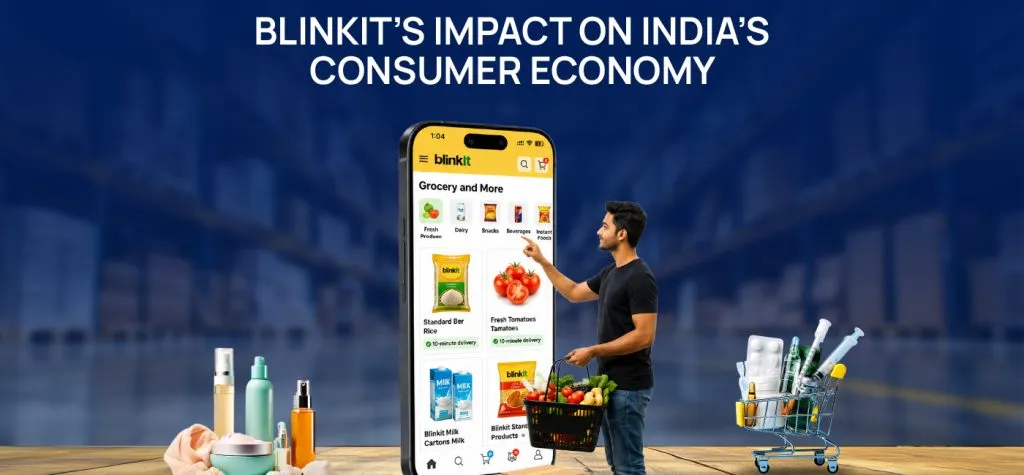
Google, Facebook, and YouTube receive Blinkit's largest performance marketing spend, targeted at high-intent search moments. The keywords that Blinkit targets are not generic grocery terms. They are situational: "midnight snack delivery," "emergency medicine delivery," "last minute grocery." These are queries made by users who already want something and are looking for who can provide it fastest. Blinkit's ads appear at exactly that moment, with exactly the message required to convert intent into an order.
App store optimization ensures that Blinkit's app ranks for the same intent signals in mobile search. The combination of web and app visibility means that a first-time user looking for fast delivery in any major Indian city will encounter Blinkit before any competitor.
Programmatic advertising spend increased 25 per cent in 2025. The AI models underpinning Blinkit's programmatic buys use purchase history, time-of-day signals, and location data to predict when a specific user is most likely to place an order and serve the relevant creative at that moment. A user who historically orders coffee at 8am receives a coffee-adjacent creative at 7:45am. A user whose last three orders included midnight snacks sees the midnight creative. The personalization is invisible to the user. The conversion rates reflect it.
Retail media — the revenue Blinkit generates from brands paying for placement within the app, sponsored product listings, and banner positions — contributes approximately 3 to 5 per cent of total revenue. This is the advertising equivalent of the eye-level supermarket shelf: brands pay for the position, Blinkit earns a margin on the visibility, and the high purchase intent of a user already inside the ordering flow makes the conversion economics significantly better than display advertising elsewhere.
The Zomato Synergy — a Distribution Advantage Nobody Talks About Enough
Blinkit's acquisition by Zomato in August 2022 for $568 million was framed primarily as a financial transaction. Its marketing implications are considerably more significant.
Zomato has more than 80 million monthly active users. Most of them have already overcome the primary barrier in quick commerce adoption: the willingness to pay for instant delivery. They have done it with food. Extending that behaviour to groceries, medicines, and household essentials is a smaller psychological step than converting a user who has never paid for rapid delivery at all.
Blinkit's integration within the Zomato app creates a cross-sell funnel that no standalone quick commerce competitor can replicate. A user finishing a Zomato food order receives a contextual prompt about a Blinkit offer. A user opening Zomato in the evening encounters Blinkit placement in the app's homepage discovery carousel. Shared loyalty mechanisms reward behaviour across both platforms, increasing session frequency and reducing churn.
The Zomato distribution advantage is, in marketing terms, a customer acquisition channel that costs Blinkit almost nothing and converts at rates that paid channels cannot match. It is a structural moat built from the acquisition rather than from any individual campaign.
The Numbers That Tell You the Strategy Worked
In Q1 FY26, Blinkit reported revenue of ₹2,400 crore — a 156 per cent year-on-year increase. Gross Order Value reached ₹11,821 crore in the same quarter. By the end of 2025, Blinkit commanded approximately 45 per cent of India's quick-commerce market. The app download rate grew 60 per cent in a three-month window at the height of one of its campaign cycles. Gross order value had grown more than 130 per cent year on year.
These are not the metrics of a company that marketed well despite average operations. They are the metrics of a company that aligned brand promise, operational capability, marketing execution, and distribution advantage into a single compounding system.
The yellow billboards are visible on every major arterial road in Delhi, Mumbai, and Bengaluru. The branded delivery riders are everywhere the billboards are not. The memes are on every phone that follows current events. The performance ads are on every search that indicates purchase intent. And at the centre of all of it is a 10-minute delivery window that the infrastructure genuinely delivers, making every piece of marketing simultaneously a promise and a proof.
Blinkit did not become India's dominant quick commerce brand by out-advertising Zepto and Swiggy Instamart. It became the dominant brand by making the advertising and the operations speak the same language — and making that language the one that urban India was already using when it talked about the life it wanted.
Fast. Frictionless. Already here.