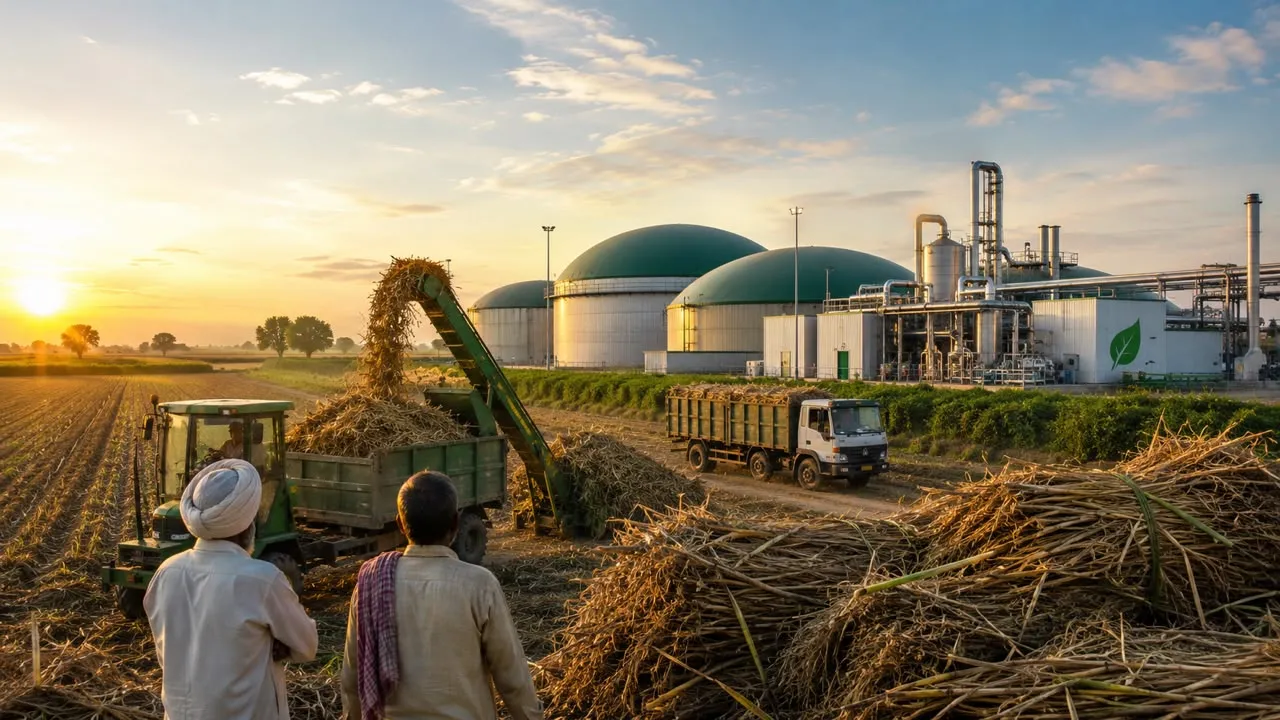
India produces hundreds of millions of tonnes of agricultural residue every year.
After harvest season, farmers are often left with vast quantities of crop waste that must be cleared quickly before the next planting cycle begins. For many, burning the residue remains the fastest and cheapest option. The consequences are visible every year as air quality deteriorates across large parts of northern India, affecting public health, transportation and economic productivity. Policymakers have spent years trying to address the issue, yet sustainable solutions have often struggled to scale because they failed to align environmental goals with economic incentives.
This is where GPS Renewables sees an opportunity.
The Bengaluru-based climate-tech company is building a business around a simple but powerful idea: agricultural waste should not be treated as a problem. It should be treated as a resource. By converting crop residue and organic waste into compressed biogas and other renewable fuels, the company is attempting to create value from materials that would otherwise be burned or discarded. In doing so, it is tackling multiple challenges simultaneously, including pollution, waste management, energy security and rural income generation.
Investors are increasingly convinced that this approach has significant potential.
The company recently raised ₹635 crore in a Series C funding round from investors including APG, the Dutch pension fund manager, and Japan's Sojitz Corporation, alongside participation from existing investors. The size of the investment reflects growing confidence in climate technologies capable of generating both environmental impact and commercial returns. More importantly, it highlights a broader belief that India's transition to cleaner energy will require solutions tailored to local realities rather than imported from elsewhere.
The stakes are enormous.
India is one of the world's largest agricultural producers, one of the fastest-growing energy markets and one of the countries most vulnerable to climate-related challenges. Any technology capable of connecting these three realities has the potential to create transformational impact.
The Hidden Energy Resource Sitting In India's Fields
When most people think about renewable energy, they imagine solar farms and wind turbines.
Those technologies have become central pillars of the global energy transition, but they are not the only sources of clean energy. Biomass represents another enormous opportunity, particularly in agricultural economies such as India. Every year, farms generate vast quantities of crop residue that contain stored energy. Traditionally, much of this material has been treated as waste because collecting, transporting and processing it efficiently remained difficult.
Advances in technology are changing that equation.
Companies such as GPS Renewables have developed systems capable of converting agricultural residue into usable fuels through biological and engineering processes. These fuels can then be used in transportation, industrial operations and energy generation. Instead of contributing to pollution through open burning, crop waste becomes a valuable input within a circular energy system.
The scale of the opportunity is difficult to overstate.
India's agricultural sector generates enormous quantities of biomass every year. Even utilizing a fraction of that resource could contribute meaningfully to the country's clean-energy ambitions. Unlike some renewable-energy sources, biomass also offers the advantage of utilizing existing waste streams rather than requiring entirely new resource inputs.That makes agricultural residue uniquely attractive.The feedstock already exists.The challenge is building the infrastructure to use it effectively.
Why Investors Are Betting Big On Biogas
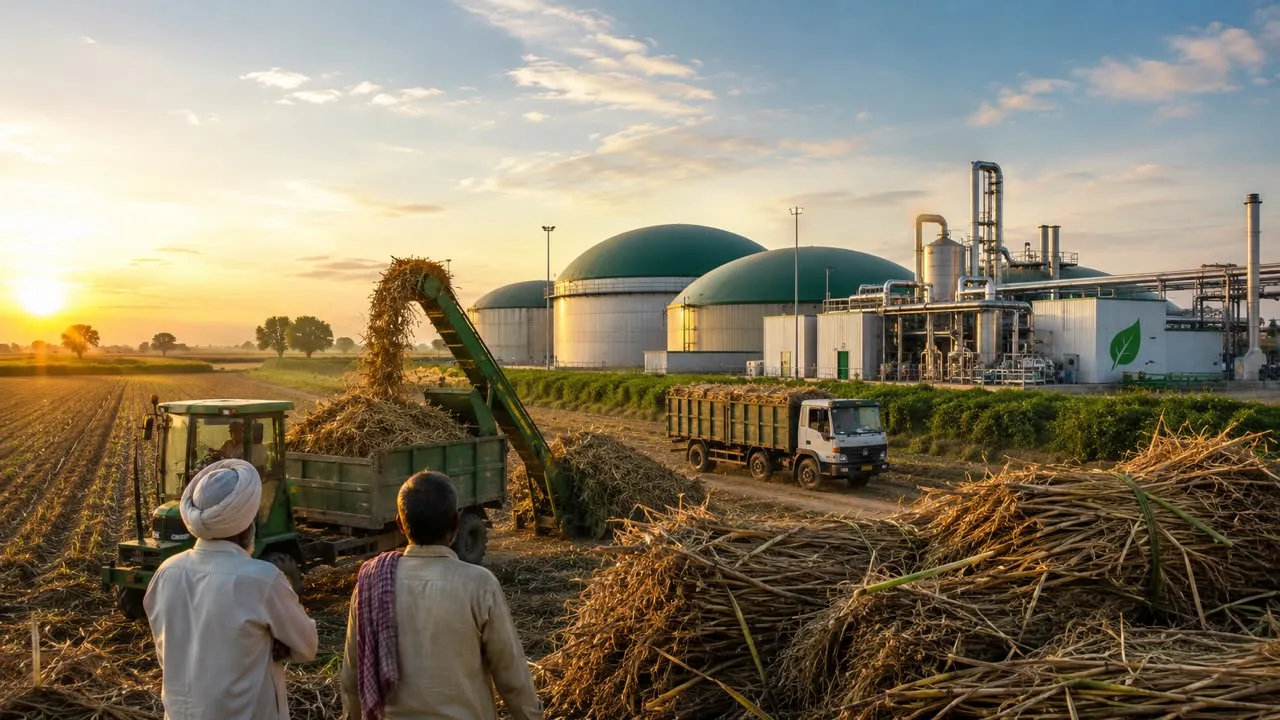
Climate technology has become one of the most important investment themes globally.
For years, venture capital focused heavily on software and digital platforms because those businesses could scale rapidly with relatively little physical infrastructure. Climate solutions are different. They often require factories, equipment, supply chains and operational complexity. Yet investors are increasingly willing to embrace these challenges because the markets involved are enormous and the need for solutions is becoming increasingly urgent.
Biogas sits at the intersection of several major trends.
Governments want cleaner energy. Industries want lower-carbon fuel alternatives. Farmers need additional income opportunities. Countries want greater energy security. Technologies capable of addressing all four objectives simultaneously naturally attract attention. Investors increasingly recognize that some of the most valuable climate companies will be those solving practical industrial problems rather than focusing solely on consumer behavior.
GPS Renewables fits this profile.
Its business model is built around converting waste into a commercially valuable product while delivering measurable environmental benefits. This combination makes the company particularly attractive to investors seeking both financial returns and sustainability impact. The recent funding round suggests that confidence in this category is continuing to grow.And not just in India.Globally, renewable fuels are becoming a critical component of decarbonization strategies.
A Solution To One Of India's Most Persistent Environmental Problems
The annual stubble-burning crisis has become one of India's most visible environmental challenges.
Each year, crop residue burning contributes significantly to air-pollution levels across several regions. Policymakers have introduced regulations, incentives and awareness campaigns, but lasting solutions have remained difficult because farmers often lack economically viable alternatives. Environmental goals alone rarely change behavior if financial realities remain unchanged.
This is what makes the GPS Renewables model particularly compelling.
Instead of asking farmers to absorb additional costs, it seeks to create economic value from agricultural waste. Crop residue becomes a commodity rather than a burden. Farmers gain an incentive to participate because waste that once required disposal can potentially generate revenue. Environmental benefits emerge not through enforcement but through market incentives.This distinction is important.
The most effective sustainability solutions often succeed because they align environmental objectives with economic interests. Businesses, consumers and communities are more likely to adopt change when doing so creates tangible value. By turning waste into fuel, GPS Renewables is attempting to build exactly this type of alignment.If successful, the implications extend far beyond energy production.The model could help reshape how agricultural waste is viewed across the country.
Why India's Energy Transition Needs Multiple Solutions
There is no single technology capable of solving climate change.
Solar power, wind energy, batteries, hydrogen, electric vehicles and biofuels all play different roles within the broader transition. Countries require diverse energy systems because different sectors face different challenges. While solar and wind have expanded rapidly, industries such as transportation and heavy manufacturing often require additional solutions capable of meeting specific operational needs.
Renewable fuels help address some of these gaps.
They can integrate into existing infrastructure while reducing reliance on fossil fuels. This flexibility makes them particularly valuable during transitional periods when energy systems are evolving. Governments around the world increasingly recognize that achieving climate goals will require multiple complementary technologies rather than a single breakthrough.
India's situation makes diversification especially important.The country's energy demand continues growing rapidly as economic development accelerates. Meeting this demand sustainably requires leveraging every viable source of clean energy available. Agricultural biomass represents one such resource, particularly because it is abundant and locally available.Companies like GPS Renewables are helping unlock that potential.And investors clearly believe the opportunity is significant.
The Bigger Story
Viewed narrowly, GPS Renewables is a climate-tech startup converting agricultural waste into fuel.
Viewed more broadly, it represents a new way of thinking about sustainability. Instead of treating environmental problems and economic growth as competing priorities, the company is attempting to align them. Agricultural waste becomes energy. Pollution becomes opportunity. Farmers become participants in the clean-energy economy rather than observers of it.
The company's recent funding round reflects growing investor confidence in this approach.
Climate technologies are increasingly moving beyond experimental projects and becoming scalable businesses capable of generating meaningful economic value. Investors recognize that solving environmental challenges can create enormous markets, particularly in countries facing both sustainability pressures and rising energy demand.That is why GPS Renewables matters.Because the future of clean energy may not be built solely through massive solar farms or advanced batteries.It may also be built from the crop residue sitting in fields after harvest season.