When India Sent Its Philosophy to Paris, the World of Fashion Stopped and Looked
There is a version of global fashion in which the great houses of Europe set the terms, the aesthetics, and the intellectual agenda of haute couture, and the rest of the world arrives as inspiration material rather than as originator. Silks from the East, embroideries from the subcontinent, dyeing traditions from every corner of the world have been absorbed into European fashion for centuries. But the stories, the conceptual frameworks, the philosophical foundations that those materials carried with them have rarely arrived intact.
Gaurav Gupta is changing that. And the speed at which he is changing it is the story that fashion has not yet told loudly enough.
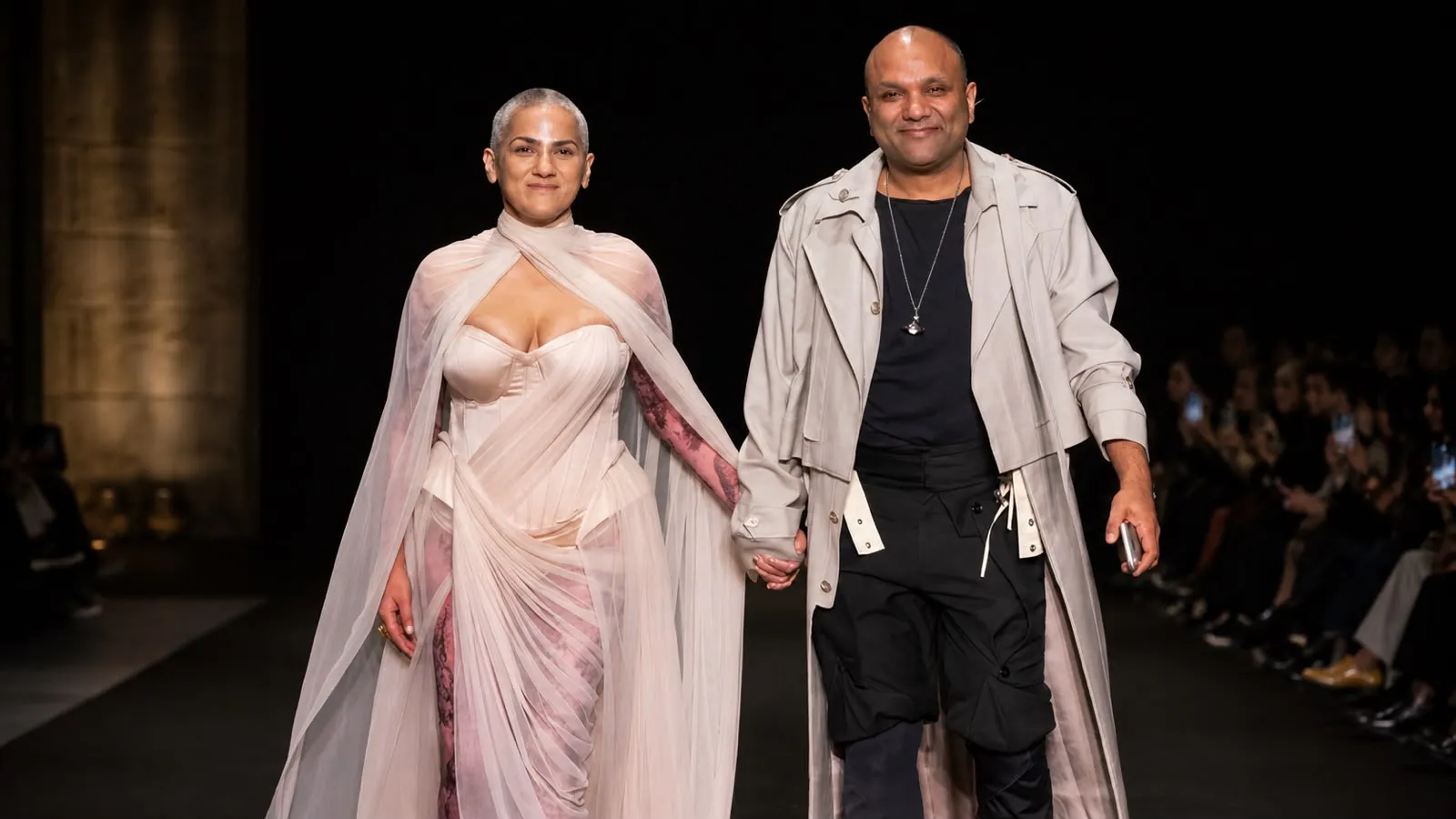
Since 2023, the Delhi based couturier has presented collections at Paris Haute Couture Week that do not simply draw on Indian aesthetics. They are built on Indian philosophical systems as their structural foundation. The visual language, the technical innovation, and the emotional register of each collection are all downstream of ideas that originate in ancient Indian thought and that Gupta has spent years learning to translate not into decoration but into architectural form on the human body.
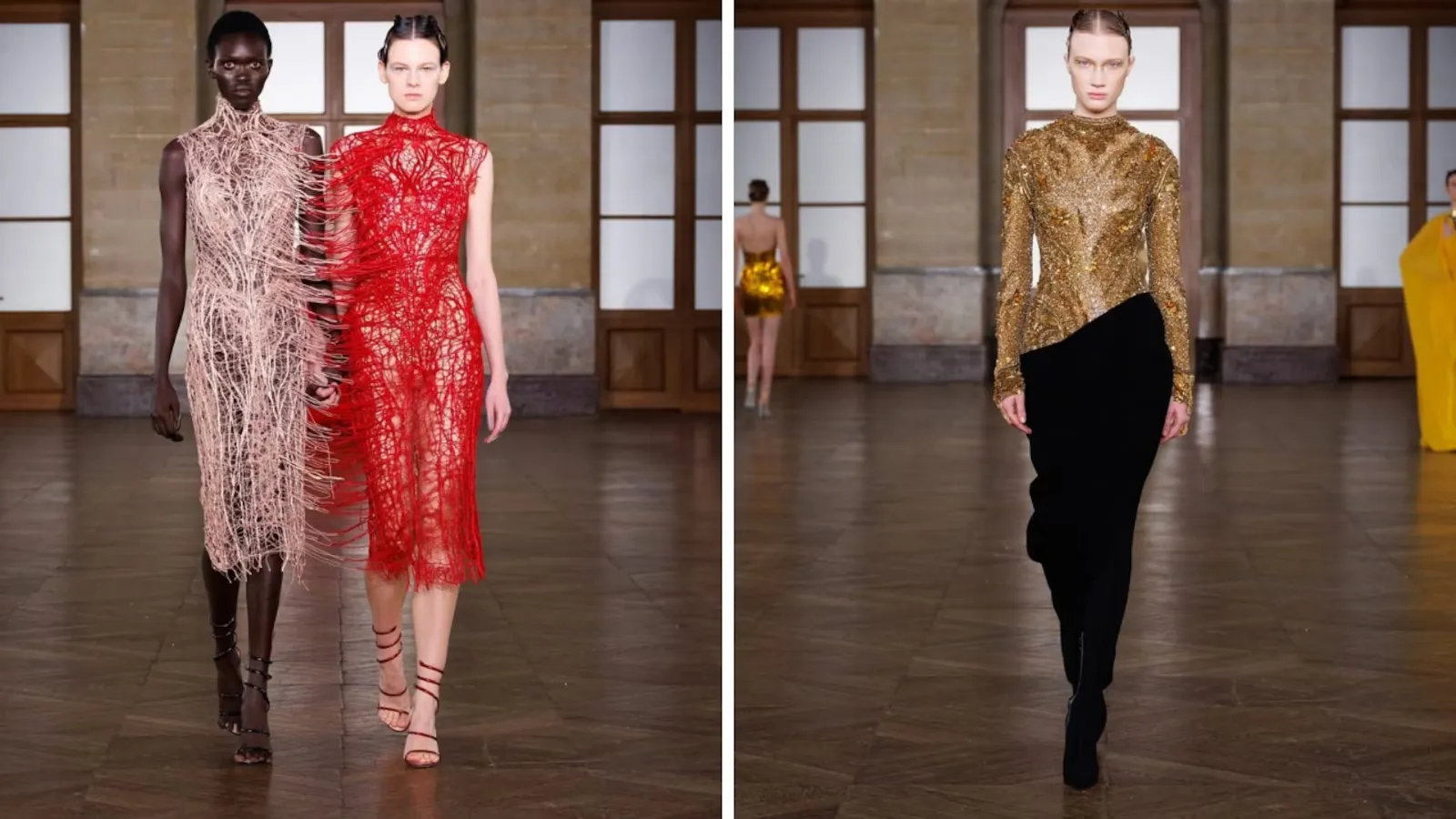
At the most recent Paris Haute Couture Week in January 2026, Gupta presented The Divine Androgyne, a collection that took the concept of Ardhanarishvara as its central idea. Ardhanarishvara is the composite deity of Hindu tradition in which Shiva and Parvati occupy a single body, male and female as indivisible aspects of a unified whole rather than opposing categories. The collection did not illustrate this idea. It embodied it. Threads were intricately interwoven across garments in ways that made the boundary between one element and another impossible to locate. A pair of models merged into a single silhouette. Metallic elements crept from a dress up across a face, dissolving the division between clothing and skin, between artifice and anatomy. Over 30,000 crystals set by Preciosa caught the light differently from every angle, so that what a garment was depended entirely on where you were standing when you looked at it.
This is not fashion inspired by India. This is Indian philosophy given a body to live in.
The Collections That Built a Global Language
To understand the scale of what Gupta has accomplished in Paris, it helps to trace the three collections that have established him as one of the most distinctive voices in global haute couture.
The Spring Summer 2025 collection, titled Across the Flame, was personal before it was philosophical. Gupta and his life partner, poet and performer Navkirat Sodhi, survived a near fatal fire in Delhi. Sodhi sustained severe burns and required multiple surgeries. The recovery that followed was not simply medical. It became a spiritual odyssey, and the collection it produced was one of the most emotionally raw and technically extraordinary presentations Paris Haute Couture Week had seen in years.
The collection incorporated Sanskrit chants woven directly into brocade handwoven in Banaras, so that the sacred text was structurally part of the fabric rather than printed on it. Sculptural breastplates in midnight blue referenced both armour and vulnerability, protection and the wound it was protecting. Ghungroo, the small metallic bells used in classical Indian dance to intensify rhythm and announce movement, appeared as a textile element, connecting the garments to a performance tradition centuries older than any fashion house. A lacquered half mask partially obscuring a model's face made literal the idea of the self that survives and the self that cannot be shown.
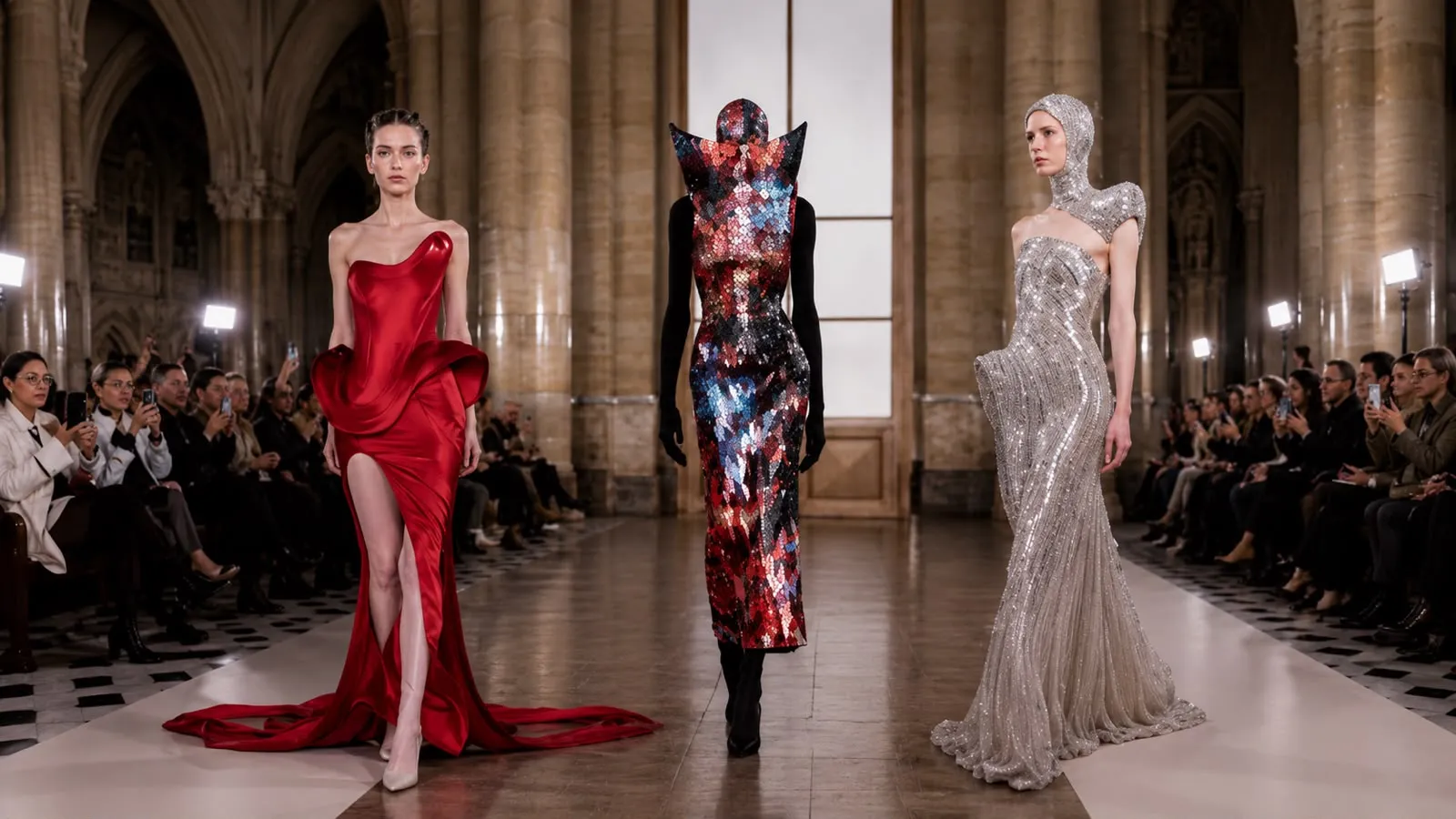
The Spring Summer 2026 collection, The Theory of Everything, went further still. It was described by Fashionado as couture as cosmology, and the description is accurate. The show opened at the moment of the Big Bang. Architectural black volumes moved down the runway embroidered with stardust constellations, and a single model emerged cloaked entirely in black with only her face illuminated, representing consciousness as it first flickers into being. The collection then traced the evolution of life through gowns with pseudo reptilian scales and white columns that bloomed like flowers, and ended with a finale gown composed of thousands of resin elements in shifting changeant tones that evoked the visual depth of interstellar photography.
The philosophical foundation of this collection was advait, the Indian philosophical concept of a non-binary, indivisible reality in which all existence exists on a single continuum rather than as a series of opposing categories. The structure of the garments embodied this idea technically. Watch movement parts were used as sequins, referencing the precision of time while questioning its linearity. Web-like thread techniques evoked energy flows between bodies and the materials surrounding them. The show did not present Indian philosophy as a theme or an inspiration. It presented Indian philosophy as a design methodology.
Why the Paris Stage Matters and What India Has Placed on It
Paris Haute Couture Week is not simply the most prestigious runway event in the global fashion calendar. It is the forum in which the world's most technically advanced, most intellectually ambitious, and most expensive clothing is presented to the institutions, collectors, and cultural arbiters who define what fashion means as a form of human expression. To show at Paris Couture is not to participate in global fashion. It is to make a claim about what the highest form of the craft can be.
Gaurav Gupta has been making that claim for three consecutive seasons, and the world has been paying attention in the most concrete way possible. Beyoncé has worn his sculptural couture on stages where the entire world was watching. Cardi B has worn his work. Zendaya has worn his work. These are not celebrity endorsements in the conventional sense. They are statements about which designers are creating the visual language that the most visible figures in global popular culture choose to express themselves through.
When Beyoncé wears Gaurav Gupta, she is choosing an aesthetic that is unmistakably his. The spiralling, body-conscious silhouettes, the architectural drama, the sense that the garment is alive and in motion rather than static drapery. That aesthetic is inseparable from the philosophy behind it. The idea that the body is a site where different energies converge, that a garment can be a living structure rather than a covering, that clothing is a form of cosmology as much as decoration. These are ideas rooted in Indian spiritual thought, and they are now on the stages of the Super Bowl halftime show and the Grammy Awards.
That is soft power. That is cultural influence operating at its highest pitch.
The Technical Innovation That Carries the Philosophy
Philosophical ambition in fashion fails unless the technical execution can hold the weight of the idea. What separates Gupta from designers who use Indian philosophy as an aesthetic shorthand is that his technical innovation and his conceptual ambition are developed simultaneously, each one making demands on the other.
The embroidered filament architecture introduced in The Divine Androgyne required months of development in the atelier. Thousands of fine threads were engineered into intricate networks that trace imagined nervous systems across the body surface, so that the garment appears to have its own circulatory system. This is not embroidery in the conventional sense. It is structural architecture at the scale of the individual thread, and it required both the traditional knowledge of Indian textile craft and a willingness to apply that knowledge to entirely new engineering problems.
The use of watch movement parts as sequins in The Theory of Everything required sourcing precision components from the Swiss watchmaking industry and developing a method for applying them to fabric in a way that preserved their mechanical precision while making them behave as textile elements. The result was a surface that caught light with the exactness of a mechanical instrument while moving with the fluidity of cloth.
The changeant resin elements in the finale gown of that same collection shifted colour depending on the angle of observation, evoking the way different wavelengths of light behave differently as they travel through interstellar space. This is a material science challenge as much as a design challenge, and it was solved in Gupta's atelier using techniques that did not previously exist in haute couture.
The collaborators Gupta has assembled reflect the global ambition of the work. Preciosa, the Czech crystal specialist, set over 30,000 crystals into The Divine Androgyne. Indriya translated temple jewellery structures and uncut diamond traditions into modern heirlooms. MAC mapped marma points, the traditional Indian energy centres of the body, through makeup application. Rene Caovilla translated the architectural logic of the garments into footwear. These are not aesthetic collaborations. They are intellectual partnerships in which each collaborator is being asked to bring their highest technical capability to bear on ideas that originate in Indian philosophy.
India at the Centre of Global Fashion
Gaurav Gupta is not the only Indian designer making the case at Paris Haute Couture Week. Rahul Mishra, whose Spring Summer 2026 collection Alchemy reimagined the five natural elements of Indian cosmology through thousands of hours of hand embroidery produced in partnership with rural Indian artisan communities, presented alongside Gupta in January 2026. Together, the two designers ensured that Indian creative voices were not merely present at the world's most prestigious fashion event but were among its most discussed, most photographed, and most intellectually ambitious participants.
What the presence of these designers on the Paris Haute Couture calendar represents is a fundamental shift in where the global fashion conversation is being originated. For most of fashion history, India has been the source of materials and craft techniques that were then given meaning by European designers. The silk came from India. The embroidery came from India. The dye techniques came from India. The intellectual framework that gave those materials meaning came from Paris, London, or Milan.
Gupta's collections invert that relationship entirely. The intellectual framework comes from India. The ancient philosophical systems of advait, of Ardhanarishvara, of the cosmic cosmologies that ancient Indian thinkers developed across millennia, are the structural foundation on which the garments are built. Paris provides the stage. The world provides the audience. But the ideas, the conceptual ambition, and the creative vision that make the work significant originate in India.
This is what genuine soft power looks like in the domain of culture. Not imitation of Western forms with Indian decoration added. Not the export of ethnic garments to an international market. The export of India's deepest intellectual traditions, made accessible through the universal language of aesthetic beauty, and received by a global audience that recognises their power even without knowing their origin.
What Comes Next and Why It Matters
Gaurav Gupta is 45 years old. He trained at NIFT Delhi and the London College of Fashion. He founded his label in 2004 and spent years building the technical mastery and the philosophical clarity that his Paris collections now demonstrate. The work he is presenting on the highest stage in global fashion is the product of more than two decades of thinking about what fashion can mean and what Indian philosophy has to offer the world through the medium of clothing.
The Indian government's recognition of fashion as a component of soft power diplomacy has been growing, and designers like Gupta are the most compelling argument for that investment. The Fédération de la Haute Couture et de la Mode, the governing body of Paris Haute Couture Week, does not invite designers lightly. Gupta's place on the official calendar represents a judgment by the global fashion establishment that his work belongs among the world's most significant expressions of the craft. That judgment has been made. The only question is how far the work will go from here.
India has always known that its philosophical traditions are among the most sophisticated produced by any civilisation in human history. What Gaurav Gupta is demonstrating at Paris, one collection at a time, is that those traditions are not only intellectually rich but aesthetically inexhaustible. That the questions they ask about the nature of existence, the relationship between the individual body and the cosmic whole, and the possibility of unity within apparent duality are questions that can be asked in silk and crystal and thread on a runway in Paris, and that the world will stop and listen.
The greatest Indian export has never been a product. It has been an idea. Gupta is sending the ideas, clothed in the most beautiful fabric the world has ever seen, to the stages where the world is watching. And the world is watching very carefully.