The Crisis That Shook Global Energy Markets
The world did not see it coming quite like this. On February 28, 2026, the Iran-US conflict erupted and with it came a seismic disruption to global energy markets. The Strait of Hormuz — that narrow, irreplaceable 33-kilometre passage between Iran and Oman through which roughly 20 percent of the world's traded oil flows — was effectively shut. Tanker operators, insurance companies, and energy traders panicked. Crude oil prices catapulted from comfortable pre-conflict ranges to a staggering $126 per barrel by April 30, 2026 — a number that made oil executives and government ministers lose sleep across the globe.
For India, the consequences were immediate and severe. The country imports nearly 90 percent of its crude oil from overseas, making it uniquely vulnerable to any disruption in global oil shipping lanes. In March 2026, India's crude imports fell by nearly 14 percent, sliding from 5.2 million barrels per day (mbd) in February to just 4.5 mbd — a significant drop that threatened refineries, downstream industries, and ultimately, the cost of fuel in the petrol pumps and cooking gas cylinders of everyday Indians.
The economic stakes were enormous. With Brent crude hovering above $120 per barrel, India's import bill was on track to balloon by tens of billions of dollars. Inflation, currency pressure on the rupee, and industrial input cost shocks loomed over what had otherwise been a period of strong GDP growth for the Indian economy.
India's Masterstroke: The Russian Pivot That Saved the Day
What happened next is the kind of story that economic historians will cite for decades. India did not panic. Instead, it pivoted — swiftly, strategically, and effectively.
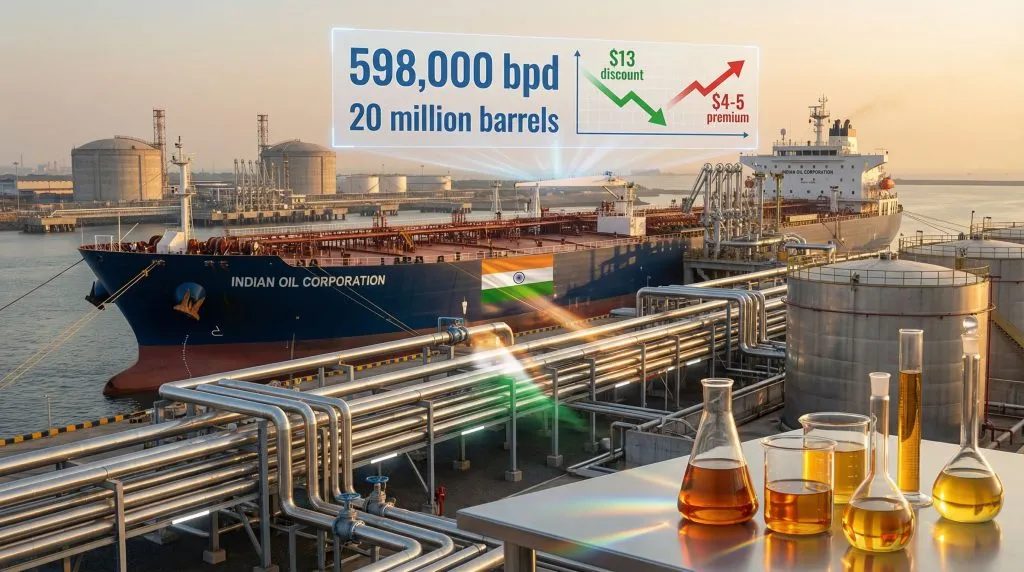
When the US temporarily eased sanctions to help stabilise global oil markets, Indian refiners seized the moment with remarkable speed. According to energy cargo tracking firm Kpler, India doubled its imports from Russia to nearly 2 million barrels per day in March alone — a figure that represented both a lifeline for Indian refineries and a statement about India's ability to navigate geopolitical complexity with pragmatic economic thinking.
Russian cargoes that were already at sea were quickly diverted to Indian buyers. The transition was smoother than anyone had anticipated, aided by existing supply chain relationships that Indian refiners had built over the previous two years of global energy disruptions. Rosneft-backed Nayara Energy played a particularly crucial role. When the company completed maintenance at its Gujarat refinery — one of India's largest with a processing capacity of 20 million tonnes per annum — it provided a massive boost to Russian crude demand and Indian refining output simultaneously.
The Gujarat refinery restart was more than a supply story. It was a signal to global markets that India's refining infrastructure was not only intact but was ready to run at full capacity. For millions of workers in the refining and petrochemical sector, it meant job security. For India's exporters of petroleum products, it meant continued revenues from refined fuel exports to Southeast Asia, Africa, and beyond.
The Great Diversification: Angola, Brazil, Venezuela and Beyond
Russia was not India's only answer. In a display of strategic diversification that underscored the sophistication of India's energy procurement apparatus, Indian refiners reached out across the globe to secure alternative crude supplies.
Angola emerged as a surprise hero in this story. The West African nation supplied approximately 334,000 barrels per day in March 2026, briefly becoming India's third-largest crude supplier — a position it had never held before. For Angola, heavily dependent on oil revenues, the Indian demand surge was a windfall that helped stabilise its national budget at a critical time.
Brazil, another major player in the offshore crude market, also stepped up. Known for its high-quality pre-salt crude grades, Brazilian suppliers found willing buyers in Indian refineries that were eager to maintain operational continuity. Venezuela and Iran, both operating under varying degrees of international sanctions and geopolitical complexity, also contributed to the supply mix as India made use of every available legal avenue to keep its refineries running.
Even Saudi Arabia continued to supply crude to India, though at reduced volumes. Saudi shipments declined in May and June as alternative crude grades became more competitively priced — a reflection of India's growing bargaining power in the global crude market. India was no longer a passive price-taker. It had become an active market participant capable of playing suppliers against each other to secure the best possible deals.
This diversification strategy — multi-continent, multi-supplier, multi-grade — is precisely what energy security experts have long recommended for import-dependent economies. India executed it under extreme pressure and in real time. That is no small feat.
The Stunning Recovery: 5 Million Barrels and Counting
By June 2026, the transformation was complete. India's crude imports had not merely recovered — they had surpassed pre-crisis levels. According to Kpler data, India's crude imports averaged more than 5 million barrels per day in June, slightly above the 4.9 mbd average recorded between April 2025 and February 2026. Oil Ministry data independently corroborated the figure, placing June imports at around 5 mbd.
To put this in perspective: India had absorbed a 14 percent supply shock in March, restructured its entire import supply chain within weeks, and by June was importing more oil than it had in the preceding year. This is not just resilience. This is strategic excellence.
Meanwhile, global crude prices told their own extraordinary story. Brent crude, which had reached $126 per barrel on April 30, crashed below $73 a barrel by June 26, 2026 — a fall of 42 percent from peak levels. The decline was driven by progress in US-Iran peace negotiations, the reopening of the Strait of Hormuz to tanker traffic, and Saudi Arabia restarting Persian Gulf exports for the first time since March.
For India, this price collapse is nothing short of a massive economic gift. Every dollar drop in crude prices saves India approximately $1.5 billion annually in import costs. A $53 per barrel decline from peak translates into potential savings of $70-80 billion annualised — a figure that rivals entire national infrastructure budgets. The fiscal breathing room this creates for the Indian government and the relief it will eventually translate into for consumers and industries is profound.
What This Means for the Indian Economy and Every Indian
The crude oil story of 2026 is ultimately about what this means for ordinary Indians — for the small business owner whose logistics costs depend on diesel prices, for the housewife whose LPG cylinder bill determines the family food budget, for the farmer whose irrigation pump runs on electricity generated partly from petroleum products, and for the software engineer whose cab to the airport costs less when fuel is cheap.
Falling crude prices, if passed on to consumers, could significantly moderate India's inflation trajectory in the second half of 2026. The Reserve Bank of India, which has been cautious about cutting interest rates due to inflationary pressures, may find more room to manoeuvre if energy prices stay subdued. Lower rates mean cheaper home loans, business credit, and consumer finance — a positive spiral that benefits millions.
For India's current account deficit, the import bill reduction is equally significant. A smaller energy import bill means less pressure on the Indian rupee, which has faced depreciation against the US dollar through much of 2026. A more stable rupee reduces imported inflation, makes foreign travel and education more affordable for India's middle class, and improves investor confidence in Indian financial markets.
India's petrochemical and downstream manufacturing sectors — which use crude oil derivatives as key inputs — will also benefit enormously from lower feedstock costs, potentially making Indian manufactured goods more competitive in global export markets.
The Geopolitical Masterstroke: India as the World's Indispensable Energy Customer
Perhaps the most underappreciated aspect of India's 2026 oil story is what it reveals about India's evolving geopolitical stature. In the space of just three months, India demonstrated to the world that it can source crude from Russia, Angola, Brazil, Venezuela, Saudi Arabia, and Iran simultaneously — without being fully dependent on any single supplier or geopolitical alignment.
This multi-vector energy strategy is the economic equivalent of India's long-standing strategic autonomy doctrine in foreign policy. Just as India refuses to join exclusive military alliances, it refuses to be locked into exclusive energy dependencies. The crisis of 2026 proved that this approach — sometimes criticised as fence-sitting — is in fact a form of sophisticated risk management that delivers real economic dividends.
For Global Indians watching from the United States, the United Kingdom, the Middle East, and beyond, this is a story worth celebrating. India is not just a large market any more. It is a strategic player in the global energy ecosystem — one that major oil producers and energy companies must court, accommodate, and respect.
Looking Ahead: The Road to Energy Security
The crisis has also accelerated India's thinking about long-term energy security. The government's launch of India's 10th bidding round under the Open Acreage Licensing Programme, with 25 upstream oil and gas blocks on offer, reflects a renewed determination to boost domestic production. Reducing import dependence — even marginally — would pay enormous dividends in future crisis scenarios.
India's renewable energy push, its nascent green hydrogen ambitions, and its expanding electric vehicle market are all part of a longer-term strategy to reduce the economy's vulnerability to crude oil price shocks. But for now, in June 2026, the immediate triumph is the recovery of the world's third-largest oil importer from a crisis that could have paralysed its economy — and the remarkable human and institutional story behind that recovery.
India bent under the pressure of the Hormuz crisis. It did not break. And now, with Brent crude below $73 and Indian refineries running at full capacity, the country is poised to enter the second half of 2026 from a position of surprising strength.