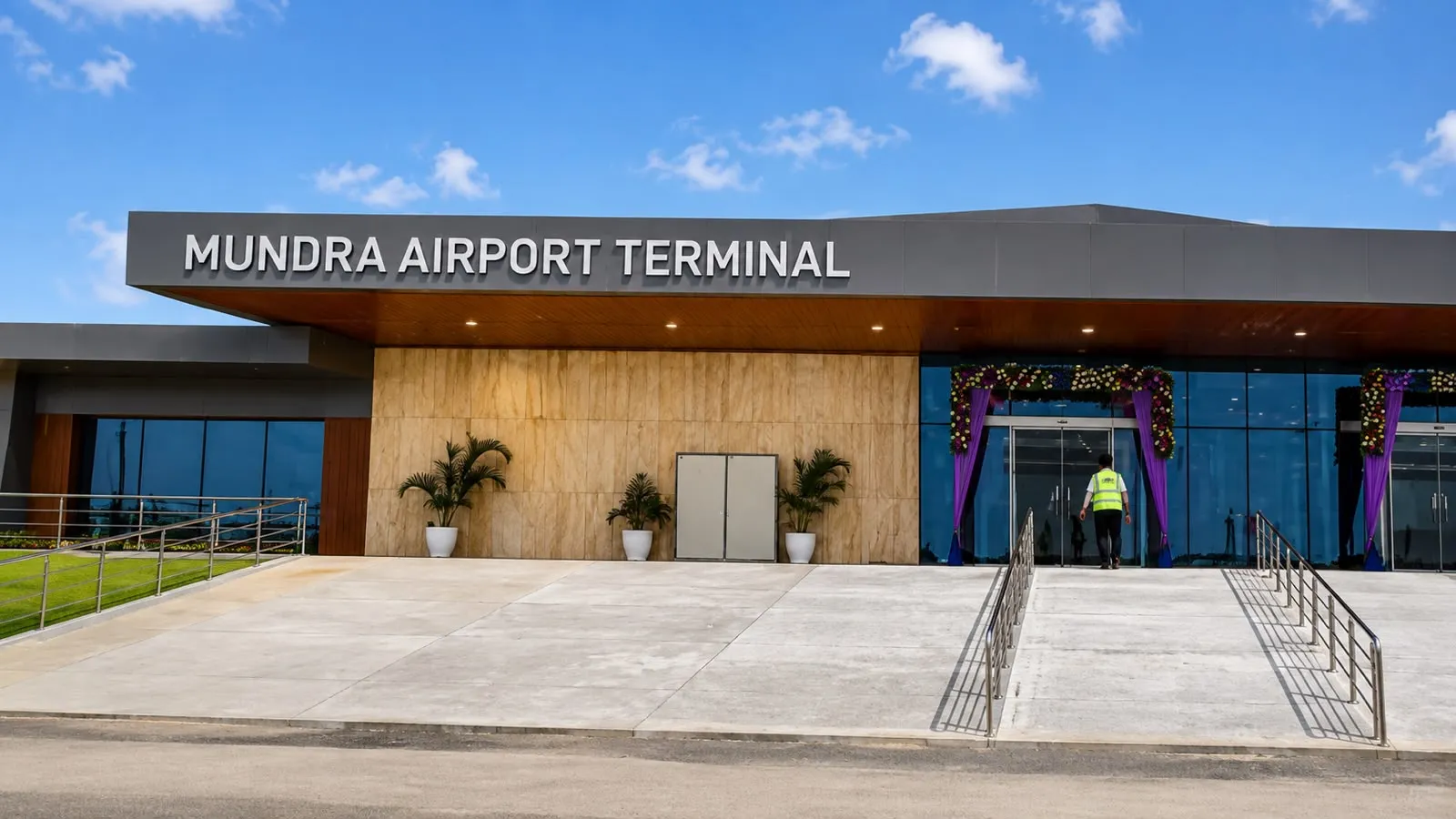
A New Gateway for the Gulf of Kutch
June 25, 2026 marks a transformational moment for one of India's most strategically important coastal regions. Adani Mundra Airport — the aviation arm of Gautam Adani's vast infrastructure empire — has officially launched its first scheduled commercial flight services, connecting the port city of Mundra and its surrounding Kutch region to eight major Indian cities including Mumbai and Goa. The flights operate in partnership with Star Air, a Bengaluru-based regional carrier known for connecting India's tier-two and tier-three markets.
For the people of Kutch — a district that has transformed dramatically from the devastation of the 2001 earthquake into one of India's most industrially vibrant regions — today's inaugural flights represent more than a new transport option. They represent the arrival of modern economic infrastructure that will compress travel times, open new business corridors, and enable the region to attract investment and talent at a pace previously unimaginable.
The Mundra Port and Special Economic Zone (SEZ), already one of India's largest and most efficient commercial ports, is the economic anchor of the region. Mundra SEZ handles vast volumes of export goods, industrial inputs, and containerised cargo. The arrival of direct air connectivity creates a multimodal transport ecosystem — road, rail, sea, and now air — that positions Mundra as one of India's most comprehensively connected industrial locations.
Adani's Aviation Empire: Building India's Largest Private Airport Network
The Mundra Airport launch is the latest chapter in Adani Airport Holdings Limited's (AAHL) remarkable journey to build India's largest private airport network. AAHL currently operates eight airports including Mumbai's Chhatrapati Shivaji Maharaj International Airport, Ahmedabad, Jaipur, Lucknow, Guwahati, Thiruvananthapuram, and Mangaluru. Together, these airports handled 95.5 million passengers in FY26, representing 23% of India's total passenger traffic and 29% of its air cargo.
As flagged by Morgan Stanley in today's initiation report, the airports business is entering a 'structural earnings inflection' driven by the commissioning of new capacity, tariff resets, and growing throughput. The Navi Mumbai International Airport — one of the most anticipated infrastructure projects in India — is expected to commission in the near term, adding a second mega airport to Mumbai and providing critical relief to one of the world's most congested aviation markets.
Each new airport launch builds on Adani's model: win the concession, deploy capital at speed, execute operationally, and then leverage the network effect as passengers and cargo flow between interconnected airports. Mundra, while smaller than Mumbai or Ahmedabad, adds a critical industrial gateway to the network — one that aligns perfectly with Adani's broader port and logistics businesses.

Regional Impact: Unlocking Kutch's Economic Potential
The economic significance of direct air connectivity to Kutch cannot be overstated. The region hosts the Mundra Port, Asia's largest private port. It is home to the Adani Total Gas distribution network, the Adani Power Mundra plant, and significant renewable energy installations. It sits adjacent to the GIFT City financial and technology hub — India's first operational smart city and international financial centre.
Historically, accessing Kutch for business meant a multi-hour road journey from Ahmedabad or an indirect routing through Mumbai. Direct flights transform this calculus. Senior executives from Indian and multinational corporations, government officials, financiers, and investors can now fly directly to Mundra for meetings, site visits, and operational oversight — dramatically reducing the friction and cost of doing business in the region.
For Kutch's growing textile, handicraft, and agriculture sectors — industries that employ hundreds of thousands of artisans and farmers — air connectivity opens new market access pathways. Perishable agricultural goods, handcrafted products, and high-value textiles can now reach India's major consumption centres faster and more reliably than before. Tourism, another high-potential sector in a region famous for the Rann of Kutch festival, white desert landscapes, and rich cultural heritage, stands to benefit enormously from improved access.
Star Air's partnership with Adani in this venture is strategically sensible for both parties. Star Air builds scale and utilisation for its regional fleet, while Adani gains a reliable airline partner committed to the routes that matter most for the airport's commercial success.
The Bigger Aviation Picture: India Takes Off
India's aviation sector is in the midst of a multi-decade structural expansion. With a growing middle class, rising disposable incomes, and a government committed to regional air connectivity through schemes like UDAN (Ude Desh Ka Aam Naagrik), the number of air travellers in India is expected to triple over the next 20 years. India is projected to become the world's third-largest aviation market by 2030.
In this context, Adani's investment in airport infrastructure is not just a business decision — it is a bet on one of the most compelling structural growth stories in global aviation. The Group's airport concessions, each carefully selected for their strategic and commercial characteristics, form a network that will only become more valuable as India's aviation market matures.
Today's launch at Mundra Airport is a small but symbolically important step in this journey. Every inaugural flight is a vote of confidence in a region, its people, and its potential. For the Kutch community — resilient, entrepreneurial, and deeply connected to the global Indian diaspora — June 25, 2026 is a day that will long be remembered.